Guides / Finishes
CVD vs PVD Coating: Temperature, Thickness, Stress and Edges
October 18, 2026
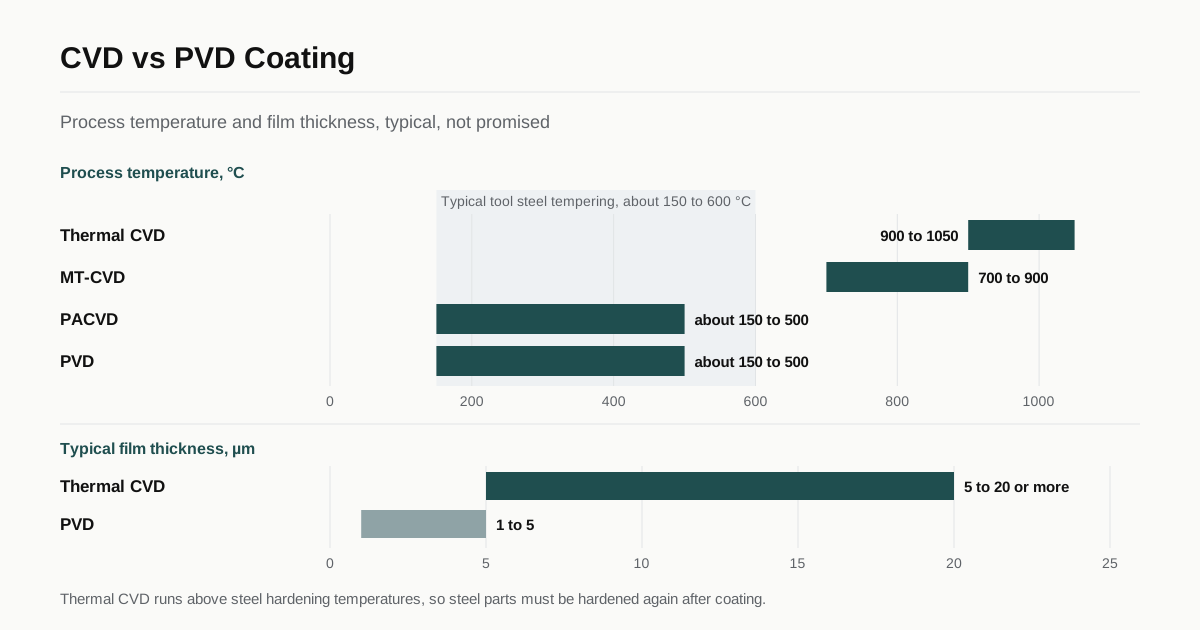
CVD vs PVD coating comes down to temperature, thickness and geometry. Thermal CVD grows thick films, often 5 to 20 µm, from reactive gases at roughly 900 to 1050 °C and coats every exposed surface evenly. That is why it dominates turning inserts made of cemented carbide. PVD deposits thinner films, usually 1 to 5 µm, at roughly 150 to 500 °C in line of sight, with compressive stress that keeps sharp edges intact, so it suits milling and drilling tools plus hardened steel tools and parts. Values in this guide are typical, not promised.
If you are new to PVD, our PVD coatings overview covers TiN, CrN and DLC. This guide sets PVD against its older relative and explains where each one fits.
How CVD builds a coating
Chemical vapor deposition feeds reactive gases into a heated reactor. The gases react on the hot surface of the parts and leave a solid film. The byproducts leave with the exhaust gas.
Thermal CVD (HT-CVD) runs at roughly 900 to 1050 °C. Typical chemistry for tool coatings uses titanium tetrachloride (TiCl4) with hydrogen plus nitrogen or methane to form TiN, TiC or TiCN. Aluminum oxide (Al2O3) forms from aluminum chloride with carbon dioxide and hydrogen. The reactions release hydrogen chloride, which the plant has to scrub from the exhaust.
Medium temperature CVD (MT-CVD) forms TiCN from acetonitrile (CH3CN) at roughly 700 to 900 °C. The film grows in tough columnar grains and is the standard base layer under aluminum oxide on modern turning grades.
A common insert stack looks like this, from the carbide outward:
- A thin TiN base layer.
- MT-CVD TiCN, several micrometers, for abrasion resistance.
- A thin bonding layer.
- Alpha aluminum oxide, several micrometers, as a heat and chemical barrier at high cutting speed.
- Often a thin TiN top layer whose gold color makes edge wear easy to see.
Total thickness of such stacks commonly runs 10 to 20 µm or more. Because the reactor is hot and the gases reach everywhere, thousands of inserts can coat in one batch over a cycle of many hours.
One CVD side effect is worth knowing. At the carbide surface the process can pull carbon from the substrate and form eta phase, a brittle mixed carbide. Process control limits it. Many CVD grades use a cobalt-enriched zone near the surface of the carbide to restore edge toughness.
How PVD differs
PVD works in a vacuum at lower temperature. A solid target of titanium, chromium, aluminum-titanium or another alloy is vaporized by cathodic arc or by magnetron sputtering. Metal ions react with nitrogen or a carbon gas and condense on the parts, which rotate in front of the sources. A negative bias on the parts accelerates ions into the growing film. Our guide to cathodic arc vs magnetron sputtering explains the methods.
Three consequences matter for buyers:
- Lower temperature. Most PVD runs between about 150 and 500 °C, below the tempering temperature of many hardened tool steels.
- Line of sight. Faces turned away from the sources coat thinner. Deep bores and blind holes get little film.
- Compressive stress. Ion bombardment packs the film and leaves compressive stress, often in the range of one to several GPa. That stress resists cracking but limits how thick the film can grow before it spalls.
Typical values side by side
| Property | Thermal CVD | PVD |
|---|---|---|
| Process temperature | About 900 to 1050 °C (MT-CVD about 700 to 900 °C) | About 150 to 500 °C, low-temperature processes below 200 °C |
| Typical thickness | 5 to 20 µm, more on some insert grades | 1 to 5 µm |
| Coverage | Conformal, every exposed surface including holes | Line of sight, rotation needed, bores coat thin |
| Residual stress | Tensile after cooling, fine cooling cracks | Compressive, often one to several GPa |
| Edge | Honed edge needed under thick films | Sharp edges and positive rake keep their shape |
| Common chemistries | TiC, TiN, TiCN, Al2O3, CVD diamond | TiN, TiCN, TiAlN, AlTiN, AlCrN, CrN, ZrN, ta-C |
| Usual substrates | Cemented carbide, ceramics | Carbide, HSS, hardened tool steel, stainless, titanium |
| Steel tools | Must be hardened again after coating | Coated after final hardening and grinding |
| Typical uses | Turning inserts for steel and cast iron | Milling, drilling, threading, forming, molds, wear parts |
Temperature and what it does to the substrate
Cemented carbide does not soften at CVD temperature, so carbide inserts take thermal CVD directly. Steel is a different case.
Thermal CVD runs above the austenitizing temperature of most tool steels. A hardened punch or die comes out of the reactor soft. To use CVD on steel, the part is coated first, then hardened in vacuum or a protective atmosphere and tempered. That sequence has costs:
- Distortion and size change during hardening, with no chance to grind the coated surface back without removing the film.
- Extra steps and a specialist shop able to harden coated parts without damaging the film.
- Limits on tight tolerances, since the final size depends on the heat treatment response.
This route has been used on cold forming punches and dies where the wear life justifies it. For most hardened steel parts, PVD after final hardening and grinding is simpler. The rule there is to keep the PVD process temperature below the last tempering temperature, as our guide on PVD coating temperature and substrates explains for common grades.
Thickness, coverage and edges
CVD coverage is conformal. The gas reaches holes, slots and the back of the part. Thickness stays fairly even across the surface. That is an advantage on parts with internal surfaces that need a wear film.
PVD coverage follows line of sight. Fixturing and 2-fold or 3-fold rotation even out the exposed faces, but bores and recesses still coat thinner. Specify the surfaces that must meet thickness and check them on a sectioned part if they matter.
Edges decide a lot of the choice in cutting tools. A 15 µm CVD stack on a razor-sharp edge would chip, so CVD inserts carry a honed edge, sometimes with a chamfer. That suits turning with steady chip loads. PVD at 2 to 4 µm can coat a sharp, positive edge without rounding it much. That is why solid carbide drills, end mills, taps, threading and grooving inserts plus fine finishing tools are mostly PVD coated.
Residual stress and toughness
CVD films form at high temperature. As the coated insert cools, the carbide shrinks less than the coating, which leaves tensile stress in the film and often a network of fine cooling cracks. In continuous turning this matters little. In interrupted cuts such as milling, those cracks can grow under thermal and mechanical cycling. Many CVD grades get a post treatment, such as wet blasting or brushing, that smooths the top layer and shifts the stress toward compression.
PVD films start in compression. A crack has to overcome that stress before it opens, which helps in milling, drilling and other interrupted cuts. The same stress is why PVD films stay thin.
Typical uses by application
- Turning steel and cast iron. CVD TiCN with aluminum oxide is the usual choice, because the oxide layer handles heat and resists crater wear at high cutting speed.
- Milling. Both are used. PVD AlTiN or TiAlN is common for steels, stainless and hardened steel with interrupted cuts. CVD grades are common for cast iron milling.
- Drilling, end milling, tapping and reaming with solid carbide. Mostly PVD, for the sharp edges and the option to regrind and recoat.
- Aluminum and non-ferrous metals. Often uncoated polished carbide or thin PVD films such as ta-C or TiB2 that keep the edge sharp and limit built-up edge. CVD diamond is used on carbide for abrasive high-silicon aluminum, graphite and composites.
- Forming and stamping tools in steel. Mostly PVD such as CrN, TiCN or AlCrN after final hardening. CVD with re-hardening where the wear justifies it.
- Plastic molds, precision wear parts and decorative parts. PVD, plus DLC by plasma assisted CVD.
For wear parts that do not need a thin film at all, compare other routes in our guide to wear resistant coatings.
Plasma assisted CVD, the middle route
Plasma assisted CVD (PACVD, also called PECVD) uses a glow discharge to break up the gas, so the reactions need much less heat. Two uses stand out for buyers:
- Hydrogenated DLC (a-C:H). Made from a hydrocarbon gas such as acetylene, commonly at low temperature, often below about 200 to 250 °C. Many DLC coatings combine a PVD chromium, CrN or tungsten carbide interlayer with a PACVD a-C:H top layer in the same chamber. Silicon-doped variants use an organosilicon gas.
- TiN and TiCN for hot work tools. Some PACVD processes for die casting dies and forging tools run around 500 °C. They reach into features better than PVD, though not as fully as thermal CVD.
So “CVD vs PVD” is not always a clean split. Ask the shop which process makes each layer and at what temperature.
Cost, availability and lead time
Thermal CVD is a high-volume process. Insert makers run very large batches in-house. Most buyers get CVD as part of a purchased insert, not as a job coating service. Job shops offering CVD on customer parts exist but are fewer. On steel the hardening step adds cost and time.
PVD job coating is widely available. Cycles are shorter, standard coatings often run on a fixed weekly schedule and reground tools are routinely recoated. For a custom part or a tool you make yourself, PVD is usually the practical starting point. Our guide on which metal finish fits your part puts both in the wider finishing picture. PVD price drivers (chamber fill, minimum charges, preparation) are covered in PVD coating cost.
Getting CVD or PVD quoted
On the RFQ, give the substrate grade and hardness, the last tempering temperature for steel, the surfaces that need coating (including any bores), the function or failure you are solving, the thickness range, edge condition and the quantity per lot. If you are not sure whether CVD or PVD fits, say so and describe the cut or the contact. The coating RFQ checklist lists the other basics.
We are a matching service, not a coating shop. Choose “PVD” as the finish on the RFQ form. Choose “Not sure yet” if you want the shops to propose a process. We pass it to up to 3 shops that run the coating. They quote you directly. You get a reply within 24 business hours. Send your coating RFQ.
Frequently asked questions
What is the main difference between CVD and PVD coating?
CVD builds the film by chemical reactions of gases on a hot surface, typically around 900 to 1050 °C for thermal CVD. It coats every exposed surface evenly. PVD condenses a vaporized solid in a vacuum at roughly 150 to 500 °C and coats in line of sight. CVD films are usually thicker, often 5 to 20 µm, while PVD films are usually 1 to 5 µm.
Which is better for carbide inserts, CVD or PVD?
It depends on the cut. Thick CVD stacks of TiCN and aluminum oxide are the usual choice for turning steel and cast iron, where heat and crater wear dominate. PVD is common on milling, grooving and threading inserts and on solid carbide drills and end mills, where interrupted cuts and sharp edges favor a thin film with compressive stress. Tool makers offer both for most applications.
Can CVD coating be applied to hardened tool steel?
Only with a full heat treatment afterwards. Thermal CVD runs above the hardening temperature of most tool steels, so the steel comes out of the reactor soft. The part must then be hardened in vacuum or protective atmosphere and tempered, which can cause distortion and size change. That is why most hardened steel parts get PVD, which runs below the tempering temperature of many tool steels.
Why are PVD coatings thinner than CVD coatings?
PVD films grow with high compressive stress from ion bombardment during deposition. That stress helps them resist cracking at sharp edges, but it grows with thickness until the film can spall. Most PVD tool and wear coatings therefore stay at about 1 to 5 µm. CVD films carry tensile stress after cooling and can be grown much thicker on carbide.
Is DLC a CVD or a PVD coating?
Both routes are used. Hydrogenated DLC (a-C:H) is commonly made by plasma assisted CVD from a hydrocarbon gas at low temperature, often on top of a PVD chromium or tungsten carbide interlayer in the same chamber. Hydrogen-free ta-C is made by PVD, usually filtered cathodic arc. Ask the shop which DLC type and process it runs and what the temperature limit is.
Need a quote for this finish?
Send the drawing. We match you with up to 3 finishing shops that run your spec and reply within 24 business hours.
Get matched with a coating shop