Guides / Finishes
Zinc Flake Coatings for Fasteners: When to Specify Them and What to Check
November 4, 2026
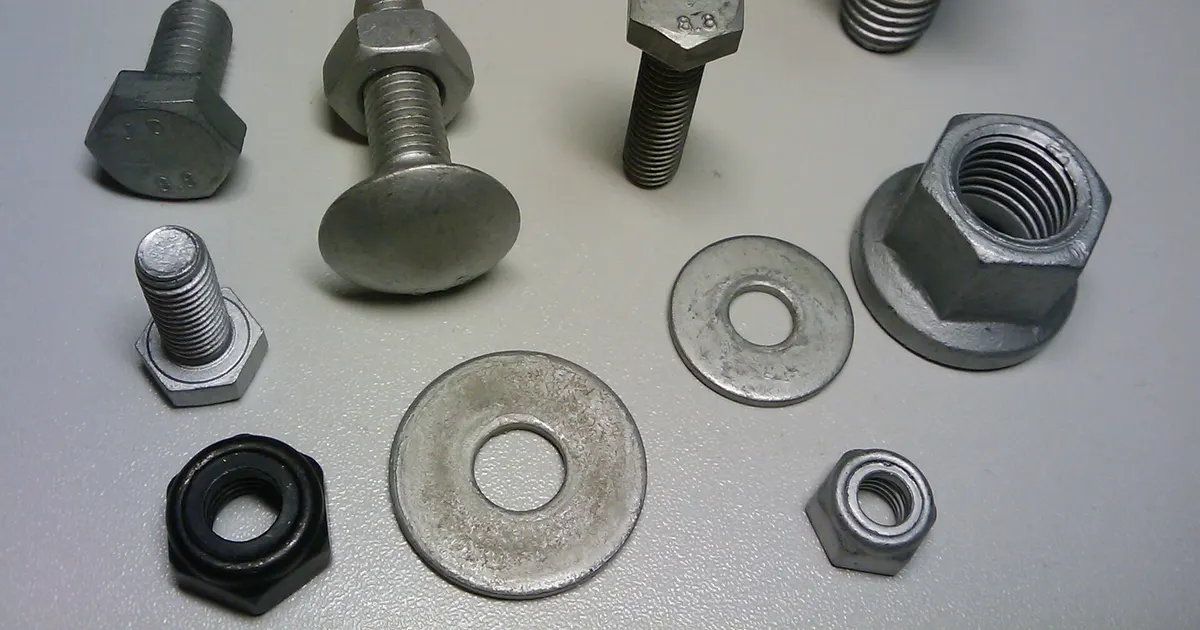
Zinc flake is the coating many engineers move to when zinc plating runs out of options. It is not electroplated. A water or solvent based liquid carrying thin zinc and aluminum flakes in an inorganic binder is applied to the part and baked. The flakes overlap in the cured film like roof tiles, which gives barrier protection plus a sacrificial effect, with a corrosion life several times that of zinc plate. For hardened bolts it also removes the hydrogen embrittlement concern of electroplating. Knowing where it fits, and where it does not, avoids paying for it when zinc would do.
How the coating is applied
- Clean and prepare. Parts are degreased and usually shot blasted or abrasive cleaned. Acid pickling is avoided, which is one reason hydrogen is not a problem.
- Apply basecoat. Small parts are dipped, spun in a basket to shed excess and then baked. Larger parts are sprayed.
- Cure. Baking at roughly 200 to 240 °C for 20 to 30 minutes, depending on the product, hardens the film.
- Repeat. Many specs call for two basecoat layers.
- Topcoat. An optional sealer or lubricated topcoat adds corrosion life, color control and friction control.
Because the coating is a film applied to the surface, the substrate goes through no electrical process. It also creeps into recesses well, though thin, deep holes can fill.
Typical numbers
| Item | Typical value |
|---|---|
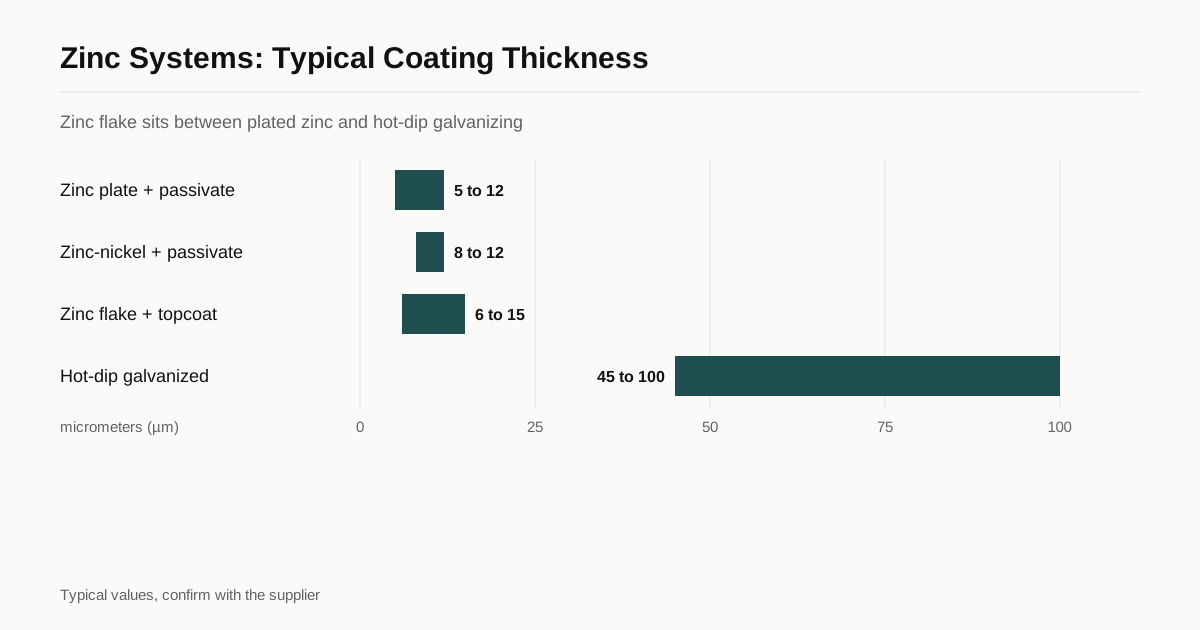
| Basecoat thickness | 6 to 12 µm |
| With topcoat | 8 to 15 µm |
| Colors | Silver gray, black, other topcoat colors |
| Commonly specified salt spray to red rust | 480 to 1000 hours or more |
| Cure | About 200 to 240 °C, 20 to 30 min |
| Friction coefficient with lubricated topcoat | Roughly 0.09 to 0.14 |
All values are typical and not promised. Every maker publishes its own data sheet, and the right figure is the one tied to your specification.
Where it beats zinc plating
- Hardened fasteners. Bolts above about Grade 10.9 or 39 HRC and springs avoid the electroplating hydrogen route. See hydrogen embrittlement relief bake for why that matters.
- High corrosion targets. A few hundred to a thousand hours in a salt fog is common for zinc flake and is difficult for plain zinc with a passivate.
- Aluminum contact. Systems that include aluminum flakes reduce galvanic attack when a steel fastener contacts aluminum.
- Torque-tension control. A lubricated topcoat gives a narrow friction range, which structural and automotive joints rely on.
- No cadmium. Zinc flake with a lubricant topcoat is a common replacement for cadmium on some fasteners. See cadmium replacement coatings.
Where it does not fit
- Tight thread classes. The film adds 6 to 15 µm, and it collects in the root of the thread. Check the fit against thread allowances. See thread fits after plating.
- Bright, decorative finishes. Zinc flake is matte gray or black. It does not offer a bright appearance.
- Tiny parts in bulk. Parts that nest or stick together in the dip-spin basket can bond and leave bare spots.
- Electrical contact surfaces. Lubricated topcoats insulate.
- High temperature service. The inorganic binder tolerates heat well, but the topcoat may not. Check the limit for the topcoat.
Comparison with other zinc systems
| Property | Zinc plate + passivate | Zinc-nickel | Zinc flake | Hot-dip galvanized |
|---|---|---|---|---|
| Typical thickness | 5 to 12 µm | 8 to 12 µm | 6 to 15 µm | 45 to 100 µm |
| Corrosion life | Low to moderate | High | High | High, long outdoor |
| Hydrogen risk | Yes, needs bake | Yes, needs bake | None from process | Low on mild steel |
| Thread fit impact | Small | Small | Moderate | Large, threads often re-cut |
| Cost | Lowest | Medium | Higher | Medium |
See hot-dip galvanizing vs zinc plating for the large-part side.
Specifications to name
Several standards govern zinc flake systems. ISO 10683 covers non-electrolytically applied zinc flake coatings on fasteners. In the US, ASTM F1136 and F2833 cover related zinc and aluminum flake coatings. Automotive makers add their own specs, with set salt spray hours, cyclic tests and friction ranges. Name the one that applies, plus the coating class or grade, thickness, color and any topcoat.
Friction and torque
A fastener joint relies on friction at the threads and under the head. A coating that changes friction changes the clamp load achieved at a given tightening torque. Zinc flake with a lubricated topcoat gives a controlled coefficient of friction, commonly checked in a torque-tension test per ISO 16047 or a similar standard. Without that topcoat, the friction can vary a lot.
If your design depends on torque-tension, say so on the RFQ, including the target coefficient range and the test method. The topcoat and the coating thickness both matter, and so does the thread tolerance.
Surface preparation and why it matters
Zinc flake needs a clean, rough, oxide-free surface to bond. Shops prepare steel in one of two ways. Shot blasting or abrasive blasting removes scale and rust and gives the film some profile to grip. Alkaline cleaning removes oil and light soil. Phosphating is also used on some lines and gives a base that helps adhesion and corrosion life.
Blasting and acid cleaning differ in a key way. Blasting adds no hydrogen. Acid pickling can, which is why electroplated hardened parts need baking. Zinc flake lines for hardened parts therefore avoid acid steps, and they do not generally need a hydrogen relief bake. If your customer demands a bake anyway, say so on the drawing and let the shop plan the order of operations.
Parts with heavy scale, deep oil or welds need extra preparation. Parts that are re-coated after service need stripping first, and stripping options differ for flake systems.
Handling, assembly and repair
Cured zinc flake is tough, but it is not a hard metallic plating. Hard impacts and repeated assembly can burnish it. The film in the thread root can crush slightly under tightening, which is normal and is allowed for in friction testing. Scratches expose steel, but the zinc around the scratch continues to protect it by sacrificial action, which is the reason for choosing zinc in the first place.
Repair of damaged zinc flake in the field is done with zinc-rich paint, which gives local protection but not the same life as the original film. For critical assemblies, plan on replacing damaged fasteners rather than touching them up.
Common mistakes buyers make
- Specifying a tight thread class and a thick coating on the same drawing.
- Naming a trade name instead of a standard, which leaves the shop unsure what test applies.
- Assuming zinc flake is chrome-free. Some older systems contain hexavalent chromium, and current systems are normally chrome-free, so confirm the product used against your regulatory needs.
- Forgetting that black topcoat is not the same as a black passivate and has different friction behavior.
- Ordering bright zinc appearance and receiving matte gray.
Cost and lead time
Zinc flake usually costs more than plated zinc. The coating material is more expensive, the cure takes longer and the process runs fewer parts per hour. Shops often price by weight for bulk parts and per piece for large ones. Lead time can be longer if the shop sends parts to a specialist line. Our guide to plating and coating cost explains the other drivers.
What to put on the RFQ
- Fastener type, size, grade and hardness.
- Specification, such as ISO 10683, and the coating grade.
- Thickness range and thread fit requirement.
- Topcoat, color and friction window.
- Corrosion test hours and who runs the test.
- Hydrogen embrittlement test requirement, if any.
- Lot size and drawing.
See the coating RFQ checklist for the rest.
How we help
We are a matching service, not a coating shop. Send one RFQ with the fastener data and specification and we pass it to up to 3 shops that apply zinc flake systems. Replies come within 24 business hours. Start with the RFQ form.
Frequently asked questions
Does zinc flake cause hydrogen embrittlement?
The coating process does not use electrolysis or strong acid pickling, so the usual hydrogen source of electroplating is absent. That is why zinc flake is widely used on hardened fasteners. Shops also prepare the surface by blasting rather than by acid. If your drawing sets a formal hydrogen embrittlement test, state it, since process control still matters.
Is zinc flake conductive?
The basecoat is electrically conductive because it is packed with metal flakes. Topcoats, especially those with lubricant or polymer, add resistance. If a part must ground or conduct, say so, and have the shop confirm the finished system on a sample.
Can zinc flake be used on threads?
Yes, and it is very common on bolts, studs and screws. The coating builds a layer in the thread root, so thickness has to be controlled and fit checked after coating. Many fastener specs set a thread thickness limit and a friction window together.
Need a quote for this finish?
Send the drawing. We match you with up to 3 finishing shops that run your spec and reply within 24 business hours.
Get matched with a coating shop