Guides / Specs
PVD Coating Temperature vs the Tempering Temperature of Your Part
October 18, 2026
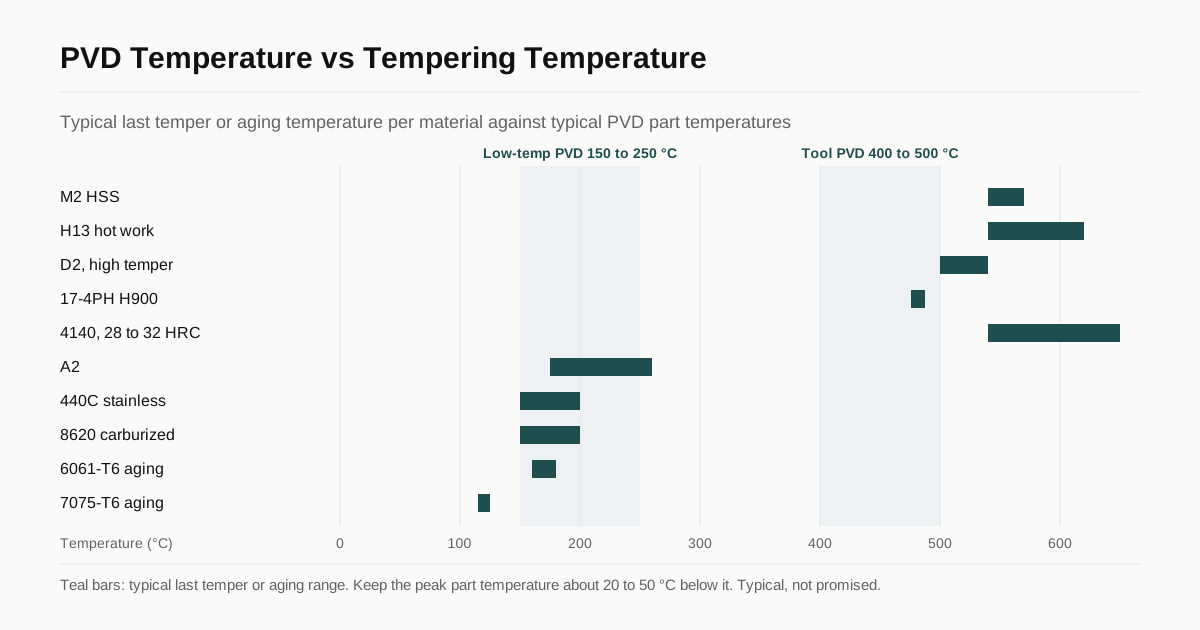
PVD coating temperature typically runs from about 150 to 500 °C at the part, depending on the coating and the equipment. Whether a part survives it comes down to one comparison: the peak part temperature in the chamber against the part’s last tempering or aging temperature, with a safety margin. High-tempered tool steels and carbide take any common PVD process. Low-tempered steels and heat-treated aluminum need a low-temperature process. Zinc, cadmium, lead and porous parts cannot go in the chamber at all. Values in this guide are typical, not promised.
The PVD overview flags process heat as the main substrate concern for PVD. This guide puts numbers on it, steel by steel. It also lists the other things that decide whether a part can be coated: distortion, outgassing and surface condition.
Why temperature matters more than hydrogen
Electroplating on steel above 39 HRC brings a hydrogen embrittlement risk and a relief bake, covered in our hydrogen embrittlement guide. PVD deposits from a vapor in vacuum and does not drive hydrogen into the steel the same way. The risk moves from hydrogen to heat.
A hardened and tempered steel is stable up to roughly the temperature it was tempered at. Hold it above that and tempering continues: hardness drops and on some steels dimensions shift. The higher above the tempering temperature and the longer the hold, the larger the loss. A PVD run typically holds parts at temperature for several hours, including heating, ion etching and deposition. That is long enough to matter.
A common shop rule is to keep the peak part temperature at least 20 to 50 °C below the last tempering temperature. Treat that as a starting point and confirm it with hardness checks on a test part.
Typical PVD process temperatures
| Process | Typical part temperature |
|---|---|
| Arc TiN, TiCN, TiAlN, AlTiN, AlCrN on carbide and HSS tools | 400 to 500 °C |
| Standard CrN and other nitrides on tool steel | 250 to 450 °C |
| Low-temperature nitride processes | about 180 to 250 °C |
| Decorative colors on stainless steel | 150 to 300 °C |
| Decorative colors on plated brass or zinc | often below 180 °C |
| Hydrogenated DLC (a-C:H) by PACVD | commonly 150 to 200 °C |
| Hydrogen-free ta-C by filtered arc | often below 150 °C |
| Sputter metallizing of plastics | near room temperature to about 80 °C |
These are part temperatures, not heater setpoints. Ion etching and high bias heat edges and thin sections faster than a heavy body. A large mold block lags behind a small punch in the same load. Ask the shop how it measures part temperature, for example a thermocouple in a dummy part or temperature-indicating labels. Ask too whether it can give you a record for the run.
The deposition method also matters: cathodic arc tool processes tend to run hotter than many sputtering setups.
Steels: tempering temperature against process temperature
The table compares typical hardened conditions. Your own heat treat record is what counts. Ask the heat treater for the actual tempering temperature and put it on the drawing or RFQ.
| Steel | Typical hardness | Typical last temper or aging | Standard 450 °C process |
|---|---|---|---|
| M2 high speed steel | 62 to 65 HRC | 540 to 570 °C, triple temper | Fits |
| H13 (1.2344) hot work | 44 to 52 HRC | 540 to 620 °C | Fits |
| D2 (1.2379), high temper | 58 to 61 HRC | 500 to 540 °C | Fits, check margin |
| D2 (1.2379), low temper | 59 to 62 HRC | 150 to 230 °C | Low-temperature process only |
| A2 | 57 to 62 HRC | 175 to 260 °C | Low-temperature process only |
| 440C stainless | 56 to 60 HRC | 150 to 200 °C | Low-temperature process only |
| 420 stainless | 48 to 52 HRC | 200 to 370 °C | Low-temperature process only |
| 17-4PH H900 | 40 to 44 HRC | about 482 °C aging | Tight, ask for a lower process |
| 17-4PH H1150 | about 28 to 33 HRC | about 621 °C aging | Fits |
| 4140, quenched and tempered | 28 to 32 HRC | 540 to 650 °C | Fits |
| 52100 bearing steel | 58 to 64 HRC | 150 to 200 °C | Low-temperature process only |
| 8620 carburized | 58 to 62 HRC case | 150 to 200 °C | Low-temperature process only |
Steels that need a decision at heat treat
D2 is the classic case. Tempered low, around 200 °C, it gives slightly higher hardness and toughness for some cold work tools. Tempered high, around 520 °C, it reaches a secondary hardness peak that tolerates standard PVD. If the tool will be coated, tell the heat treater before hardening so the high temper is used. The same applies to many powder metallurgy cold work steels that offer both routes.
440C and 420 are usually tempered low because tempering in roughly the 370 to 565 °C range lowers their toughness and corrosion resistance. A higher temper is not a fix. These need a low-temperature process. Tell the shop the grade.
17-4PH in H900 is aged at about 482 °C. A process near 450 °C leaves little margin. H1025 and H1150 are aged higher and are easier. If H900 strength is not needed, a higher condition makes coating simpler.
Carburized and induction hardened parts
Case-hardened parts such as carburized 8620 gears and pins are usually tempered at 150 to 200 °C. Their case hardness drops quickly above that. They need a low-temperature process, often DLC by PACVD below about 200 °C, with a hardness check on the case after coating. Induction-hardened shafts behave the same way.
Nitrided steel
Gas or plasma nitriding runs at roughly 500 to 570 °C, so a nitrided part tolerates most PVD processes. Nitriding followed by PVD, called a duplex treatment, gives the thin film a hard supporting layer. Ask the shop how it handles the compound layer, since a loose white layer under the coating hurts adhesion. Our wear surfaces guide covers nitriding on its own.
Carbide, titanium and other metals
Cemented carbide. No temperature issue in the PVD range, which is why the hottest tool coatings run on carbide. Cobalt leaching from aggressive cleaning is the bigger risk. Shops tune their washing for it.
Titanium. Ti-6Al-4V is annealed well above PVD temperatures and aged at about 480 to 595 °C, so standard processes usually fit. Titanium forms a tight oxide quickly, so in-chamber etching before deposition decides adhesion.
Aluminum alloys. The limit is the artificial aging temperature. 6061-T6 is aged at roughly 160 to 180 °C and 7075-T6 at about 120 °C. Above that, the alloy over-ages and loses strength. The loss depends on time as well as temperature. Only processes that stay below the aging temperature fit, which for 7075 means very low-temperature sputtering or ta-C. Aluminum is also soft. A 2 µm film rated at 2,500 HV on a substrate under 150 HV can crack under a point load, the eggshell effect. For many aluminum wear parts, hard anodizing alone is the better answer. See anodizing 6061, 7075 and cast alloys.
Copper alloys. Unleaded copper and copper alloys can be coated. Precipitation-hardened grades such as beryllium copper have their own aging limit to check.
Plastics. Possible with low-temperature sputtering, usually over a basecoat lacquer, mostly for decorative metallizing. This is a different set of shops from tool and component coaters.
Materials and assemblies a chamber cannot take
Under vacuum and heat, some materials release vapor. It contaminates the chamber, ruins adhesion on the whole load and can take a shop’s chamber out of service for cleaning. Shops commonly refuse:
- Zinc and cadmium coated parts. Zinc plating, galvanizing and cadmium all have high vapor pressure.
- Unplated zinc die castings. Need a plated nickel and chrome base first.
- Lead-bearing brass and leaded free-machining steels. Lead and zinc outgas. Some shops refuse grades such as 12L14 outright.
- Porous castings and sintered parts. Pores trap cleaning fluid that boils out in vacuum and blisters the film. Impregnated castings release the sealant. Additive parts can have the same issue, see coating 3D printed metal.
- Soft-soldered assemblies. Tin-lead solder melts near 183 °C and lead-free solders not much higher.
- Glued, potted or bonded parts. Adhesives outgas and degrade.
- Rubber seals, plastic inserts and labels. Remove them before coating.
- Cadmium or zinc rich brazes. Ask about the braze alloy on brazed carbide tools.
Sulfurized free-machining grades such as 303 stainless can show pinholes at sulfide inclusions. For decorative parts, 304 or 316 coats more cleanly.
Distortion and dimensional change
The coating itself adds only its thickness, typically 1 to 5 µm per surface, so 2 to 10 µm on a diameter. On a precision fit, allow for it in the tolerance or ask for masking.
Heat causes the larger changes:
- Residual stress. Parts machined, ground or wire EDM cut without stress relief can move when heated to 400 °C or more. Long thin punches, blades and slender pins are most at risk. Stress relieve after rough machining and before finish grinding.
- Retained austenite. Some tool steels hardened without a deep freeze or full tempering carry retained austenite that transforms on heating, which changes size. Proper multiple tempering reduces it.
- Fixturing. Parts hung or clamped at one point can sag at temperature. Tell the shop which surfaces are critical for flatness or straightness.
EDM recast layer is a surface issue, not a dimensional one, but it matters here. A brittle recast layer under the coating can flake with it. Remove it by polishing or a skim cut before coating.
Before you send the part
Check these before choosing a coating or a shop:
- Material grade and supplier certificate.
- Heat treat record with the actual last tempering or aging temperature, not just the hardness.
- Maximum allowed part temperature, written on the drawing, for example “PVD process not to exceed 180 °C”.
- Surface condition. No EDM recast, no marker ink, no oil in blind holes or threads.
- Assembly content. No solder, adhesives, seals or plated zinc or cadmium.
- Hardness check after coating on the part or a test piece of the same heat treat lot, if hardness is critical.
If the hottest process you can accept rules out the coating you wanted, ask about a low-temperature alternative. Sometimes the better move is a change at heat treat. The CVD vs PVD guide covers the much hotter CVD route that hardened steel tools usually cannot take without re-hardening. Background on the metallurgy is in the tempering article on Wikipedia. The same checks sit inside the wider buying path in our guide to PVD coating services.
Getting PVD quoted
On the RFQ, give the base material, the heat treat condition with the last tempering or aging temperature, the hardness you must keep and the maximum part temperature you accept. Add the coating or the function you need, thickness range, surfaces to coat and surfaces to mask, any assembly content and the quantity. The PVD specification guide has a full drawing note.
We are a matching service, not a coating shop. Choose PVD as the finish on the form. We pass the RFQ to up to three shops that run the coating and can hold your temperature limit. They quote you directly. You get a reply within 24 business hours. Start with the RFQ form.
Frequently asked questions
What temperature does PVD coating run at?
Most PVD processes heat the parts to somewhere between about 150 and 500 °C. Tool coatings such as TiN, TiAlN and AlCrN on carbide and high speed steel often run near 400 to 500 °C. Decorative coatings on stainless steel commonly run about 150 to 300 °C. Low-temperature processes for sensitive steels and DLC run below about 200 °C. The exact figure depends on the coating, the equipment and the load.
Will PVD coating soften my hardened steel?
It can if the part gets hotter than its last tempering temperature. A common shop rule is to keep the peak part temperature at least 20 to 50 °C below the tempering temperature. High-tempered steels such as M2, H13 and secondary-hardened D2 have plenty of margin for standard processes. Low-tempered steels such as 440C, A2, 52100 and carburized 8620 need a low-temperature process.
Can aluminum parts be PVD coated?
Yes, with limits. Heat-treated aluminum alloys lose strength if they are held above their artificial aging temperature, roughly 160 to 180 °C for 6061-T6 and around 120 °C for 7075-T6. That rules out standard tool coating processes. Low-temperature sputtered coatings and some DLC processes can work. Aluminum is also soft, so a thin hard film can crack under point loads. For many aluminum wear parts, hard anodizing alone is the better choice.
Which materials are not allowed in a PVD chamber?
Shops commonly refuse zinc and cadmium coated parts, unplated zinc die castings, lead-bearing brass, soft-soldered assemblies, bonded or glued parts, rubber or plastic inserts and porous castings or sintered parts that trap fluids. These release vapor under vacuum and heat. Vapor contaminates the chamber and the coating, so ask the shop for its exclusion list before sending parts.
Need a quote for this finish?
Send the drawing. We match you with up to 3 finishing shops that run your spec and reply within 24 business hours.
Get matched with a coating shop