Guides / Finishes
Wear Surfaces: Choosing Between Hard Anodize, Nitriding and Hard Chrome
November 3, 2026
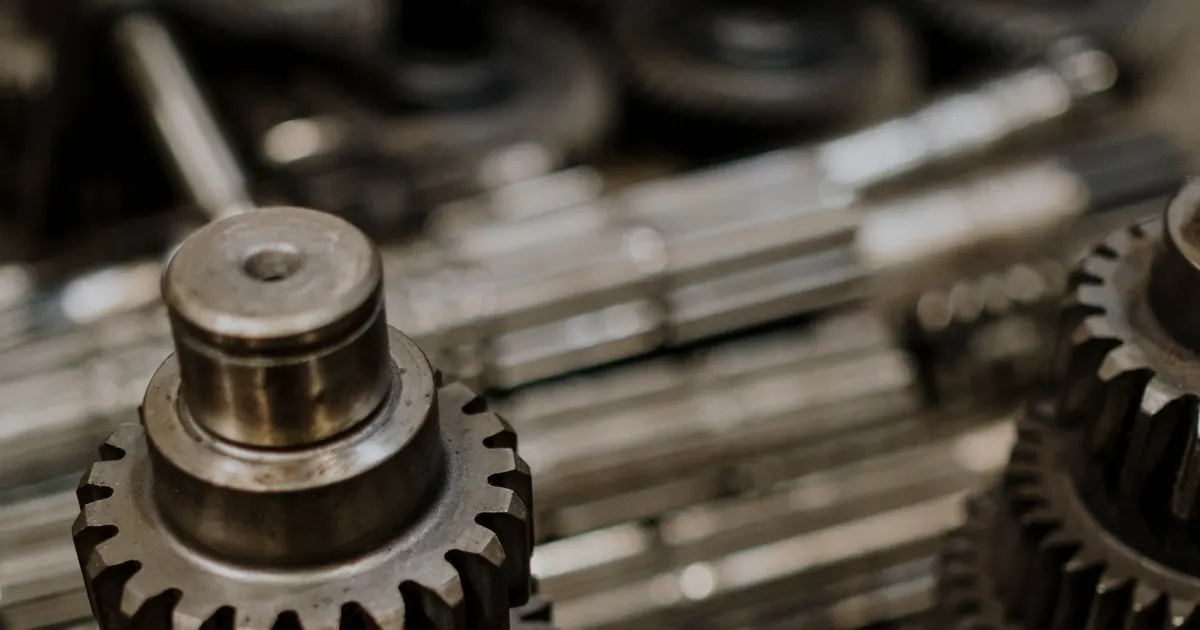
When two metal surfaces slide, roll or rub, the softer one wears. A wear coating or case hardening makes the surface harder than whatever it runs against, or lowers friction so it wears less. Three processes cover most requests on drawings: hard anodize for aluminum, nitriding for steel and hard chrome plating for shafts, rods and tooling. They are not interchangeable, since each works on certain base metals and fails in different ways. Picking by base metal first, then by load and environment, avoids the usual mistakes.
How each one works
Hard anodize (Type III) converts the surface of aluminum into a dense aluminum oxide layer, typically 25 to 75 µm thick. The layer is hard, brittle and part of the metal. See Type II and Type III anodizing vendor selection for thickness, growth and sealing.
Nitriding diffuses nitrogen into the surface of steel at roughly 500 to 570 °C. The result is a hardened case, plus a thin compound layer on top, with no added coating. Variants include gas nitriding, plasma (ion) nitriding, salt bath nitriding and ferritic nitrocarburizing.
Hard chrome is electroplated chromium, applied in thick layers over steel to give a very hard, low-friction, wear and corrosion-resistant surface. It is a coating on top of the part and builds up in thickness.
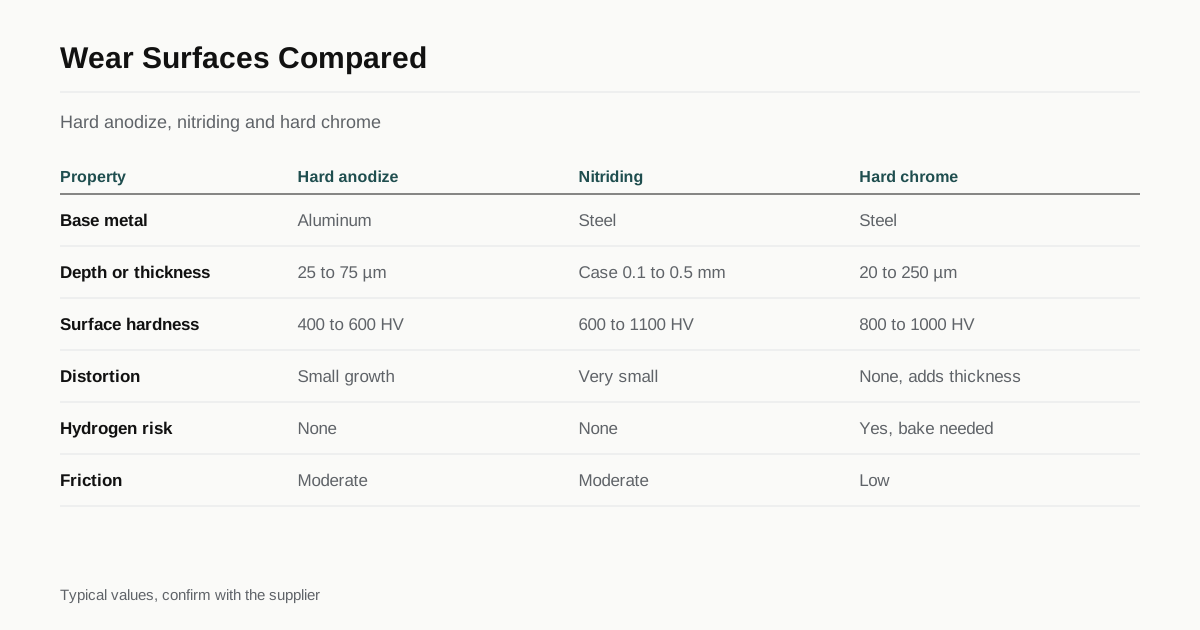
Typical properties
| Property | Hard anodize | Nitriding | Hard chrome |
|---|---|---|---|
| Base metal | Aluminum alloys | Steel, some cast iron, titanium variants | Steel, some others with preparation |
| Typical depth or thickness | 25 to 75 µm | Case 0.1 to 0.5 mm, compound layer 5 to 25 µm | 20 to 250 µm and up |
| Typical surface hardness | About 400 to 600 HV equivalent | About 600 to 1100 HV, depends on steel | About 800 to 1000 HV |
| Distortion | Small, growth from surface | Very small | None, but thickness adds |
| Hydrogen risk | None | None | Yes, needs bake on hardened steel |
| Friction | Moderate, can be sealed with PTFE | Moderate | Low |
| Corrosion help | Good when sealed | Fair, compound layer helps | Fair, microcracks let corrosion in |
Values are typical and not promised. Actual numbers depend on alloy, process and shop.
Hard anodize in detail
Hard anodize suits aluminum parts that slide, take abrasion or need to insulate: pistons, valve bodies, guide rails, tooling plates and housings. It is limited to aluminum alloys. Copper-rich alloys and cast alloys give poorer, thinner and less uniform hardcoat. See anodizing 6061, 7075 and cast aluminum.
Watch-outs include fatigue strength loss on cyclic parts, dimensional growth of about half the coating thickness per surface, and burning at sharp edges. A PTFE-impregnated hardcoat lowers friction for sliding parts. Seal or leave open as the drawing requires, since sealing slightly softens the surface. For alloys, thickness, fatigue and cost of hard anodize, see our guide to aluminum anodizing.
Nitriding in detail
Nitriding is chosen for steel parts such as gears, shafts, crankshafts, extrusion screws, dies and valve parts where a hard surface and low distortion are both needed. Because it runs at a modest temperature, parts can be finish machined before nitriding and need little or no grinding after. Steel type matters. Alloys with chromium, molybdenum, aluminum and vanadium form hard nitrides and reach the highest surface hardness. Plain carbon steel nitrides to a thin, softer case. Stainless steel needs special treatment because its passive layer blocks nitrogen, and nitriding it lowers corrosion resistance unless it is a low-temperature plasma process.
Notes for the drawing:
- Name the steel and its pre-hardened condition. Nitriding is normally done on quenched and tempered steel with a tempering temperature above the nitriding temperature.
- State the case depth and surface hardness, and the test method, such as a microhardness traverse on a section.
- Say whether the white compound layer is wanted or must be limited, since it is brittle and some applications want it removed or thin.
- Mask areas that must stay soft, for threads or press fits, using plating stop-off or paint.
Hard chrome in detail
Hard chrome has been the default for hydraulic rods, rolls, molds and engine parts for decades. It gives high hardness and low friction and can be built up to restore worn parts. It also has weaknesses.
- Process restrictions. The plating bath uses hexavalent chromium. Regulations such as EU REACH restrict it, with limited authorizations, and many regions apply tight worker exposure limits. Many shops no longer offer it.
- Hydrogen embrittlement. Chrome plating is a hydrogen source. Hardened steel parts need a relief bake. See hydrogen embrittlement relief bake.
- Microcracks. The deposit is cracked at a fine scale, which holds oil for lubrication but lets corrosive fluid reach the steel in harsh environments.
- Fatigue. Chrome plating can reduce the fatigue strength of the base steel. Shot peening before plating is a common countermeasure.
- Edges. Chrome builds up on corners, so edges need radius and parts are usually ground back after plating.
Hard chrome is applied for wear or repair, not decoration. When a drawing calls it out, ask the design owner whether an alternative is acceptable.
Testing and verification
Wear claims need numbers that can be checked.
- Hardness. Microhardness traverses on a cross section for nitrided cases and hard anodize, and Rockwell or Vickers surface tests on chrome. Surface hardness readings can mislead on thin layers, so the test load must match the layer thickness.
- Case depth. Defined by the depth where hardness falls to a stated value above core hardness. Name the criterion.
- Thickness. Eddy current for anodize, magnetic or micrometer methods for chrome, and a section for compound layer thickness. See coating thickness measurement.
- Wear tests. Taber abrasion for anodic coatings, pin-on-disk or reciprocating tests for sliding pairs. Standards exist, but the test should mimic the real pair.
- Adhesion. Bend and file tests for chrome, and visual checks for flaking.
A certificate that gives hardness and thickness data with the method is more useful than one that says only “processed per drawing”.
Surface finish and run-in
A hard surface rubs against a mating part, so the roughness of both parts decides how fast wear settles. Surfaces that are too rough chew up the mating part. Surfaces that are too smooth hold no lubricant. Hard chrome is often ground or lapped after plating to a stated roughness, and nitrided parts are sometimes lapped lightly to remove the compound layer. Hard anodize is rougher than the base metal, because the oxide grows outward and opens the surface, and many drawings allow a light polish after coating.
Run-in matters too. A new hard surface and a new mating surface may need a short break-in under light load. Name the lubricant and the load case, so the shop and the designer agree on what a good surface looks like.
Other options
- Electroless nickel plus heat treat reaches about 900 to 1000 HV and coats evenly. See electroless nickel phosphorus content.
- PVD and DLC give thin, hard, low-friction films on tools and precision parts. See PVD coatings explained.
- HVOF tungsten carbide gives very high wear resistance on rolls, rods and valve parts, at higher cost, and is a common hard chrome replacement.
- Through hardening or carburizing gives deeper hardened cases than nitriding on suitable steels but with more distortion.
Choosing by situation
- Aluminum part with sliding or abrasion: hard anodize, with PTFE if friction matters.
- Steel shaft, gear or die needing a hard case and low distortion: nitriding.
- Rod or roll needing a thick, hard surface or repair by build-up: hard chrome if allowed, or HVOF or a thick electroless nickel alternative.
- Cannot heat the part to 500 °C or more: hard anodize, hard chrome, PVD or electroless nickel instead of nitriding.
- Corrosion and wear together: consider sealed hardcoat, nitrided and oxidized steel, or a duplex system, and ask the shop for data.
What to put on the RFQ
- Base metal, grade and heat treat condition.
- Required surface hardness and depth or thickness, with test method.
- Dimensions after processing and finish-grinding allowances.
- Masked areas for threads and fits.
- Surface roughness after coating.
- Mating material and loading, so the shop understands the failure mode.
- Hydrogen embrittlement bake requirement for plated parts.
- Lot size and drawing.
See the coating RFQ checklist for more, and masking for plating and anodizing for masked areas.
See also: Hard chrome plating reference page.
How we help
We are a matching service, not a coating or heat treat shop. Send one RFQ with the wear problem and the base metal and we pass it to up to 3 shops that run the process you need. Replies come within 24 business hours. Start with the RFQ form.
Frequently asked questions
Which wear coating works on aluminum?
Hard anodize, Type III, is the standard answer for aluminum, since nitriding does not apply to aluminum and hard chrome on aluminum needs a complex pretreatment. Electroless nickel with heat treat and PVD coatings are other options. The choice depends on load, sliding speed and what the part runs against.
Does nitriding change part dimensions?
Very little. The process runs well below the transformation temperature of steel, around 500 to 570 °C for gas and plasma nitriding, so distortion is small, and growth is usually a few micrometers. Parts are normally finished to size before nitriding for this reason, though a final light polish or lap is sometimes used.
Is hard chrome still a good choice?
It has an excellent track record for hardness, low friction and repairability, but the process uses hexavalent chromium and is restricted in several regions. It also needs a hydrogen relief bake on hardened steel. Many new designs choose nitriding, HVOF coatings or other alternatives where the design allows.
Need a quote for this finish?
Send the drawing. We match you with up to 3 finishing shops that run your spec and reply within 24 business hours.
Get matched with a coating shop