Guides / Finishes
Coatings for Food Equipment Parts: What Food Contact Allows and What It Does Not
October 22, 2026
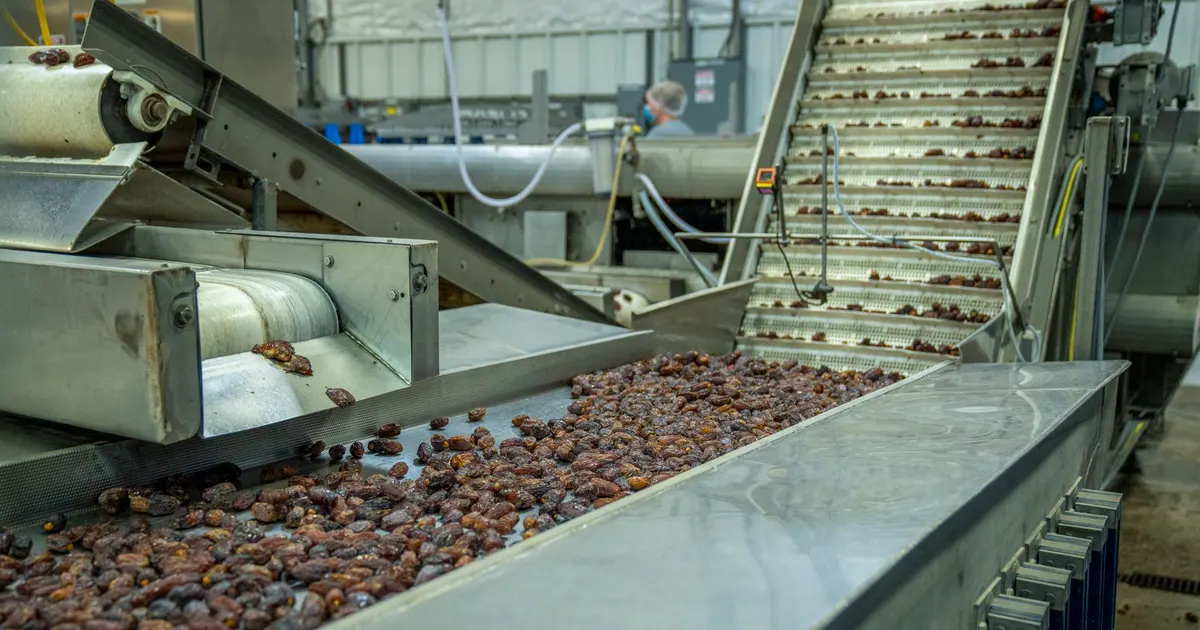
Food equipment finishing starts from a simple rule: whatever touches food must not harm it, flake into it or feed bacteria. That rule sets limits on the finishes available, and it is why so much food equipment is bare stainless steel. Coatings still have a place, for non-stick surfaces, wear parts, color coding and frames that never touch product. Knowing which zone a part lives in tells you most of what you need to know about its finish.
Three zones, three sets of rules
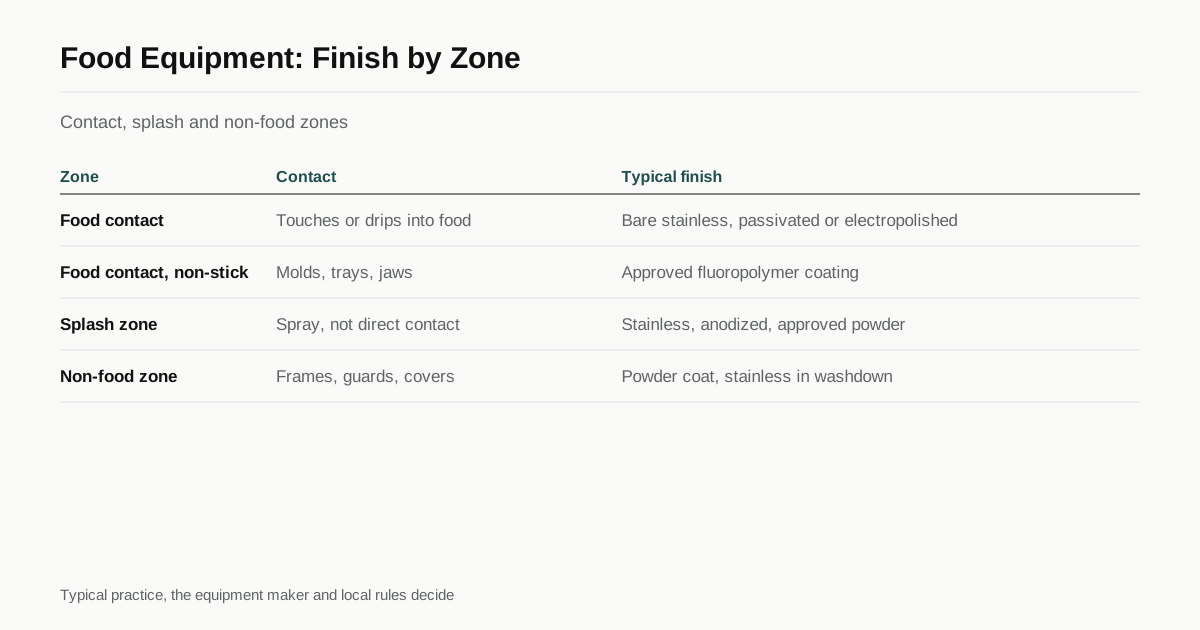
Equipment designers usually split a machine into zones.
| Zone | Contact | Typical finish |
|---|---|---|
| Food contact | Touches food or drips into it | Bare stainless, passivated, electropolished or an approved food-contact coating |
| Splash zone | Exposed to splash, cleaning and spray, not direct contact | Stainless, anodized aluminum or approved powder coat |
| Non-food zone | Frames, guards, covers, motors | Powder coat, paint, galvanized steel in dry areas, stainless in washdown |
The strictest rules apply in the contact zone. In the other zones corrosion resistance, washdown chemical resistance and cleanability still matter, but the coating is not part of the food path.
The rules behind it
Rules differ by region, and they apply to the specific coating formulation more than to a process name.
- United States. The FDA regulates food-contact substances. Coating resins and polymers used on food-contact surfaces appear in sections of 21 CFR, such as Part 175 for adhesives and coatings and Part 177 for polymers, with fluoropolymers like PTFE covered separately. The formulation and the cure must meet the stated limits.
- European Union. Regulation (EC) 1935/2004 sets general requirements for food contact materials, with Regulation (EU) 2023/2006 on good manufacturing practice, and specific rules for plastics. Many coatings fall under national rules or the general framework.
- Standards for equipment. Standards from groups such as NSF and 3-A cover equipment design, with surface finish and material requirements.
A coating maker can supply a declaration of compliance for a product and a stated use. That declaration is the document to request. We do not claim compliance for any coating or shop, and the equipment maker or buyer decides what applies.
Stainless steel: the baseline
For most product contact surfaces, 304 or 316 stainless steel is the default material. Typical finishing steps include:
- Grinding and polishing to a surface roughness limit. Dairy standards, for example, often require a roughness average near 0.8 µm (32 microinches) on product contact surfaces.
- Passivation per ASTM A967 or A380 to restore the passive layer after fabrication.
- Electropolish for a smoother, more cleanable surface on difficult shapes.
- Weld cleaning. Weld heat tint is removed by pickling or polishing.
For details on the difference between passivation and electropolish see passivation vs electropolish. Bare stainless needs no coating, which removes any flaking risk.
Non-stick coatings
PTFE, FEP and PFA fluoropolymer coatings give a non-stick surface for molds, baking trays, sealing jaws and conveyors. They are applied as liquid or powder and baked at high temperature. Performance depends on the coating system, the surface preparation (often a grit blast) and the number of layers. Fluoropolymer coatings are soft compared with metals and can wear or scratch. Food-contact use requires a formulation that meets the applicable regulations, and a shop that applies it as a specific product with controlled cure.
Check whether your market has restrictions on specific fluorinated substances, since regulation of PFAS chemicals is changing quickly in several regions.
Anodized aluminum
Hardcoat anodized aluminum is used for some food processing parts, such as molds, trays and rollers, because it resists abrasion and does not shed metal. Sealing is important, since an open oxide holds moisture and soil. Dyes should be food-safe or avoided in contact areas. High-pH washdown chemicals can attack aluminum and its oxide, so check chemical compatibility. See Type II and Type III anodizing vendor selection.
Powder coating in the splash and non-food zones
Powder coat is widely used on frames, guards, hoppers’ outer surfaces and motor housings. For splash zones, pick a powder with good chemical resistance, smooth finish and low porosity, and check that the film is continuous at edges and seams. Rough or chipped coatings harbor bacteria. Cleaning chemicals, hot water and pressure washing can soften or lift a poorly cured film. See powder coating pretreatment, cure and adhesion testing for what to ask.
Some powders carry food-contact declarations for specific uses, and those are different from standard industrial powders. Name the requirement.
Finishes to avoid in contact zones
- Zinc plating and galvanizing. Zinc dissolves in acidic foods and drinks.
- Cadmium. Toxic. Do not use.
- Black oxide and bare carbon steel, which rust.
- Nickel and chrome plating on contact surfaces unless the equipment maker has reviewed nickel release and wear. Hard chrome is used on some rollers, and its use depends on the standard and the food type.
- Electroless nickel on acidic or salty foods, unless approved, since nickel can leach.
- Any coating that chips, since flakes are physical contamination.
When in doubt, ask the equipment maker or the food safety lead before specifying a finish.
Cleaning and washdown
Food plants wash with hot water, caustic, acid and sanitizer cycles, sometimes under pressure. A coating must survive its own cleaning program for years. A finish that fails in washdown, by blistering, lifting or staining, becomes a contamination source. Ask for chemical resistance data for the cleaning agents used, at the concentration and temperature in use.
Design and cleanability
Coatings should not make equipment harder to clean. Hygienic design rules, such as those published by equipment hygiene groups, call for smooth surfaces, radiused corners, no crevices and no exposed threads in the product zone. A coating that fills a crevice or leaves a rough edge at a masked boundary can create the very niche a cleaning crew cannot reach. Specify coating limits at joints, fasteners and edges, and do not let a masking line fall inside a food-contact area.
Surface roughness also changes after coating. A thick or textured coating can raise roughness above the limit that was met by the polished base. Measure roughness on the finished surface, not on the bare part, when the standard sets a limit.
Wear, chipping and inspection
Any coating in or near the food path needs an inspection plan. A coating that wears through exposes base metal and shows as a change in color or gloss. A coating that chips can drop fragments into product. Typical controls include scheduled visual inspection, a defined replacement or recoat interval, and metal detection or X-ray at the end of the line. Coatings in bright, contrasting colors, such as blue, make fragments easier for inspection systems and workers to see. Many plants use blue for detectable plastic parts and tools for exactly that reason, and some apply the same logic to coatings.
Documentation to request
- A declaration of compliance from the coating maker for the specific product and use.
- Material and coating data sheets with cure conditions.
- Lot traceability and process records.
- Surface roughness and thickness results.
- Migration test reports, if the equipment maker requires them.
- Test results for washdown chemical resistance.
Ask early, since some documents take time to obtain.
What to put on the RFQ
- The part and its zone: contact, splash or non-food.
- Base metal and surface finish before coating.
- Coating type, with the regulation or standard the buyer needs it to meet.
- Cleaning chemicals, temperature and cycles.
- Documentation required.
- Thickness, color and masking.
- Lot size and drawing.
See the coating RFQ checklist for more.
How we help
We are a matching service, not a coating shop, and we do not certify any coating as food safe. Send one RFQ with the zone, the regulation you need and the documents you expect, and we pass it to up to 3 shops that coat food equipment parts. Replies come within 24 business hours. Start with the RFQ form.
Frequently asked questions
Is there such a thing as a food grade coating in general?
Not as a single category. Whether a coating is acceptable depends on the exact material, how it is cured, what food touches it and under what conditions. Regulations such as US FDA rules for food contact surfaces and EU framework rules apply to specific formulations. Ask for a declaration of compliance from the coating maker for the specific product and use.
Can I use zinc plated or galvanized parts around food?
Not on surfaces that touch food. Zinc dissolves in acidic foods and drinks and can contaminate the product, and galvanized or zinc plated parts are not used for food contact. Zinc is sometimes found on non-contact frames, fasteners and guards in dry areas, but even there stainless steel is usually preferred in wet washdown zones.
Why is bare stainless steel so common on food equipment?
It is corrosion resistant, smooth, easy to clean and does not need a coating that could chip or wear off into food. A passivated, ground or electropolished 304 or 316 stainless surface is the default for product contact. Coatings are used where stainless is not enough, for example for non-stick, wear or color coding.
Need a quote for this finish?
Send the drawing. We match you with up to 3 finishing shops that run your spec and reply within 24 business hours.
Get matched with a coating shop