Guides / Specs
Anodizing Vendor Selection: Which Shop Runs Type II or Type III for Your Parts
November 2, 2026
Type II and Type III are the two anodizing classes most buyers meet on a drawing, and not every shop runs both. Both grow an aluminum oxide layer from the part’s own surface, and both are defined in the same family of specifications, MIL-A-8625 in the US. What differs is the bath conditions, the coating thickness, the hardness and what the coating does to the part’s size. Choosing a vendor means checking which classes the shop runs, how it seals, and what it does about growth and masking, because a mismatch there is a common reason a lot gets rejected for fit or for wear.
What each type means for the shop you pick
Type II is sulfuric acid anodizing at roughly room temperature. It gives a thin, porous oxide that takes dye well and is then sealed. It is the standard decorative and general corrosion finish for housings, brackets, enclosures and consumer hardware.
Type III, also called hardcoat, is sulfuric acid anodizing run much colder, close to the freezing point of water, at higher current density and for a longer time. The oxide is denser and much thicker. It is chosen for wear resistance, sliding surfaces and electrical insulation, not for appearance.
Both can be specified under MIL-A-8625 or under ASTM B580 or ISO 7599 equivalents. Some shops also run Type IIB, a thin sulfuric coating, for parts that cannot tolerate much growth. Check which classes a shop actually runs before you assume the callout will match.
Typical thickness and growth
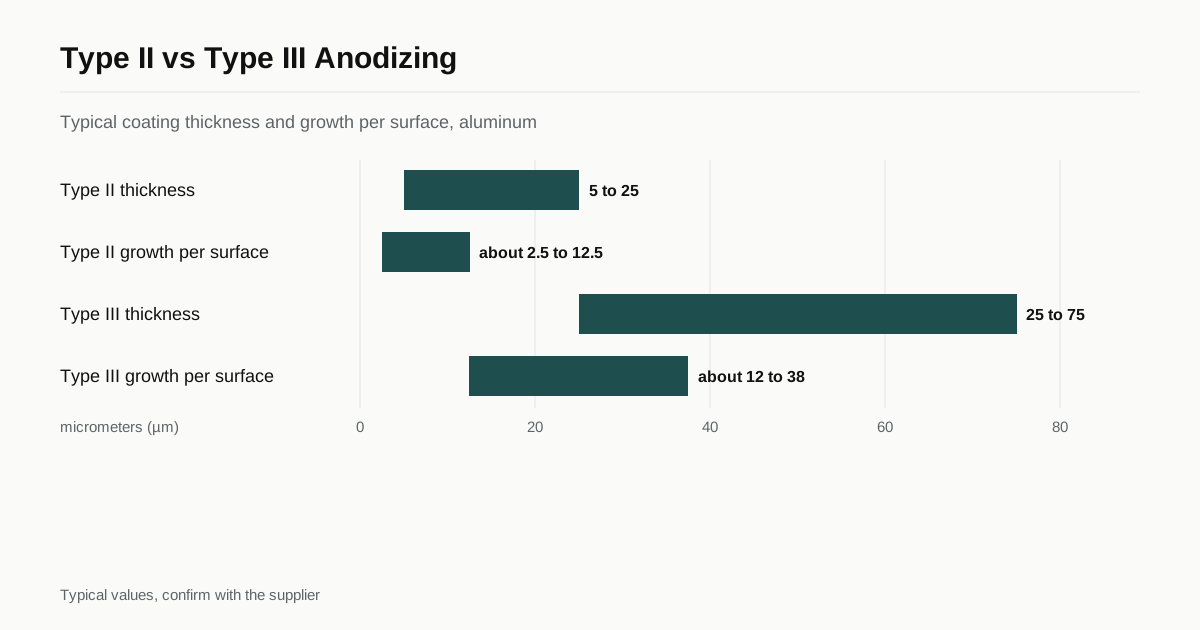
Thickness is the headline difference. The figures below are typical ranges, not promises, and every shop quotes its own process window.
| Property | Type II | Type III hardcoat |
|---|---|---|
| Typical thickness | 5 to 25 µm | 25 to 75 µm |
| Common callout | 0.0002 to 0.001 in | 0.001 to 0.003 in |
| Growth outward per surface | about half of total | about half of total |
| Typical bath temperature | 18 to 22 °C | 0 to 5 °C |
| Surface | Porous, takes dye | Dense, dark gray to bronze |
| Hardness | Moderate | High, comparable to hardened steel |
A common rule of thumb is that about half of the coating thickness builds outward and half penetrates into the base metal. A 50 µm hardcoat therefore adds about 25 µm per surface. On a shaft that is 50 µm added to the diameter, and on a bore it is 50 µm removed from the diameter. Ask the shop for the growth they see on your alloy rather than relying on the rule.
Sealing
After anodizing the oxide is full of microscopic pores. Sealing closes them, which is what delivers most of the corrosion resistance.
- Type II is almost always sealed, either in hot deionized water, in nickel acetate or in a cold seal. Dyed parts must be sealed or the color washes out.
- Type III is often left unsealed when wear is the only goal, because sealing slightly reduces surface hardness and abrasion resistance. If the part also sees moisture or salt, it is sealed.
- MIL-A-8625 sets a salt spray requirement for sealed coatings. If your part needs a specific exposure time, state it as a test requirement under ASTM B117 and see our guide to what salt spray hours really mean.
Write the seal on the drawing. A callout of just “anodize” leaves it to the shop, and an unsealed Type II surface behaves very differently from a sealed one.
Color and appearance
Type II takes a wide range of dyes: black, clear, red, blue, gold and many more. Black is the most common and the most forgiving on lot-to-lot variation. Bright colors show differences between alloys and between lots, so assemblies with several anodized parts should come from one lot and one alloy where color matching matters.
Type III is naturally gray to dark brown and its shade depends strongly on the alloy. Copper-bearing alloys such as 2024 and 7075 and cast alloys with high silicon go darker and duller. Buyers who want a consistent look on hardcoat parts usually specify black dye, accept the natural shade or ask for a sample first. The alloy-by-alloy picture is covered in anodizing 6061, 7075 and cast aluminum.
Effects on the part
Three side effects deserve a line on the drawing.
- Fit. Growth changes hole and shaft sizes. Specify whether tolerances apply before or after coating, and mask critical bores or threads.
- Fatigue. Thick anodic layers are hard and brittle and can crack under cyclic load. Hardcoat typically reduces fatigue strength compared with bare aluminum. Parts in cyclic service should be reviewed by the designer.
- Electrical. The oxide is an insulator. A grounding or contact surface needs masking, or a conversion coating instead.
Sharp edges also matter. Oxide builds up unevenly on external corners and can crumble there. A small edge radius, typically 0.2 to 0.5 mm, is what shops usually ask for on hardcoat parts.
What moves the vendor quote
Hardcoat usually costs more than Type II for reasons that are mostly process-related:
- A colder bath and a cooling load.
- A longer cycle, often 40 to 120 minutes against 20 to 40.
- Tighter control of current and temperature.
- More careful racking to keep contact points small.
Beyond the type itself, the price is moved by part size, lot size, racking marks allowed, masking and any test coupons. Our article on plating and coating cost lists the other drivers.
Common reasons anodized lots get rejected
Most disputes come from a short list of causes, and nearly all of them trace back to a drawing that said too little.
- Thickness out of range. Thickness varies across a part, thinner in recesses and thicker on edges. Say where it is measured and accept a range, not a single number.
- Color mismatch. Dyed Type II parts from two lots rarely match exactly. Order all pieces of one assembly together or agree a color standard.
- Racking marks. Every part hangs on a rack, and the contact point stays uncoated. Name the areas where a mark is acceptable.
- Fit problems. Threads and bores that were machined to final size before anodizing come back too tight. Either machine them oversize on purpose or mask them.
- Soft or chalky surface. This points to a seal or bath problem and is a reason to ask for an abrasion or weight-loss test on hardcoat.
Thickness verification is its own topic, since the method changes the answer. Our guide to coating thickness measurement explains which gauge suits an anodic layer. Eddy current is the usual choice, and a metallographic cross section settles any disagreement.
Which type to ask the vendor to quote
Use Type II when the part is visible, needs a color, sees moderate wear and needs a general corrosion barrier. Use Type III when the part slides, rubs, takes abrasion or needs a thick insulating layer. If you need both appearance and wear resistance, ask for black hardcoat and confirm the shade on a sample.
If the real question is wear rather than anodizing, compare it with the alternatives in hard anodize, nitriding or hard chrome. For alloy, color, seal, masking and cost in one place, see our guide to aluminum anodizing.
What to put on the RFQ to anodizing vendors
- Alloy and temper of the part.
- Type and class per MIL-A-8625, or the equivalent ASTM or ISO callout.
- Thickness range and whether it applies to the final surface.
- Which dimensions are final after coating and which areas stay uncoated.
- Color, seal type and any salt spray or abrasion test requirement.
- Lot size and drawing in PDF or STEP.
See also: Type II sulfuric acid anodizing reference: process, dyes, seals and alloys.
How we help
We are a matching service, not an anodizing shop. Send one RFQ with the details above and we pass it to up to 3 shops that run the type and alloy you named. Replies come within 24 business hours. Start with the RFQ form or read the coating RFQ checklist first.
Frequently asked questions
Can I dye a Type III hardcoat part?
Yes, but the result is dark and limited. Hardcoat is dense and dark by nature, so dyes work best in black and dark colors. Bright colors such as red or blue are usually done as Type II. Dyeing also needs a seal, which slightly softens the surface compared with unsealed hardcoat.
Does anodizing change the dimensions of a part?
Yes. Part of the coating grows outward from the original surface and part penetrates into it. Hardcoat grows more in absolute terms because it is thicker. Hole sizes shrink and shaft sizes grow, so critical fits should be called out as final dimensions after anodizing, or masked.
Which one is cheaper?
Type II is usually cheaper because the cycle is shorter and runs at higher bath temperature. Hardcoat needs a colder bath, longer time and tighter process control, so shops typically quote it at a clear premium. Racking, masking and tolerance requirements often move the price more than the type does.
Need a quote for this finish?
Send the drawing. We match you with up to 3 finishing shops that run your spec and reply within 24 business hours.
Get matched with a coating shop