Guides / Specs
Powder Coating Pretreatment, Cure and Adhesion Testing: What Decides Whether It Lasts
October 28, 2026
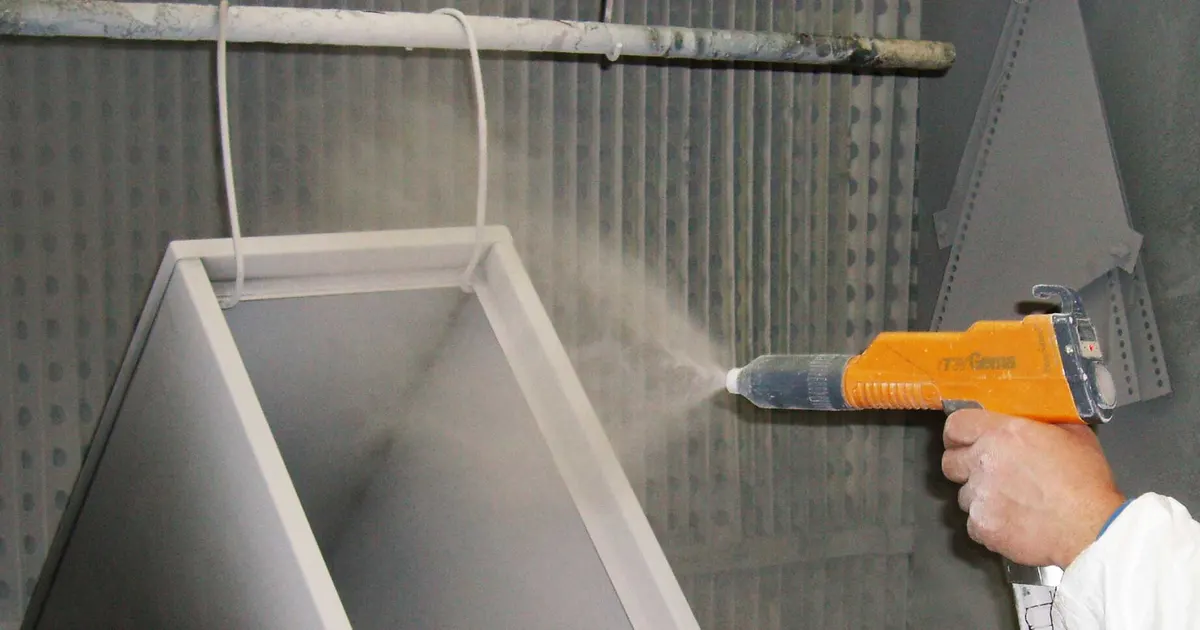
A powder coat film is only as good as what sits underneath it. Most field failures, such as peeling at edges, rust creeping from a scratch or blistering after a season outdoors, trace back to cleaning and pretreatment, or to a cure that did not reach temperature. Powder coating itself is a simple, repeatable process. Knowing the steps lets you ask for the right ones and read a shop’s answer with some confidence.
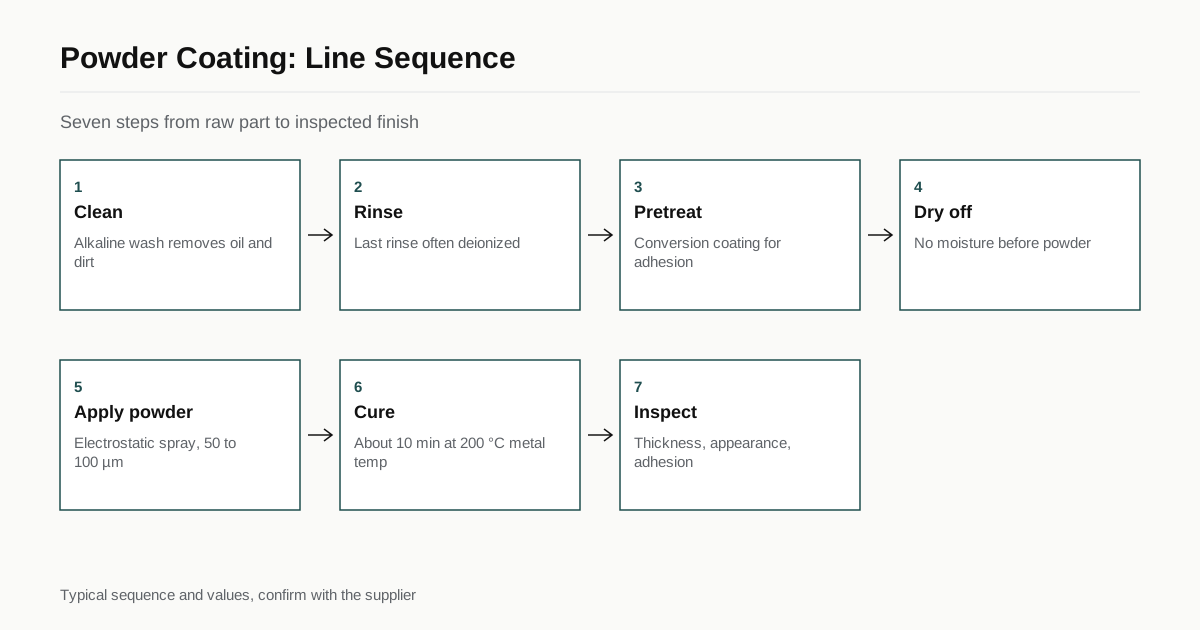
The sequence in a typical line
- Clean. An alkaline wash or spray removes oil, cutting fluid and dirt. Parts that arrive with heavy oil or with weld scale may need a separate degreasing or blasting step first.
- Rinse. Clean water removes the cleaner. The final rinse often uses deionized water to avoid salts that cause blistering later.
- Pretreat. A conversion coating is applied to the metal. See the table below.
- Rinse again and dry. Parts go through a dry-off oven so no moisture remains.
- Apply powder. The powder is electrostatically charged and sprayed on the grounded part. Film thickness is controlled by gun setting and part geometry.
- Cure. The part goes through an oven where the powder melts, flows and cross-links.
- Cool and inspect. Thickness, appearance and sometimes adhesion are checked.
Pretreatment by base metal
| Base metal | Common pretreatment | What it adds |
|---|---|---|
| Steel, indoor use | Iron phosphate | Light adhesion layer, low cost |
| Steel, outdoor use | Zinc phosphate or thin film zirconium | Better adhesion and corrosion resistance |
| Aluminum | Zirconium or titanium based conversion | Adhesion on a clean oxide-free surface |
| Aluminum, aerospace | Chromate conversion per MIL-DTL-5541 | Specified by aerospace drawings |
| Galvanized steel | Light etch or zirconium based, or none | Needs a clean zinc surface |
| Stainless steel | Light abrasive blast or special conversion | Smooth, passive surface needs profile |
Typical choices only. The right system depends on the powder, the environment and the specification.
Conversion coatings add a thin crystalline or amorphous layer that bonds to the metal and gives powder something to grip. They also slow corrosion creep under the film if the surface is scratched. For chromate options and their restrictions see chromate conversion coating.
Film thickness
Most powder coat films are applied at about 50 to 100 µm, roughly 2 to 4 mils. Thin films under 40 µm tend to show orange peel, pinholes and early edge failure. Films over 125 µm can run, trap gas or lose flexibility. Edges, corners and outside surfaces pick up more powder than recesses, which is the Faraday cage effect, so recessed areas end up thin. Name where thickness is measured and use a magnetic gauge on steel or an eddy current gauge on aluminum. See coating thickness measurement.
Cure schedules
Most standard polyester, epoxy and hybrid powders cure for about 10 minutes at a metal temperature of around 200 °C, or longer at a lower temperature. Some low-cure powders cure at roughly 150 °C. The powder maker’s data sheet gives the window for that product.
The key point is that cure is set by part temperature, not oven air temperature. A thick cast or a heavy weldment takes much longer to heat through than a thin sheet part. If the part reaches temperature late, the shop has to extend the time. A cure schedule that works for a bracket will under-cure a heavy frame.
Under-cure shows up as poor solvent resistance, softness and brittleness. Over-cure shows up as yellowing, color shift and sometimes loss of gloss. Both can be reduced by a thermocouple on a representative part, a practice some shops follow.
Adhesion and cure tests
| Test | Standard | What it shows |
|---|---|---|
| Cross-hatch tape | ASTM D3359 or ISO 2409 | Adhesion to the substrate |
| Impact | ASTM D2794 | Resistance to chipping and cracking |
| Mandrel bend | ASTM D522 | Flexibility |
| MEK double rub | ASTM D4752 | Degree of cure |
| Pencil hardness | ASTM D3363 | Film hardness |
| Gloss | ASTM D523 | Appearance |
| Salt spray | ASTM B117 | Corrosion resistance under a scribe |
Cross-hatch is the quickest and most common check on production lots. MEK rub is a handy cure test, since a properly cured film resists a set number of rubs with a solvent-soaked cloth. Read what salt spray hours really mean before you put an hour count on a powder coat drawing.
Typical defects and what causes them
- Pinholes and craters. Trapped gas from castings, oil residue or moisture in the powder.
- Orange peel. Film too thin or too thick, or a cure that started too fast.
- Poor adhesion. Skipped or weak pretreatment, or contamination.
- Thin edges. Sharp corners pull the film thin. A small radius helps.
- Color mismatch. Different powder lots or cure profiles. Order assemblies together.
- Rust bleed at edges. Steel edges from laser or punch cutting need cleaning of oxide before pretreatment.
Why surface condition before cleaning matters
The line can only clean what it can reach and dissolve. Several surface conditions on incoming parts need handling before the wash, and they are best flagged on the RFQ.
- Weld scale and heat tint. Alkaline cleaners do not remove oxide. Weldments usually need grinding, blasting or an acid step.
- Laser-cut oxide edges. Oxygen-assist cutting leaves a hard oxide on the edge. Nitrogen-cut edges are cleaner and take pretreatment better.
- Rust and mill scale. Blasting or pickling is needed first, since a conversion coating will not bond through them.
- Heavy oils and drawing compounds. Parts from stamping or deep drawing may need a pre-clean or a solvent wipe.
- Silicone. Silicone sprays and some mold release agents are very hard to remove and cause craters in the film. Keep them off parts that will be coated.
- Porous castings. Impregnation or a pre-bake helps stop outgassing.
A shop can often fix these, but the fix costs time. Telling the shop about them in the RFQ gives a realistic quote instead of a surprise charge.
Storing and handling between steps
Cleaned and pretreated metal starts to oxidize, especially steel. Most lines run clean, pretreat, dry and coat as one continuous flow, which avoids the problem. When parts are pretreated at one place and coated at another, or held overnight, the surface can pick up moisture and dust. Ask the shop how long the gap between pretreatment and powder application can be, and whether parts are handled with gloves. A good shop will have a clear answer, and short gaps are the usual rule.
Recoating and repair
A damaged film can be touched up with a compatible liquid paint or re-coated after sanding. A fully cured film usually needs a light abrasion before re-coating so the new film bonds. For parts that will be recoated often, name the original powder type on the drawing so a repair shop knows what it is working with.
Masking and fixturing
Powder coating also needs bare areas for grounding and for any mating surface. Plugs and caps are common, and high-temperature tape is used for flat surfaces. See masking for plating and anodizing for the general approach. A rack or hook leaves a small bare spot, and you can name the area where that is acceptable.
What to put on the RFQ
- Base metal and condition: cast, welded, laser cut or machined.
- Powder type, color and gloss, with a RAL or other color code.
- Film thickness range and where it is measured.
- Pretreatment required, or the environment the part sees if you want the shop to pick.
- Adhesion, cure or corrosion tests required, with standards.
- Masked areas and the allowed hang point.
- Lot size and drawing.
For outdoor products, add the exposure type, since it changes the powder choice. See outdoor powder coating for enclosures and brackets.
How we help
We are a matching service, not a coating shop. Send one RFQ with the base metal, color and test requirements and we pass it to up to 3 shops that run powder lines for that kind of part. Replies come within 24 business hours. Start with the RFQ form or the coating RFQ checklist.
See also the reference on dry film thickness gauges and reading counts.
Frequently asked questions
Is pretreatment really necessary before powder coating?
For parts that see weather, moisture or chemicals, yes. Powder gives the film but pretreatment gives the adhesion and the corrosion resistance underneath it. A part that is only degreased and then powder coated can look the same on day one and fail much earlier at the edges and in scratches.
What happens if the powder is under-cured?
The film looks fine but is soft or brittle, has poor solvent resistance and may peel or chip. Over-curing can yellow light colors and dull gloss. The cure is measured at the metal temperature of the part, not at the oven air temperature, which matters on heavy parts.
Can cast aluminum be powder coated?
Yes, but castings often hold trapped gas that escapes during cure and leaves pinholes or blisters. Shops commonly pre-bake castings and use powders made to degas. Say on the RFQ if the parts are cast.
Need a quote for this finish?
Send the drawing. We match you with up to 3 finishing shops that run your spec and reply within 24 business hours.
Get matched with a coating shop