Guides / Specs
Masking for Plating and Anodizing: Plugs, Tape and Lacquer Compared
October 24, 2026
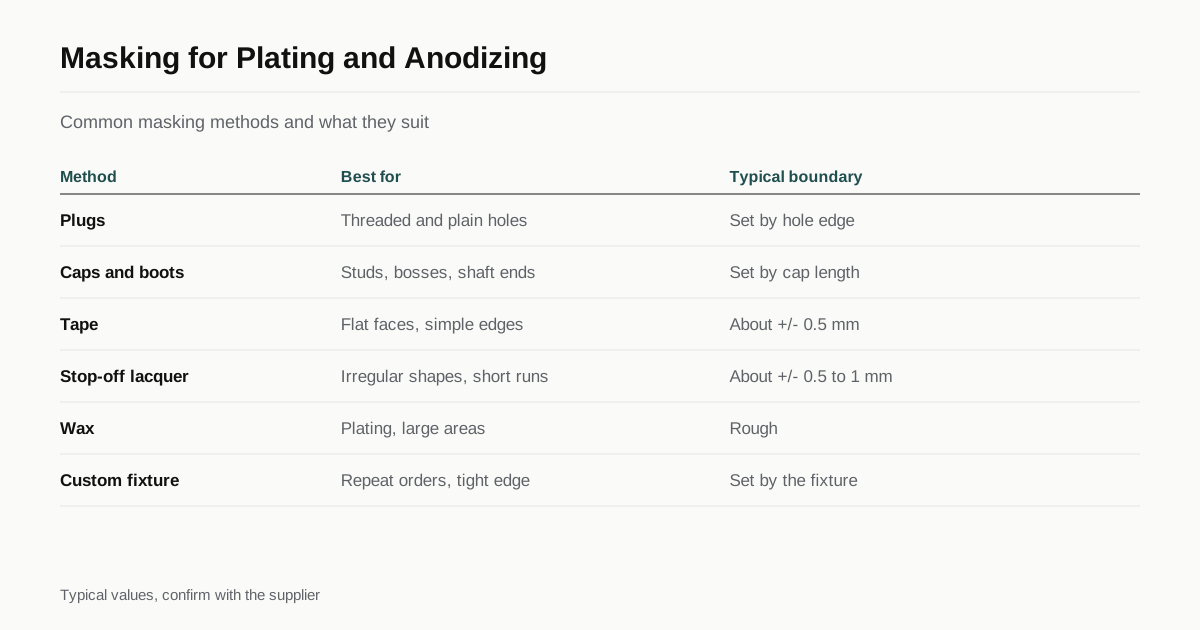
Masking is how you keep a coating off the places where it would cause a problem: a bearing bore that must stay on size, a thread that has to keep its fit, a grounding pad that must conduct. It looks like a small detail on a drawing and it is one of the larger cost and quality drivers on a plated or anodized part. A good masking call states what stays bare, how sharp the boundary must be and who pays for the labor.
Why parts get masked
Four reasons cover most requests.
- Dimensional. Plating and anodizing add thickness. A press-fit bore or a precision shaft that was machined to final size will not fit after coating unless it is masked.
- Electrical. Anodizing is an insulator. A contact or ground surface must stay bare aluminum. Plated contact areas may need to be bare on one side and plated on the other.
- Functional. Weld zones, bonding surfaces and sealing faces often have to be uncoated.
- Process. Some areas should not be plated for cost reasons, such as a precious metal plated only on the contact tip.
The main masking methods
| Method | Best for | Typical boundary | Watch for |
|---|---|---|---|
| Rubber or silicone plugs | Threaded and plain holes | Set by hole edge | Wrong size leaks, blind holes trap solution |
| Caps and boots | Studs, bosses, shaft ends | Set by cap length | Needs one cap size per feature |
| Tape (polyester, polyimide, vinyl) | Flat faces, simple edges | About plus or minus 0.5 mm | Edge lift on curved or rough surfaces |
| Stop-off lacquer | Irregular shapes, short runs | About plus or minus 0.5 to 1 mm | Brush or dip variation, removal by peeling or solvent |
| Wax | Plating, large areas | Rough | Must be fully removed afterward |
| Custom fixture | Repeat orders, tight boundary | Tighter, set by the fixture | Tooling cost up front |
Boundary values are typical, not promised. A shop that runs a masking fixture daily will do better than one that masks your part by hand once.
Masking for anodizing
Anodizing needs electrical contact with every part, so the rack touches the part somewhere and leaves a mark. That contact point is itself a form of masked area, and it is worth naming on the drawing. Acid-resistant tape and plugs are standard. Because the bath is sulfuric acid, masking materials must be rated for it, and lacquer is used less often than plugs and tape.
A threaded hole on an anodized part is usually either plugged or left unmasked. If you leave it open, Type II growth is small enough that many standard threads still assemble, but Type III hardcoat will tighten a thread noticeably. See Type II and Type III anodizing vendor selection for growth figures, and thread fits after plating for the allowance side. For where masking sits in the anodizing decision path, see our guide to aluminum anodizing.
Masking for plating
In electroplating, the plating bath will deposit onto any exposed conductive surface, and the current distribution means edges and corners collect more. Masking in plating therefore also has a second job: it shields areas from current as much as from solution.
Electroless nickel does not use current, so masking only has to block solution. That makes it easier to mask than electroplating, although the same materials are used. The bath is also hot, commonly around 85 to 95 °C, so tape adhesive and lacquer must tolerate heat.
Hardened steel parts that are plated need a relief bake. Masking does not change that, and the bake can lift tape or soften some lacquers, so say on the drawing if the part is hardened and the order of operations matters. See hydrogen embrittlement relief bake for the full picture.
Removal and cleanliness
Masking is not finished when the coating is. The material has to come off without damaging the finish or leaving residue, and that step is where many parts get scrapped.
- Tape can leave adhesive on the surface. On a part that will be bonded, sealed or cleaned for a clean room, residue is a defect, so say so up front and let the shop choose a low-residue tape.
- Lacquer is peeled or dissolved. Peeling can lift the edge of the coating if the film was thick, and solvent removal needs a rinse step afterward.
- Plugs can leave a witness ring on a hole edge, which is cosmetic unless the edge is a sealing face.
- Wax needs a hot strip or solvent step and a final clean. Any wax left in a thread will show up as a failed fit or a stained assembly.
If the part goes to a later process such as painting, bonding or welding, the masked surface usually needs to be clean and dry, and some shops will add a light wipe or an ultrasonic rinse for an extra charge.
Edge quality at the boundary
Where the mask ends, the coating also ends, and the edge there is rarely square. On anodized parts the oxide thins out toward the boundary, so a 25 µm layer may taper over a fraction of a millimeter. On plated parts a thin feather edge can lift in service if the mask was cut on a rough surface. Two habits help:
- Put the boundary on a natural feature such as a shoulder, a groove or a hole edge, not in the middle of a flat face.
- Give the shop a tolerance you can live with. A boundary tolerance of plus or minus 1 mm costs less than plus or minus 0.2 mm, and many parts do not need the tighter figure.
Typical masking mistakes
- Marking a thread as masked but not saying which end of a blind hole needs the plug.
- Leaving “mask all holes” on the drawing when only the through holes matter.
- Specifying a tight boundary on a casting with a rough surface.
- Forgetting that the rack contact point is also a bare spot.
- Changing the masked area between the first article and the production order.
Alternatives to masking
Sometimes the cleaner answer is to avoid masking.
- Machine after coating. Leave extra stock on the feature, coat the whole part, then machine the surface to size. This works when the coating is thin and the machining is easy.
- Selective plating. Brush plating or selective tank plating puts metal only where you want it. It suits precious metal on contact tips.
- Change the design. A relief groove at the edge of a masked area makes a clean boundary without a tight tolerance.
- Accept the growth. For thin Type II anodizing or thin zinc, the growth may fit inside the tolerance and masking is not needed.
Cost drivers
Masking is mostly labor, so the price follows count and complexity.
- Number of features per part and number of parts.
- Size of holes, since small holes are slower.
- Whether the shop already owns plugs and caps in that size.
- Whether a custom fixture is worth building for a repeat order.
- Inspection of the boundary after removal.
Our guide to plating and coating cost shows how masking sits among other drivers. A common mistake is to quote only the coating and then be surprised by a separate masking line.
How to show masking on a drawing
Clear callouts reduce disputes more than any other step.
- Mark masked surfaces with a hatch or a note such as “MASK, no coating”.
- Say whether the boundary has a tolerance, for example plus or minus 0.5 mm.
- State whether tolerances are before or after coating.
- Name any area where a rack mark is acceptable.
- Name any area where tape residue or lacquer residue is not acceptable.
- For threads, give the thread class after coating, not only before.
What to put on the RFQ
Send the drawing with masked areas highlighted, the base material, the finish and spec, lot size and whether you will accept machining after coating. The coating RFQ checklist lists the rest. Shops can then say honestly whether they mask by hand, by plug or by fixture.
How we help
We are a matching service, not a plating shop. Send one RFQ with masked areas marked and we pass it to up to 3 shops that handle that kind of masking. Replies come within 24 business hours. Start with the RFQ form.
Frequently asked questions
How sharp is the edge of a masked area?
Not perfectly sharp. Tape and lacquer leave an edge that can wander by a fraction of a millimeter, and plating can creep under a poor seal. Most shops hold a boundary of about plus or minus 0.5 mm on manual masking. If your boundary is tighter than that, say so on the drawing so the shop can use a fixture or machine the area after coating.
Can the shop mask threads and blind holes?
Yes, with threaded or tapered rubber and silicone plugs sized to the hole. Blind holes need a plug that seals, because trapped solution can leak out later and stain or corrode. Very small holes under about 2 mm are slow to plug and are often priced per hole.
Is masking charged separately?
Usually yes. Masking is manual labor before and after the process, so shops either price it per part, per hole or as a setup. Parts with many masked features can cost more to mask than to coat.
Need a quote for this finish?
Send the drawing. We match you with up to 3 finishing shops that run your spec and reply within 24 business hours.
Get matched with a coating shop