Guides / Specs
RoHS and REACH Compliance for Plated and Coated Parts: What to Ask For and What the Tests Show
November 7, 2026
For a plated or coated part that goes into electrical or electronic equipment, RoHS asks one question per layer: does any layer carry more than 0.1 percent hexavalent chromium or lead, or more than 0.01 percent cadmium, by weight. REACH asks a different one about the whole article: is any substance on the Candidate List present above 0.1 percent. The short answer for buyers: the finish chemistry decides the outcome, so name the chemistry on the drawing, ask the shop for a written declaration per finish and require a test report when the risk is real.
This guide covers the limits, the finishes that trip them, the lead exemptions that matter for substrate metals, the tests and the documents to ask for. It is general information for buyers, not legal advice. Your customer’s compliance team has the final word on what their product needs.
Two laws, two questions
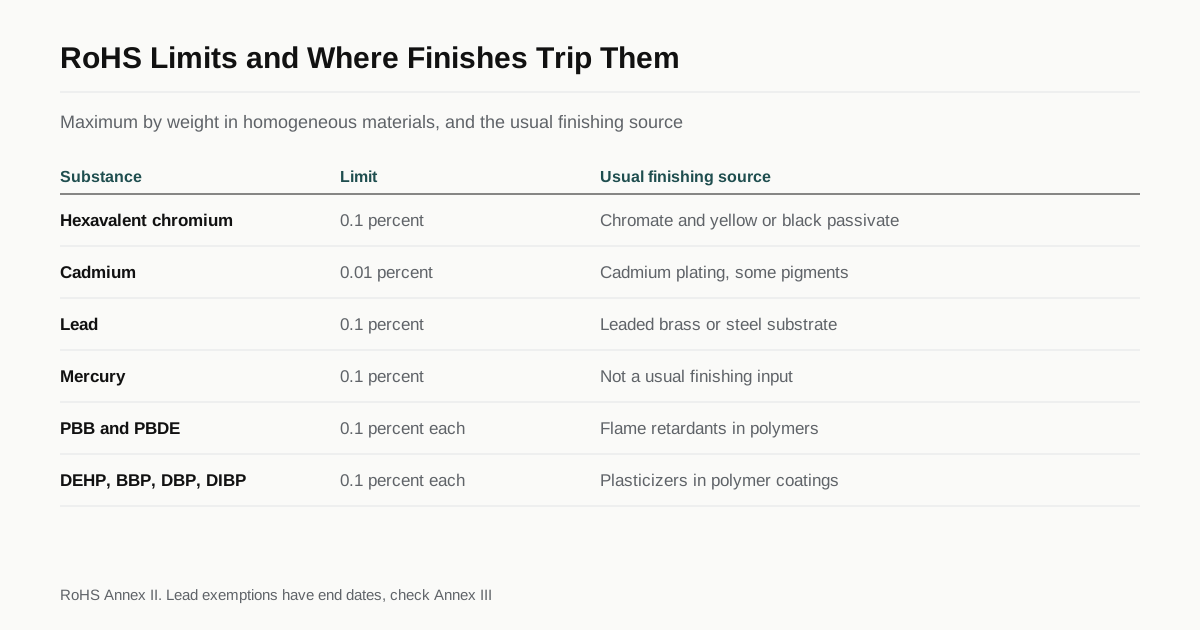
RoHS (Directive 2011/65/EU) restricts substances in electrical and electronic equipment, including cables and spare parts. The maximum concentrations by weight in homogeneous materials are:
| Substance | Limit |
|---|---|
| Lead | 0.1 percent |
| Mercury | 0.1 percent |
| Cadmium | 0.01 percent |
| Hexavalent chromium | 0.1 percent |
| PBB and PBDE flame retardants | 0.1 percent each |
| Four phthalates (DEHP, BBP, DBP, DIBP) | 0.1 percent each |
The four phthalates were added by Directive (EU) 2015/863 and apply from 22 July 2019, with medical devices and monitoring and control instruments following on 22 July 2021. A homogeneous material is a material of uniform composition throughout, or a combination that cannot be separated into different materials by mechanical actions such as unscrewing, cutting, crushing, grinding or abrasive processes. In practice labs treat a plated layer as its own material, since abrasive processes can remove it from the base, and test it apart from the substrate. The directive leaves the detailed rules for surface coatings to a delegated act, so confirm the interpretation your customer uses.
REACH (Regulation (EC) 1907/2006) works on articles in general, not only electronics. Under Article 33, a supplier of an article that contains a Candidate List substance above 0.1 percent by weight must give the recipient enough information for safe use, at minimum the substance name. A consumer can ask for the same information, and the supplier must provide it free of charge within 45 days. ECHA’s Candidate List stood at 253 entries after the update of 4 February 2026, and it is revised about twice a year, so the list you checked last year is out of date.
Which finishes put a restricted substance on the part
| Substance | Where it comes from in finishing | Cr(VI)-free or lead-free route | Guide |
|---|---|---|---|
| Hexavalent chromium | Chromate conversion coat, yellow or black passivate, chromic acid anodize sealers | Trivalent passivate, trivalent conversion coat | Trivalent passivates on zinc, chromate conversion coating |
| Cadmium | Cadmium plating, some pigments | Zinc-nickel, other cadmium replacements | Cadmium replacement options |
| Lead | Leaded brass or free-cutting steel substrate, some solder and tin finishes | Lead-free alloys, pure tin or other finishes | See the exemption table below |
| Phthalates | Polymer-based coatings, dips and sealers that use plasticizers | Plasticizer-free formulations | Ask for the coating data sheet |
Two points often missed. First, a hexavalent passivate puts Cr(VI) on the surface of the part, which is what RoHS tests. Hard chrome is different: the deposit is chromium metal and the Cr(VI) sits in the bath, as the EU chromium(VI) restriction guide explains. Second, a bath chemical being on the Candidate List does not by itself put the part over 0.1 percent. Boric acid, for example, is on the list as toxic for reproduction and is widely used as a pH buffer in nickel baths. Article 33 looks at the article, so the question for the shop is what remains on the finished part, not what is in the tank.
Lead in the base metal: the exemptions with end dates
Lead usually comes from the substrate, not the plating. RoHS Annex III exempts lead as an alloying element in some metals, and those exemptions were renewed with short validity by Delegated Directive (EU) 2025/2364, published 21 November 2025. The expiry dates in the text are:
| Annex III entry | What it covers | Expires |
|---|---|---|
| 6(a) | Steel for machining and galvanised steel, up to 0.35 percent lead | 11 December 2026 |
| 6(b) | Aluminum, up to 0.4 percent lead | 11 June 2027 |
| 6(c) | Copper alloy, up to 4 percent lead | 30 June 2027 |
Sub-entries such as 6(a)-I, 6(a)-II and 6(b)-I to 6(b)-III carry their own dates, some of which differ by equipment category. The exemptions also exclude equipment for the general public that children may place in the mouth. These dates are volatile. Treat the table as the position in October 2026 and confirm each entry in the Official Journal with your customer before you rely on it, especially for leaded brass parts that will be plated.
Tests: what they show and what they miss
Hexavalent chromium on a coating. IEC 62321-7-1 is a boiling water extraction that gives a qualitative result for Cr(VI) in colorless and colored corrosion-protection coatings on metal. A result below 0.10 micrograms per square centimeter is negative and above 0.13 is positive. The band between is a grey zone, and the standard notes additional testing may be needed. A single sample may not represent a lot, so ask how many samples were tested and when.
Lead, cadmium and mercury. These are measured by chemical analysis of the layer or the base, usually after an XRF screening. Screening is fast but a result near the limit goes to wet chemistry. The coating thickness guide explains what XRF can and cannot tell you about a thin layer.
What a test cannot do. It reports on the sample you sent. A passing report on a trivalent passivate does not cover the next lot if the shop changes chemistry or adds a yellow dip for a different customer.
Documents to ask the shop for
- Process chemistry statement per finish. For example, “zinc plate, trivalent passivate, trivalent sealer, no hexavalent chromium used at any step”.
- RoHS and REACH declaration for the finished part, naming the finish and the part number, signed by someone who can stand behind it.
- Test reports from an accredited laboratory for the substances that matter, with the date, the sample description and the method.
- Candidate List statement. A yes or no on whether any listed substance exceeds 0.1 percent in the finished article, and the substance name if yes.
- Change notice commitment. The shop tells you before it changes a chemistry, sealer or supplier of a bath additive.
What to put on the drawing and the RFQ
- The finish and its spec, plus the sentence “no hexavalent chromium, cadmium or lead added in any process step” where the product is under RoHS.
- The base metal grade, so the shop knows if the substrate carries lead. Free-cutting steel and leaded brass both do.
- The compliance format your customer uses, if any, so the shop fills in the right form.
- The market you sell into, since a US or Asian customer may add rules of their own.
- A line asking each shop to flag any process step they cannot declare.
Compare shops on the answers, not only the price. The questions to ask a plating shop is a useful companion list.
See also: Coating rules for parts sold in the EU.
How we help
We are a matching service, not a plating shop. Send your drawing, base material, finish callout and the compliance documents your customer requires, and say that you need RoHS and REACH declarations. We pass the RFQ to up to three finishing shops that can supply them, and you receive a reply within 24 business hours. Start with the RFQ form.
Sources
- Directive 2011/65/EU (RoHS), EUR-Lex (Annex II limits, homogeneous material, Annex III)
- Directive (EU) 2015/863, EUR-Lex (four phthalates)
- Delegated Directive (EU) 2025/2364, EUR-Lex (lead exemptions 6(a), 6(b), 6(c))
- IEC 62321-7-1:2015, IEC webstore (Cr(VI) in metal coatings)
- REACH Article 33, reachonline.eu (0.1 percent, 45 days)
- iPoint: SVHC update February 2026 (Candidate List count)
- Technic: Understanding REACH and the plating industry (boric acid)
See also how to test for hexavalent chromium on plated parts.
Frequently asked questions
Does RoHS apply to my plated part?
RoHS applies to electrical and electronic equipment placed on the EU market, including cables and spare parts. A plated bracket or screw that goes into such equipment is covered, and your customer will pass the limits down to you. A part for a machine or vehicle that is not electrical equipment falls under other rules, though REACH still applies to the article.
Is the RoHS limit measured on the whole part or on the coating?
On each homogeneous material. A plated layer can be separated from the base metal by abrasive processes, so in practice labs test the layer and the substrate separately. A part can fail on its coating even when the base metal passes, which is why the finish chemistry belongs on the declaration.
What is the REACH 0.1 percent rule for articles?
If an article contains a substance on the REACH Candidate List above 0.1 percent by weight, the supplier must give the recipient enough information for safe use, at minimum the substance name. Consumers can ask for the same information and the supplier must answer free of charge within 45 days.
Which test shows hexavalent chromium on a coating?
IEC 62321-7-1 describes a boiling water extraction that qualitatively detects Cr(VI) in colorless and colored corrosion-protection coatings on metal. A result below 0.10 micrograms per square centimeter is negative, above 0.13 is positive, and the band between is a grey zone that needs further testing.
Need a quote for this finish?
Send the drawing. We match you with up to 3 finishing shops that run your spec and reply within 24 business hours.
Get matched with a coating shop