Guides / Specs
What the PFAS Restrictions Mean for PTFE-Coated Parts and Your RFQ
November 6, 2026

PTFE, the polymer behind most non-stick and low-friction coatings on metal, is a PFAS. The short answer for buyers: no EU-wide ban on PTFE-coated parts is in force today, the universal restriction is still moving through ECHA and the Commission, and the practical risk now sits with your customer’s PFAS policy and with state laws such as Minnesota’s. Write the PFAS question into your drawings and RFQs now, so a later change does not force a requalification under deadline.
This guide covers where the EU process stands at the start of October 2026, the US rules that already apply, which coatings on metal parts contain PFAS, and what to ask a finishing shop. It is general information, not legal advice. Your customer’s compliance team has the final word.
Why PTFE is covered
PFAS is a class of fluorinated chemicals. The State of Minnesota’s definition, one of the most widely copied, covers any substance with at least one fully fluorinated carbon atom. PTFE (polytetrafluoroethylene) is built from a chain of carbon atoms fully loaded with fluorine, and Wikipedia’s PTFE article states that PTFE and its production chemicals are PFAS. That is why the usual line “PTFE is stable and safe in use” does not remove it from the rules: the proposals regulate the whole class, including the manufacture and end of life, not only the finished coating.
The properties that make PTFE useful on metal are the reasons it is hard to replace. It has a friction coefficient of about 0.05 to 0.10 against polished steel, it is chemically inert, and it holds up to roughly 260 °C before it starts to deteriorate. It is used as a non-stick coating on cookware, and on valve and seal parts that handle aggressive chemicals.
Where the EU restriction stands
Five member states submitted the universal PFAS restriction dossier in 2023 and a revised proposal in 2025. ECHA’s two scientific committees have worked through it since:
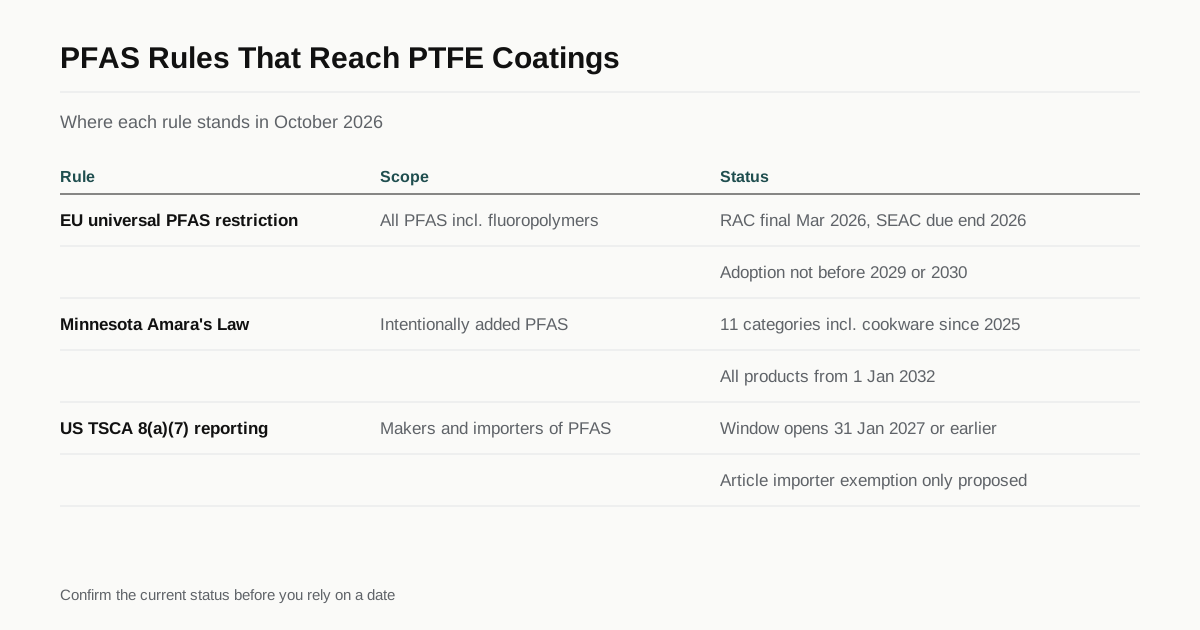
- 2 March 2026: the Risk Assessment Committee (RAC) adopted its final opinion, which favours a group-wide restriction.
- 26 March 2026: ECHA published the RAC final opinion together with the draft opinion of the Socio-Economic Analysis Committee (SEAC), opening a consultation that ran to 25 May 2026.
- End of 2026 (expected): SEAC adopts its final opinion. The European Commission then prepares a legislative proposal with the member states.
Law firm summaries of the committee documents give the main shape of the draft. Restriction option 1 is a full ban with an 18-month transition. Option 2 is a ban with the same transition plus time-limited derogations for specific uses, and SEAC sees option 2 as the more appropriate in principle. Where a derogation is granted, additional transition periods of 5 or 12 years are discussed, tied to how strong the evidence on alternatives is. According to Linklaters’ reading of the SEAC draft, the committees do not support a derogation for fluoropolymers and volatile PFAS as a group, and SEAC doubts that the dossier’s site-specific management plans for fluoropolymers are practical. Keller and Heckman expect the final regulation no earlier than 2029 or 2030, followed by a further transition or sell-off period.
Treat that as direction, not law. The text can change at any of the steps still ahead, and the sector assessments differ in how much derogation they allow. The reliable planning assumption is that PTFE will not stay a free choice for every use in the EU, and that the date is years away rather than months.
US rules that already apply
Two US rules matter for buyers who sell into or import for the US market.
Minnesota. Since 1 January 2025, intentionally added PFAS are banned in 11 product categories, and cookware is one of them. The Minnesota Pollution Control Agency treats a product as cookware when it carries a non-stick coating that contains intentionally added PFAS, and says no exceptions or extensions apply to the 2025 categories. From 1 January 2032 the ban extends to all products with intentionally added PFAS unless the use is judged a currently unavoidable use. The agency defines intentionally added PFAS as PFAS added deliberately to perform a specific function, such as water resistance on a jacket. A PTFE layer applied for release or low friction is a deliberate function.
Federal reporting. The EPA’s TSCA section 8(a)(7) rule asks manufacturers and importers to report PFAS they made or imported between 2011 and 2022. EPA proposed in November 2025 to exempt imported articles, a 0.1 percent de minimis level and several other items, but that exemption is not final. The reporting period is now set to start on 31 January 2027, or 60 days after the final revisions take effect if that comes earlier. If you import coated parts into the US, ask your customs or compliance adviser whether you are a reporter.
Both rules are moving, so confirm the current text before you rely on a date.
Which finishes on metal parts contain PFAS
PTFE topcoats and dry-film lubricants are the obvious case, but the question is wider than one coating. Check each of these with the shop:
- Fluoropolymer topcoats and primers applied to steel or aluminum for release, low friction or chemical resistance.
- Composite and impregnated finishes where fluoropolymer particles or a fluoropolymer sealer is added to a metal or anodic layer. Ask whether the sealer or impregnation step uses one.
- Process additives. Hexavalent chrome baths need a fume suppressant. The National Association for Surface Finishing says current suppressants use a short-chain PFAS, 6:2 fluorotelomer sulfonate, and that the industry is working toward processes that need no PFAS at all, with trivalent chrome named as one route. Your finished part may carry no PFAS even when the bath that made it did, so ask about the part and the process separately. The trivalent versus hexavalent chrome comparison covers the chrome side.
PFAS-free options by job
Pick the replacement from what the PTFE does on the part, not from the coating name. None of these is a drop-in match, and each needs your own test data.
| Job the PTFE does | Options to qualify | What to check |
|---|---|---|
| Sliding wear on aluminum | Hard anodize | Friction in your pairing, sealing, dimensional growth. See Type II and Type III anodizing vendor selection |
| Low friction on hardened steel | PVD such as DLC, electroless nickel | Process temperature, coating thickness, fit. See PVD coatings explained |
| Abrasion and wear in general | Hard anodize, nitriding, hard chrome | Substrate, load, regulatory status of the process. See wear surfaces compared |
| Corrosion barrier with some lubricity | Zinc-nickel with a lubricated sealer, electroless nickel | Salt spray, torque-tension on fasteners |
| Non-stick release (food equipment, molds) | Non-fluoropolymer release coatings, polished or hard-coated surfaces | Food-contact status, cleaning cycle, service life |
The honest summary: where PTFE’s very low friction is the actual requirement, a replacement may give higher friction or shorter life, and that is a design decision, not a finishing detail.
What to put on the drawing and the RFQ
- State the requirement you actually have. A friction range, a wear life, a release behavior or a temperature limit, with the test method. Let the shop propose finishes that meet it.
- Define PFAS in the note. For example: “No intentionally added PFAS in the coating, sealer or impregnation. PFAS as defined by [your customer standard].” Use your customer’s definition word for word.
- Ask for layer-by-layer declarations. Topcoat, primer, impregnation, composite particles, process additives. A written yes or no for each, with safety data sheets.
- Separate the part from the process. Ask what is on the finished part and what is used in the bath or line.
- Plan the qualification. A new finish needs first articles and your own tests. The coating RFQ checklist lists the other fields the shop needs.
- Keep the dates in view. SEAC’s final opinion at the end of 2026 and the EPA final rule are the next markers.
Before you commit a program, the questions to ask a plating or coating shop is a useful second list.
How we help
We are a matching service, not a coating shop. Send your drawing, base material, the job the current PTFE coating does and the market you sell into, and say that you need a PFAS-free option. We pass the RFQ to up to three finishing shops that run the relevant processes, and you receive a reply within 24 business hours. Start with the RFQ form.
Sources
- Wikipedia: Polytetrafluoroethylene (properties, PFAS status)
- Linklaters: EU universal PFAS restriction process enters its decisive phase (RAC and SEAC dates, options, fluoropolymers)
- Keller and Heckman: PFAS restrictions advance, EU regulatory framework takes shape (timeline to adoption)
- Minnesota Pollution Control Agency: PFAS use prohibitions
- Bergeson and Campbell: EPA postpones start of TSCA 8(a)(7) PFAS reporting (reporting start date, proposed article exemption)
- NASF: PFAS replacement chemicals (fume suppressants, trivalent route)
Frequently asked questions
Is PTFE banned in the EU?
Not today. PTFE is a fluoropolymer and counts as a PFAS, and it falls inside the proposed EU universal PFAS restriction. That proposal is still being assessed by ECHA's committees, and law firm summaries expect adoption no earlier than 2029 or 2030, with transition periods after that. Until then, individual customers and national rules are the practical constraint.
Does the PFAS restriction ban PTFE-coated metal parts outright?
The rule is not final, so nothing is banned yet by the EU proposal. The draft options are a full ban with an 18-month transition or a ban with time-limited derogations for specific uses. Which uses get a derogation is exactly what is still open, so a part used in a regulated or safety-critical product may be treated differently from a consumer item.
How do I know if a coating or finish contains PFAS?
Ask the shop for a written yes or no for each layer and chemical: topcoat, primer, impregnation, composite particles and process additives. Request the safety data sheet and the supplier's declaration. Name the definition you use, for example any substance with at least one fully fluorinated carbon atom, so the answer matches your customer's.
Is there a PFAS-free coating that matches PTFE friction?
Not as a general drop-in. PTFE runs at roughly 0.05 to 0.10 friction coefficient against polished steel, among the lowest of any solid. Hard anodize, DLC and electroless nickel can cover wear and sliding jobs, but each needs a test on your part. Qualify with your own friction, wear and temperature data.
Need a quote for this finish?
Send the drawing. We match you with up to 3 finishing shops that run your spec and reply within 24 business hours.
Get matched with a coating shop