Guides / Finishes
Finishes for Medical Device Parts: From Passivation to Anodize and PVD
October 25, 2026
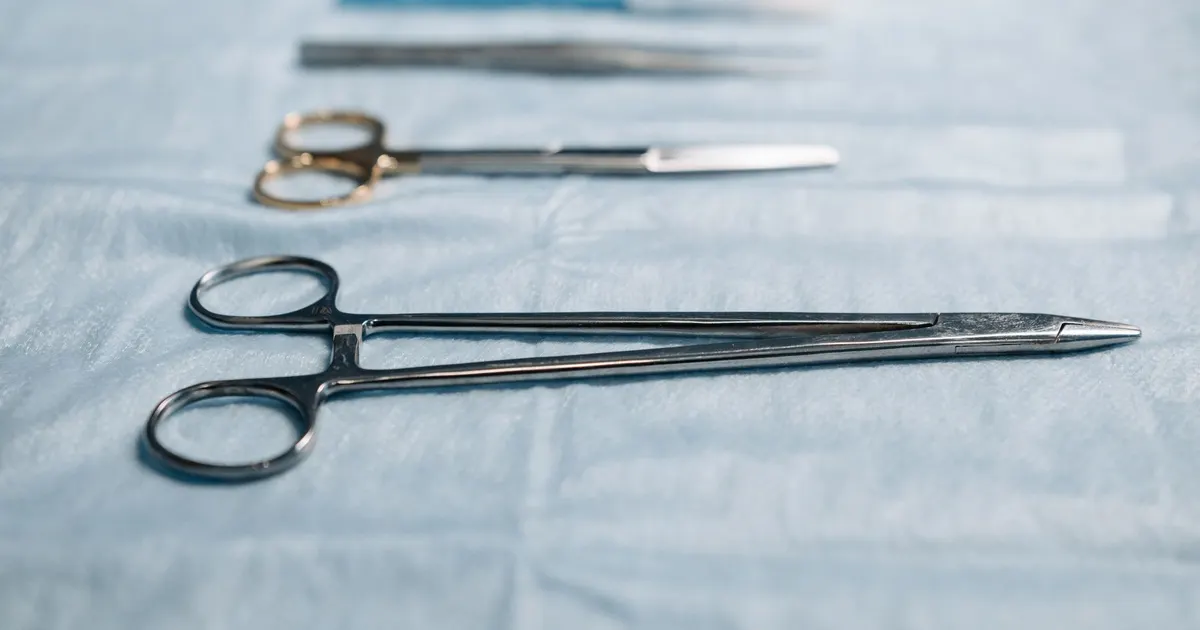
A coating on a medical part has to do two jobs at once: protect the metal and stay out of the way of the patient and the cleaning process. That pushes choices toward a short list of finishes with a long track record on stainless steel, titanium and aluminum. This guide covers what each finish does, what it cannot do and what to state on an RFQ. It is general information for buyers, and the device maker’s quality system and regulatory file decide what is actually acceptable for a given device.
What medical parts ask of a finish
Several demands appear again and again.
- Corrosion resistance after many cleaning, disinfection and sterilization cycles.
- Cleanability. Smooth surfaces without crevices release soil and bioburden more easily.
- No release of harmful material. Coatings should not flake, shed particles or leach.
- Identification. Colors and markings help staff tell instruments or sizes apart.
- Consistency and records. Lot traceability and process records matter more here than in most industries.
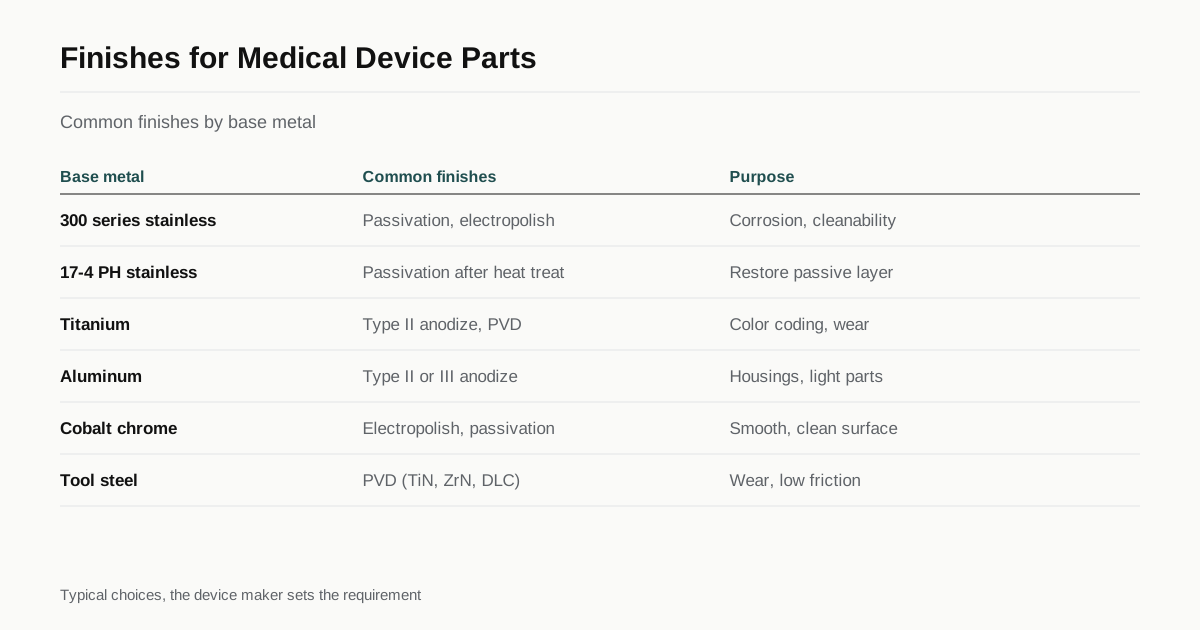
Finish options by base metal
| Base metal | Common finishes | Purpose |
|---|---|---|
| 300 series stainless (303, 304, 316L) | Passivation, electropolish | Corrosion resistance, cleanability |
| 17-4 PH and other hardenable stainless | Passivation after heat treat | Restore passive layer |
| Titanium (Ti-6Al-4V, CP grades) | Type II anodize, passivation, PVD | Color coding, wear, appearance |
| Aluminum | Type II or III anodize | Housings, handles, light instruments |
| Cobalt chrome | Electropolish, passivation | Smooth, clean surface |
| Tool steel and hard parts | PVD (TiN, ZrN, DLC) | Wear, low friction |
Passivation of stainless steel
Passivation is an acid treatment, most often with citric or nitric acid, that removes free iron and surface contaminants from machined stainless steel and lets the chromium oxide layer re-form. ASTM A967 covers chemical passivation treatments, and ASTM A380 covers cleaning and descaling. The process does not change dimensions or appearance in a noticeable way. Passivation matters after machining because tools leave iron particles in the surface that can rust.
Testing options include a copper sulfate test, a high humidity test and a salt spray test as set by the specification, with the result and the test method named on the certificate. For a comparison with electropolish, read passivation vs electropolish.
Electropolish
Electropolish removes a thin layer, about 5 to 25 µm, from the surface, smoothing peaks and burrs and leaving a bright, clean finish. It is common on stainless steel instruments, tubing and implants for cleanability. ASTM B912 covers passivation of stainless steel with electropolishing. It does not rescue a rough surface, so good machining and deburring still matter.
Titanium anodizing
Type II anodizing of titanium is an electrochemical process that grows a thin oxide layer whose thickness controls its interference color. Voltage sets the color, from gold through blue, purple and green. No dye is used. AMS 2488 covers it for aerospace, and the process is also widely used on medical titanium to color-code screws, instruments and drill sizes.
The oxide is thin, on the order of 0.05 to 0.3 µm, and adds essentially no dimension. It improves wear modestly and gives a durable color. Titanium alloys give consistent colors on repeated lots when the process is controlled. Color varies with alloy, surface finish and lighting.
Aluminum anodizing for devices
Anodized aluminum is common in device housings, handles, covers and some surgical tools. Type II gives color and moderate protection, and Type III gives wear resistance. For thickness, sealing and alloy effects, see Type II and Type III anodizing vendor selection and anodizing 6061, 7075 and cast aluminum.
The weak point is chemical cleaning. Alkaline washer-disinfector detergents with high pH can attack the oxide and aluminum underneath, and dyes can fade after many cycles. If the device is reprocessed in strong detergents, ask the shop about seal type and expected lifetime, and test a coupon under the real cleaning regime.
PVD coatings
PVD coatings such as titanium nitride, zirconium nitride and diamond-like carbon give hard, low-friction thin films on instruments, cutting tools and wear parts. Colors are gold, black, gray and others. See PVD coatings explained for thickness and process temperature details. PVD can be applied to stainless steel and titanium and is usually thin enough to maintain edge geometry on sharp instruments.
Coatings to be careful with
- Nickel plating on skin-contact parts. Nickel is a common allergen, and some markets restrict nickel release from items that touch skin. Check requirements before specifying a nickel-bearing finish.
- Cadmium and hexavalent chromium. Do not use them on device parts.
- Black oxide, zinc and other plated finishes are generally not for patient-contact or reusable devices, since they corrode or shed in steam and detergents.
- Dyed finishes on reusable instruments may fade under repeated reprocessing.
If a finish is not on the device maker’s approved list, ask the design owner before specifying it.
Surface condition before finishing
A finish can only be as good as the surface it covers, and medical parts are held to a high standard here.
- Machining residue. Cutting oils, polishing compounds and fingerprints must be removed before passivation or anodizing. Many shops run an ultrasonic degrease first.
- Embedded particles. Iron from steel tools or grit from blasting can embed in stainless steel and titanium. Passivation removes free iron but not embedded abrasive.
- Burrs and sharp edges. Burrs trap soil and give anodic films and PVD an uneven start. Deburr and edge-break to a stated radius before finishing.
- Surface roughness. Many device files set a roughness limit, such as Ra 0.8 µm or lower, on patient-contact surfaces. Electropolish and fine finishing reduce roughness but do not repair deep scratches.
- Heat tint. Weld areas and laser marks leave oxide that must be removed, normally by pickling or electropolish, before passivation.
State these conditions in the RFQ. They change the process route and the price.
Laser marking and identification
Many devices carry unique device identification marks. Laser marking and etching change the surface locally, and the finishing sequence matters. Passivation after marking restores the passive layer in the marked area on stainless steel. Anodizing of titanium can be done before or after marking, and the choice changes the mark’s contrast. Anodize first and laser through the oxide gives a high-contrast mark on colored parts. Tell the shop the marking method and when it happens.
Cost drivers
Medical finishing costs more than general industrial finishing for several reasons: tighter documentation, small lots, lot segregation, cleaner handling and more inspection. Driver list:
- Quantity per lot and the number of different part numbers.
- Documentation and traceability depth.
- Roughness and cleanliness requirements.
- Racking, since parts often cannot show contact marks.
- Test coupons run with each lot.
- Re-work policy, since some finishes cannot be stripped and redone without dimensional change.
See plating and coating cost for the wider picture.
Sterilization and reprocessing
Steam autoclave cycles at 121 to 134 °C, ethylene oxide, hydrogen peroxide plasma and gamma radiation each stress coatings differently. Steam and high humidity attack zinc and bare carbon steel. Strong oxidizers can pit stainless steel. Gamma can fade some dyes and darken some plastics. Match the finish to the sterilization method named in the device file, and test coupons through the real cycle count.
Cleanliness and documentation
Medical buyers usually expect process records. Typical requests include a certificate of conformance listing the specification, the material and the lot, the passivation or anodizing batch record, test results and any lot traceability back to the raw material. Some buyers also ask whether a shop works under a medical quality system. We make no claim that any shop holds one. Ask each shop directly and request evidence if the device file needs it.
Packaging and handling matter too. Parts leave the line in clean bags or trays, handled with gloves. If parts must arrive free of oils and particles, state the cleanliness requirement and the test, for example a visual inspection under magnification or a residue test.
What to put on the RFQ
- Base material, grade and heat treat condition.
- Finish and specification, such as ASTM A967 passivation, ASTM B912 or AMS 2488.
- Surface roughness requirement before finishing.
- Color or identification needs, with a sample if possible.
- Sterilization and cleaning methods the part will meet.
- Documentation, traceability and record retention needs.
- Restricted materials, such as nickel release limits.
- Lot size and drawing.
For more on what to include in an inquiry, see the coating RFQ checklist.
How we help
We are a matching service, not a finishing shop, and we do not hold or claim medical certifications for any shop. Send one RFQ with the finish, specification and documentation needs and we pass it to up to 3 shops that run these processes. Replies come within 24 business hours. Start with the RFQ form.
See also the specification reference for ASTM A967 and AMS 2700 passivation.
See also ISO 13485 and medical device finishing suppliers.
Frequently asked questions
Which finish is standard for stainless steel surgical instruments?
Passivation per ASTM A967 or A380 is the most common baseline. It removes free iron from the surface and restores the passive layer. Electropolish is added where a smoother, easier-to-clean surface is wanted. The device maker sets the exact requirement in its own specifications.
Can anodized aluminum go through repeated autoclave and washer cycles?
It depends on the washing chemistry. Strong alkaline detergents attack aluminum and its oxide and fade dyes. Steam sterilization alone is easier on it. For reusable instruments that see harsh washers, stainless steel or titanium is the safer base, and anodized aluminum is usually kept for housings and covers.
Does a shop's finish make my device biocompatible?
No. Biocompatibility is a property of the finished device and is shown by the device maker through testing, for example against the ISO 10993 series. A finishing shop can supply process records and material declarations, and the device maker decides what testing the finish needs.
Need a quote for this finish?
Send the drawing. We match you with up to 3 finishing shops that run your spec and reply within 24 business hours.
Get matched with a coating shop