Guides / Finishes
Anodizing 6061, 7075 and Cast Aluminum: How Alloy Changes Color and Finish
October 16, 2026
Anodizing converts the surface of the aluminum itself into oxide. Because the coating grows out of the base metal, the alloy decides what it looks like and how it behaves. The same bath that gives a clean, clear finish on 6063 can give a dull, patchy or yellow-tinted result on 7075 and a mottled gray on a die casting. Choosing the alloy early, and naming it on the drawing, is the best way to avoid disappointment at the end of the line.
What alloying elements do
Pure aluminum anodizes cleanly. Alloying elements change the oxide in different ways.
- Magnesium and silicon (6xxx series) form a clean, uniform oxide and are the best for cosmetic work.
- Zinc (7xxx series) gives a slightly yellow or gray tint, and the oxide is a little less uniform.
- Copper (2xxx series, some 7xxx) leaves copper-rich particles that dissolve during anodizing and make the coating thinner, more porous and less corrosion resistant. It also darkens the surface.
- Silicon in large amounts (cast alloys) does not oxidize at all. The particles stay as inclusions and give the surface a gray, dull look.
- Manganese and iron add streaks and darker shades, which show in alloys such as 3003.
Alloy by alloy
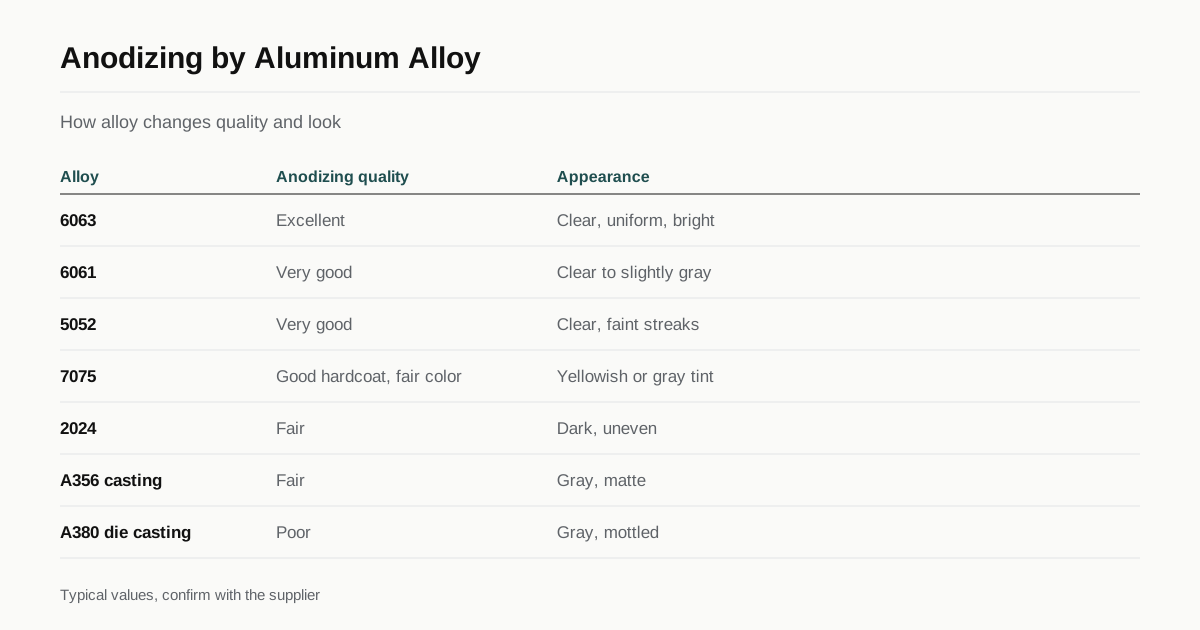
| Alloy | Anodizing quality | Appearance | Notes |
|---|---|---|---|
| 6063 | Excellent | Clear, uniform, bright | Extrusions, architectural parts |
| 6061 | Very good | Clear to slightly gray, takes dye well | Most machined parts |
| 5052 | Very good | Clear, can show faint streaks | Sheet, enclosures |
| 3003 | Fair | Slightly dark, streaky | Sheet, low cost |
| 7075 | Good for hardcoat, fair for color | Yellowish or gray tint | High strength parts |
| 2024 | Fair | Dark, uneven, lower thickness | Aerospace, needs care |
| A356 and similar low-silicon castings | Fair | Gray, matte | Sand and permanent-mold castings |
| A380 and A360 die castings | Poor | Gray, mottled, dull | Hardcoat usually not advised |
This is a typical picture. Individual lots and shops vary.
6061 and 6063: the reliable pair
6061 is the most common alloy for machined parts and anodizes consistently. It takes both Type II and Type III well. For bright colors and a matched look, 6063 from extrusions is a notch better. If a part is cut from 6061 plate, mill-finish plate often has surface variation, so many buyers specify a bead blast or a brushed finish before anodizing to even it out.
For thickness, growth and sealing of Type II and Type III, see Type II vs Type III anodizing.
7075: strong, harder to color
7075 is chosen for strength in aerospace, tooling, firearm and sporting parts. Its zinc and copper content gives the oxide a slight yellow or gray tint. Dyeing works but light and bright colors show a color shift and some blotchiness, and black is the safe choice. Hardcoat on 7075 works well, with a few cautions: the corners can burn if current concentrates there, and the coating at edges can chip, so a small edge radius helps.
Do not expect a 7075 part and a 6061 part dyed in the same bath to match. They will differ.
2024 and other copper alloys
2024 is a high copper alloy with good fatigue strength and poor corrosion resistance. Anodizing it needs more care. The coating tends to be thinner for the same cycle, less uniform and a darker gray. Aerospace programs use 2024 widely, and shops that handle it follow the process steps in MIL-A-8625. Do not choose 2024 for a cosmetic anodized part unless you can accept the look.
Cast aluminum
Castings are the hardest case, for two reasons.
- Silicon content. Die casting alloys such as A380 hold roughly 8 to 10 percent silicon, and A360 and A413 carry similar levels. Silicon does not anodize. The surface turns gray and dull, and the coating is thin and weak.
- Porosity. Gas and shrinkage pores near the surface trap cleaning solutions and anodizing electrolyte. Trapped acid can weep from the pores days or weeks later and stain the finish. Sealing helps, but it does not solve deep porosity.
Practical options for castings:
- Use a lower silicon alloy such as A356 or a permanent mold casting instead of a die casting.
- Accept a gray finish and specify it, or anodize black, which hides mottling.
- Ask for impregnation of the casting before anodizing to close porosity.
- Consider a different finish. Powder coat or electroless nickel handles castings better. See powder coating pretreatment and cure or electroless nickel phosphorus content.
Surface finish before anodizing
Anodizing is transparent. It shows the surface underneath, so finishing before anodizing is the biggest control on appearance.
- Machined finish. Shows tool marks. Fine for hidden parts.
- Bead blast. Gives a uniform matte surface that hides scratches. Common on consumer and tool parts.
- Brushed or satin. A directional finish, set before anodizing.
- Chemical etch. A caustic etch gives a satin look, with some material removal and dimension change.
- Bright dip. A chemical polish that gives a bright, reflective surface on suitable alloys.
Parts from different suppliers, or different material lots, should be finished to a common standard before anodizing if they are to match.
Dyeing: how much the alloy matters
Dye is absorbed in the pores of the oxide before sealing. Anything that changes pore structure changes the color. Three practical rules follow.
- Dark colors forgive more. Black, dark blue and dark red hide alloy and lot differences. Light blue, gold, red and clear show them.
- Thicker oxide takes more dye. A 25 µm Type II coating dyes darker than a 10 µm coating in the same bath. Keep thickness consistent across a set of parts.
- Sealing affects color. Hot water seal can bleed some dyes and nickel acetate seal shifts some shades. A shop will usually run a sample to confirm.
Organic dyes fade in sunlight, with reds and blues fading first. For outdoor or high UV use, ask about inorganic or electrolytic colors, which are more lightfast, or choose clear or black.
Machining and handling before anodizing
How a part is machined and handled before anodizing shows up afterward. Cutting fluids, heavy oils and fingerprints that are not removed leave marks. Mixed alloys on one rack, or parts of different thickness on the same rack, anodize at different rates. Tool chatter and scratches that look minor on bare metal become obvious after the oxide forms, since anodizing is transparent.
Welded aluminum is a special case. Weld filler alloy differs from the base metal, so the weld bead anodizes with a different color and often a dark or gray band along the weld. Welds on cosmetic parts are normally blended and the color difference is accepted or the part is painted instead.
Temper and lot variation
Even within one alloy, temper and rolling or casting history change the result. T6 and T651 behave similarly, but material from different mills and heat lots can show different shades after dyeing. For programs where color matching matters over time, buy material from one source and keep a reference sample. Mixing extruded and plate parts in one assembly is the most common cause of visible mismatch.
Common defects and their causes
- Burning at corners on hardcoat from excessive current density. Radius edges and ask for racking at corners.
- Streaks from rolling or extrusion lines in the alloy.
- Soft, powdery coating from a bath that is too warm or poorly controlled.
- Spotting and staining from trapped solution in holes and porosity.
- Color variation between lots, which is amplified in light shades.
What to put on the RFQ
- Exact alloy and temper, and whether it is extrusion, plate, bar or casting.
- Type and class per MIL-A-8625 or equivalent, with thickness.
- Color, with a sample or standard where match matters.
- Surface finish before anodizing, such as bead blast grit.
- Cosmetic areas and acceptable rack marks.
- Masked or threaded areas and critical dimensions.
- Lot size and drawing.
For thickness checks see coating thickness measurement, and for masking see masking for plating and anodizing.
The whole buying path, from alloy to specification and quote, is in our guide to aluminum anodizing.
See also: Type II sulfuric acid anodizing reference page.
How we help
We are a matching service, not an anodizing shop. Send one RFQ with the alloy and finish needs and we pass it to up to 3 shops that anodize that alloy. Replies come within 24 business hours. Start with the RFQ form or read which metal finish for your part.
Frequently asked questions
Which aluminum alloy anodizes best?
For appearance, 6063 and 6061 are the usual answers. They give a clear, uniform oxide that takes dye evenly. 5052 is also good. High copper alloys such as 2024 and high silicon castings give duller, less uniform results. If cosmetic quality matters, choose the alloy first and the finish second.
Why does my cast aluminum part look gray and blotchy after anodizing?
Cast alloys contain a lot of silicon, often 7 to 12 percent, and silicon does not convert to oxide. The silicon particles show as a gray, dull, uneven surface. Porosity can also trap solution and stain later. Lower silicon casting alloys and a bead blast finish reduce the effect.
Can I mix 6061 and 7075 parts in one anodized assembly?
You can, but they will not match in color. 7075 has a different tint and takes dye differently, especially in bright colors and light shades. Where match matters, use one alloy, or choose black, which hides the difference best.
Need a quote for this finish?
Send the drawing. We match you with up to 3 finishing shops that run your spec and reply within 24 business hours.
Get matched with a coating shop