Guides / Specs
EN 1811 Nickel Release: What the Limits Mean for Plated Parts That Touch Skin
November 5, 2026
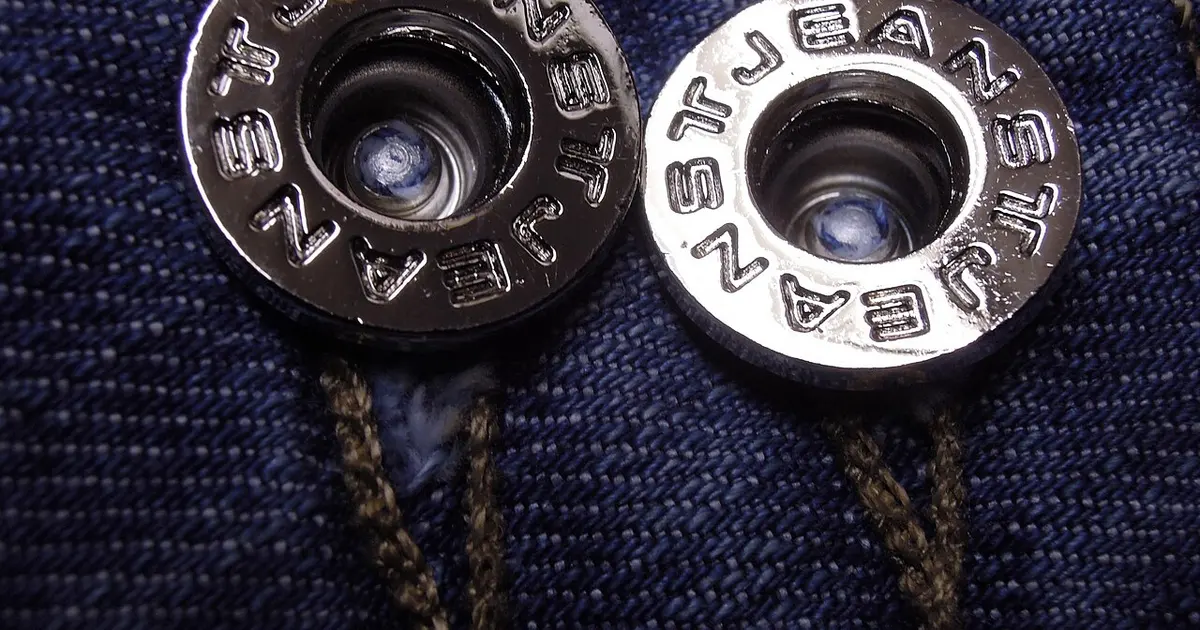
If a plated part touches skin for long periods, the EU limits how fast nickel may come out of it. The short answer for buyers: the limit is 0.5 micrograms per square centimeter per week for watch cases, straps, garment rivets, buttons, zippers and similar parts, and 0.2 for posts that go into piercings. The test is EN 1811, and a coated part has to hold the limit after a wear and corrosion simulation that stands in for two years of use. Write the limit and the test on the drawing, because a nickel underlayer that passes as plated can fail once the top layer wears.
This guide covers what the rule says, what the test does, why plated parts fail it and what to write on an RFQ. It is general information for buyers, not legal advice. Your customer or importer carries the legal responsibility and has the final word on the test plan.
What the rule says
The restriction sits in REACH Annex XVII, entry 27. In summary:
| Case | Limit | Covered items |
|---|---|---|
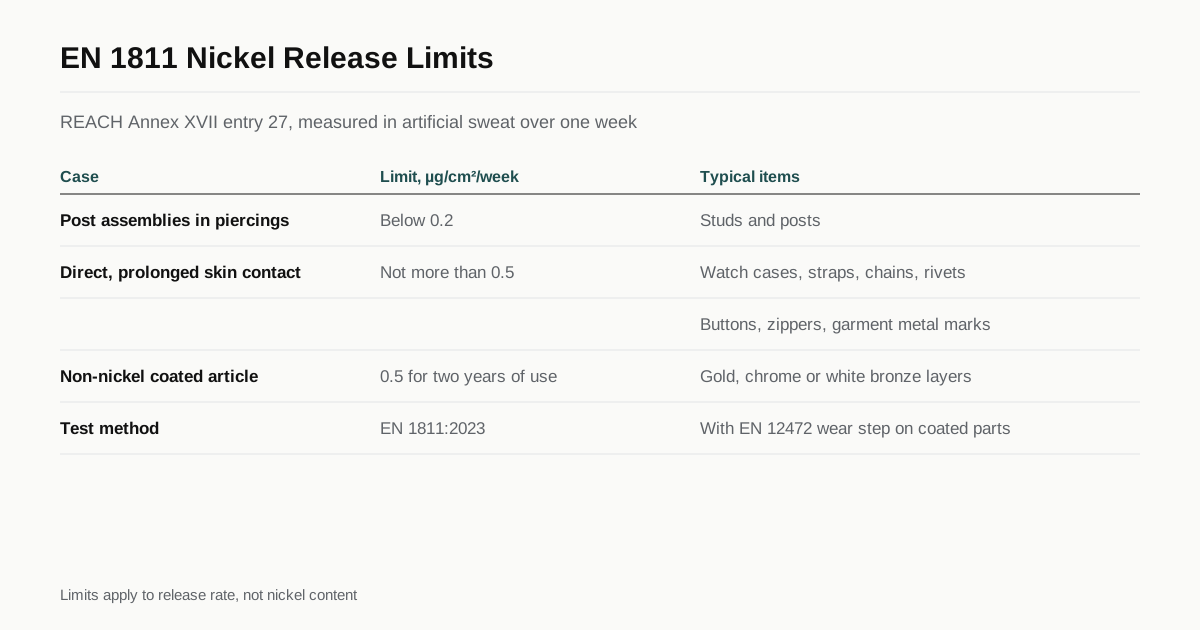
| Post assemblies inserted into pierced ears and other pierced body parts | Below 0.2 µg/cm²/week | Studs, posts, other piercing jewelry |
| Parts in direct and prolonged skin contact | Not more than 0.5 µg/cm²/week | Earrings, necklaces, bracelets, chains, anklets, finger rings, wrist-watch cases, watch straps and tighteners, rivet buttons, tighteners, rivets, zippers and metal marks used in garments |
| The same articles with a non-nickel coating | 0.5 µg/cm²/week for at least two years of normal use | Gold, chrome, white bronze or any other top layer |
Articles that do not meet the limits may not be placed on the market, and the CEN standards are the test methods used to show conformity. Three things buyers miss:
- It is a release limit, not a content limit. A part is judged on what comes out in the test, not on the nickel percentage in the alloy or the plating.
- It applies to the parts that touch skin. A hidden nickel layer on a surface that never contacts skin is not the target, but a layer that is exposed after wear is.
- “Prolonged contact” is not defined in the restriction itself. ECHA was asked to propose a definition, and SGS reported it in 2014. Ask your customer which interpretation they apply to your part.
What EN 1811 and EN 12472 do
EN 1811 is the reference test method. The current edition, EN 1811:2023, was published by CEN on 22 February 2023 and replaces EN 1811:2011+A1:2015. According to a testing laboratory’s description, the sample sits in artificial sweat at 30 ± 2 °C for 168 ± 2 hours with no agitation, the nickel in the solution is measured by ICP-MS, ICP-AES or atomic absorption, and the reporting limit is 0.01 µg/cm²/week. Points that change how you plan a test:
- Each homogeneous sub-part is tested, so a watch case, a strap and a clasp each have to comply.
- Samples can be masked with wax or lacquer to expose only the surface that contacts skin.
- For the 0.5 limit, a result of 0.88 or below passes under the 2023 edition. The previous edition required a result below 0.88.
- Several samples of the same article are each required to meet the limit.
EN 12472 is the pre-treatment for coated items. It simulates accelerated wear and corrosion so the coating is aged before the EN 1811 immersion. The edition from 2020 changed the abradant requirements and clarified that the standard does not cover items whose outer coating contains nickel or items inserted into pierced body parts. When it is uncertain whether the outer coating contains nickel, EN 1811:2023 requires both methods, without and with EN 12472.
This is why a thin flash on a bright nickel base is a risk: the coating has to survive the simulated wear for the part to pass.
Why plated parts fail
- Thin top layer over nickel. Gold flash, thin chrome or a decorative color layer over bright nickel can wear through at corners, edges and contact points. The nickel then releases at the worn spot.
- Porosity. A thin or porous coating lets the electrolyte reach the nickel through pores, even before wear.
- Nickel-bearing substrate with no barrier. An alloy that contains nickel can release nickel if nothing covers it.
- Process variation. A lot with thin racking points or tumbling damage can differ from the approved sample.
The mitigation is a barrier that holds: a thicker or denser top layer, a different underlayer, or a nickel-free system. See the electroless nickel guide for the nickel side and the electrical contact plating guide for thin gold and tin systems.
Nickel-free options to qualify
White bronze, a copper-tin-zinc alloy, is a common nickel-free finish for garment and fashion hardware. One plater describes it as centered around about 55 percent copper, 30 percent tin and 15 percent zinc, with white deposits up to 3.0 micrometers, used as a final finish on zippers, snaps and buttons or as an undercoat or topcoat with palladium, silver or gold. Palladium is the other usual route in jewelry, but palladium-nickel alloys contain nickel and still need testing. The vendor information is marketing, so ask the shop for its own release data on your part. A nickel-free layer does not exempt the part: the same test and the same limit apply, and the same two-year wear rule applies to a coating on a nickel-bearing base.
What to write on the drawing and the RFQ
- State the limit and the method. “Nickel release not more than 0.5 µg/cm²/week per EN 1811:2023 after EN 12472 simulated wear and corrosion, on all surfaces in skin contact.” For posts, 0.2.
- Name the contact surfaces. Mark which faces touch skin, so masking and sampling are right.
- Specify the finish system. Underlayer type and thickness, top layer and thickness, with the “typical, not promised” ranges agreed with the shop. The coating thickness guide lists the common measurement methods.
- Require an accredited laboratory report. Per qualification and when the finish or bath changes, not only once.
- Ask for nickel-free options. Get a quote for the nickel-free system alongside the nickel-based one.
- Plan first articles. Test pre-production parts, including worn samples, before the lot ships.
- Link it to compliance. Nickel release is one of several chemical rules on plated parts. See the RoHS and REACH checks guide.
See also: Nickel electroplating reference: Watts, sulfamate, bright nickel and specs.
How we help
We are a matching service, not a plating shop. Send your drawing, base material, the surfaces that touch skin and the nickel release requirement, and say whether you want nickel-free options. We pass the RFQ to up to three finishing shops that run the relevant lines, and you receive a reply within 24 business hours. Start with the RFQ form or read about electroless nickel plating.
Sources
- REACH Annex XVII, entry 27 Nickel, reachonline.eu (limits, covered items, two-year rule)
- Intertek: EN 1811:2023, new nickel release standard published (changes, decision rule, EN 12472 interplay)
- Intertek: Commission updates EN 12472:2020 as harmonised method (EN 12472 scope)
- JFE Techno-Research: nickel release test service description (test conditions, reporting limit)
- Danish EPA: nickel fact sheet (responsibility, allergy)
- SGS Softlines: ECHA definition of prolonged skin contact
- Arlington Plating: white bronze plating (vendor information, directional)
Frequently asked questions
What is the EU nickel release limit for plated parts?
REACH Annex XVII entry 27 sets 0.5 micrograms per square centimeter per week for parts in direct and prolonged skin contact, such as watch cases, garment rivets, buttons and zippers, and 0.2 for post assemblies inserted into pierced body parts. The limit is on the rate of nickel release in a test, not on nickel content.
Does a gold or chrome top layer over nickel pass automatically?
No. A part with a non-nickel coating is allowed only if the coating keeps nickel release within 0.5 micrograms per square centimeter per week for at least two years of normal use. Labs simulate that wear with EN 12472 before the EN 1811 test, so a thin layer that wears through can fail.
How long does the EN 1811 test take and what does it measure?
A testing laboratory describes it as immersion of the sample in artificial sweat at 30 degrees Celsius for one week, 168 hours, without agitation, followed by measurement of the nickel in the solution by ICP or atomic absorption. Plan on more than a week once sample preparation, any EN 12472 wear step and reporting are included.
Who is responsible for compliance, the plater or the part maker?
The legal duty falls on those who place the article on the market: manufacturers, importers and dealers, as the Danish EPA puts it. A plater is not off the hook in practice, because you will ask the plater for process data and test support. Put the requirement in the order so the shop knows the finish must pass.
Need a quote for this finish?
Send the drawing. We match you with up to 3 finishing shops that run your spec and reply within 24 business hours.
Get matched with a coating shop