Guides / Finishes
Types of PVD Coating by Hardness, Temperature and Use
October 18, 2026
The main types of PVD coating for tools and wear parts are nitrides and carbonitrides of titanium, aluminum, chromium, zirconium and silicon: TiN, TiCN, TiAlN, AlTiN, AlCrN, CrN, ZrN and TiSiN-type nanocomposites. They differ in hardness, the temperature at which they start to oxidize, friction and color. Those four properties decide whether a coating suits drilling, milling hardened steel, cutting aluminum, forming or molding. Values in this guide are typical, not promised.
The PVD overview introduces TiN, CrN and DLC. This guide covers the full nitride family, the multilayer designs built from it and how to match a coating to an operation. Carbon films are covered in a separate guide on DLC coating types.
How to read a PVD coating datasheet
Coating suppliers publish four or five numbers per coating. Each one needs context.
- Hardness. Given in HV or in GPa from nanoindentation. One GPa is about 102 HV, so 30 GPa is roughly 3000 HV. On a film 2 to 4 µm thick, a conventional microhardness indent feels the substrate and reads low. Nanoindentation under ISO 14577 at shallow depth is the usual method for the film itself.
- Maximum service temperature. Usually tied to the onset of fast oxidation in air. It is a ranking value, not a limit the coating holds under every load.
- Friction coefficient. Commonly from a pin-on-disc or ball-on-disc test against steel, dry. Values move with load, speed, humidity and counterface. Compare coatings only within one supplier’s data.
- Thickness. Tool coatings commonly run 1 to 4 µm. Sharp cutting edges often get the thin end so the edge does not round over or chip.
- Color. Mostly a result of chemistry. It helps identify the coating and, on gold TiN, shows wear as the substrate starts to show.
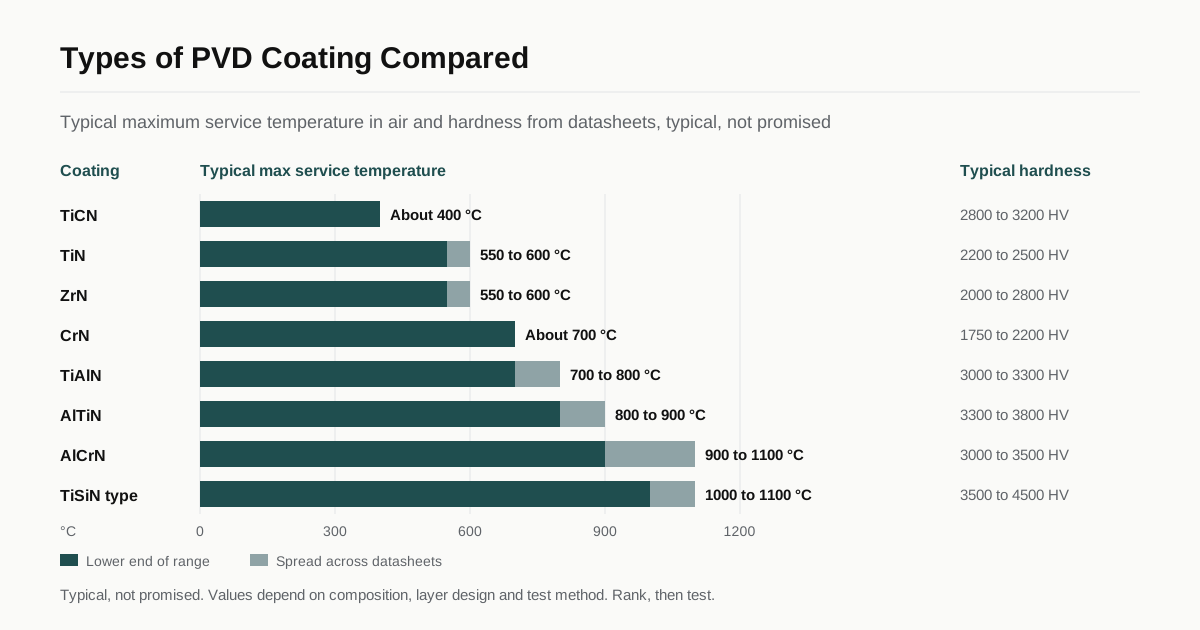
Typical values by coating
| Coating | Color | Typical hardness | Typical max service temperature | Friction vs steel, dry | Typical thickness |
|---|---|---|---|---|---|
| TiN | Gold | 2200 to 2500 HV | About 550 to 600 °C | 0.4 to 0.6 | 1 to 4 µm |
| TiCN | Blue-grey to violet-grey | 2800 to 3200 HV | About 400 °C | 0.2 to 0.4 | 1 to 4 µm |
| TiAlN | Violet-grey to dark grey | 3000 to 3300 HV | About 700 to 800 °C | 0.3 to 0.5 | 1 to 4 µm |
| AlTiN | Dark grey to black | 3300 to 3800 HV | About 800 to 900 °C | 0.4 to 0.7 | 1 to 4 µm |
| AlCrN | Blue-grey | 3000 to 3500 HV | About 900 to 1100 °C | 0.3 to 0.5 | 1 to 4 µm |
| CrN | Silver-grey | 1750 to 2200 HV | About 700 °C | 0.3 to 0.5 | 1 to 6 µm, thicker on request |
| ZrN | Pale gold to brass | 2000 to 2800 HV | About 550 to 600 °C | 0.4 to 0.6 | 1 to 4 µm |
| TiSiN type | Bronze to dark grey | 3500 to 4500 HV | About 1000 to 1100 °C | 0.4 to 0.6 | 1 to 3 µm |
These ranges reflect what coating datasheets commonly list. Exact values depend on composition, deposition method, bias and layer design. Two shops selling “AlTiN” can deliver films with different aluminum content and different structure.
Titanium-based: TiN and TiCN
TiN
TiN was the first PVD coating in wide production and is still the reference. It is hard, chemically stable and gold. It starts to oxidize at around 550 to 600 °C in air, which limits it in high-speed dry cutting of steel. Its friction against steel is moderate.
Common uses: high speed steel drills and taps, general purpose cutters at moderate speed, punches and dies, plastic molds, food equipment parts and decorative gold finishes. The gold color doubles as a wear indicator.
TiCN
Adding carbon from acetylene or methane gives TiCN. It is harder than TiN, has lower friction and is tougher in interrupted cuts. It loses performance above roughly 400 °C, so it works best with coolant and at moderate cutting speeds. Most TiCN is built as a gradient, starting as TiN at the substrate and adding carbon toward the surface. Color runs from blue-grey to violet-grey with carbon content.
Common uses: tapping and threading, milling at moderate speed with coolant, reamers, punching, fine blanking and forming stainless or coated sheet where galling is the problem.
Aluminum-bearing: TiAlN, AlTiN and AlCrN
Aluminum changes the high-temperature behavior. When the coating heats up in air, aluminum forms a thin, dense aluminum oxide at the surface that slows further oxidation. Hot hardness also rises. Titanium aluminum nitride coatings are also documented to age harden in the range of about 800 to 1000 °C, as the cubic structure separates into nanometer-scale AlN-rich and TiN-rich domains.
TiAlN and AlTiN
The name follows the metal with the larger share. TiAlN usually has less than half aluminum in the metal fraction. AlTiN commonly has around 60 to 67 percent. Aluminum cannot rise without limit: above roughly 65 to 70 percent of the metal fraction, part of the film forms hexagonal AlN, which is softer than the cubic phase. That is why aluminum-rich datasheets cluster near a two-thirds aluminum share.
Common uses: TiAlN for drilling and milling of steel and cast iron, wet or dry, on carbide or high speed steel. AlTiN for high-speed and dry milling, hardened steel and high-feed carbide end mills. Neither is a good first choice for aluminum, because aluminum chips stick to aluminum-bearing coatings and build up an edge.
AlCrN
AlCrN forms a protective mix of aluminum and chromium oxides when hot. Datasheets commonly put its maximum service temperature around 900 to 1100 °C, among the highest in the nitride family. It combines high hot hardness with good resistance to abrasive wear and tends to chip less than very hard AlTiN on interrupted work.
Common uses: gear hobbing and shaping, milling and drilling of steels and cast iron, titanium and nickel alloy machining, punching and fine blanking, aluminum die casting cores and hot forming tools.
Chromium and zirconium: CrN and ZrN
CrN
CrN is softer than the titanium nitrides but has low internal stress, so many shops can build it thicker than other nitrides. It resists adhesive wear and performs better than TiN in mildly corrosive conditions. Its affinity for copper and many plastics is low. It is also offered at lower process temperatures than most tool coatings.
Common uses: plastic injection molds, aluminum and zinc die casting tools, forming tools, sliding wear parts and machining of copper and other nonferrous metals.
Like every PVD nitride, CrN is not a standalone corrosion barrier on carbon steel. Pinholes and droplet defects in a film a few µm thick let moisture reach the steel.
ZrN
ZrN has a pale gold to brass color, lighter than TiN. Its low affinity for aluminum makes it a common coating for tools that cut aluminum and other nonferrous metals. Its brass tone is also used on decorative hardware. Hardness and temperature resistance are close to TiN.
Silicon-bearing nanocomposites: TiSiN, AlTiSiN and AlCrSiN
Adding a few atomic percent of silicon changes the structure. Nanocrystalline nitride grains a few nanometers across sit in a thin amorphous silicon nitride phase. The amorphous phase limits grain growth and blocks dislocation movement, which raises hardness and oxidation resistance. Datasheets commonly list around 3500 to 4500 HV and maximum service temperatures around 1000 to 1100 °C.
Common uses: milling hardened steels of about 50 to 65 HRC, high-speed finishing in mold and die making and dry machining where edge temperature is high.
Watch for: high compressive stress. These coatings are usually kept thin and need good edge preparation. On interrupted cuts or on a soft substrate they can chip where a tougher coating would survive.
Multilayer, nanolayer and gradient designs
Few production coatings are a single uniform layer. Three design ideas recur:
- Metal bond layer. A thin titanium or chromium layer, often well under 0.5 µm, sits on the substrate to improve adhesion.
- Gradient. Composition shifts gradually through the thickness, for example from TiN to TiCN or from a tough base to a hard top. This spreads stress and reduces sharp property jumps at interfaces.
- Multilayer and nanolayer. Alternating layers of two compositions, such as TiN with TiAlN or AlTiN with a silicon-bearing layer. Periods run from a few nanometers, created as the parts rotate past different targets, up to hundreds of nanometers. Interfaces deflect cracks, which adds toughness. Very short periods can also raise hardness.
Top layers are often functional. A thin TiN cap gives a gold wear indicator. A friction-reducing carbon or WC/C top layer helps chip flow or sliding. The design matters as much as the chemistry name, so ask for the datasheet and the layer architecture when comparing quotes. The PVD deposition methods guide explains how source type and rotation shape these layers.
Matching the coating to the job
| Job | Common first choices | Notes |
|---|---|---|
| Drilling steel with high speed steel | TiN, TiCN, TiAlN | TiCN for tougher duty with coolant |
| Drilling and milling steel and cast iron with carbide | TiAlN, AlTiN, AlCrN | AlTiN or AlCrN for dry or high-speed work |
| Milling hardened steel, about 50 to 65 HRC | AlTiN, TiSiN type, AlCrN | Thin coating, honed edge |
| Aluminum and nonferrous metals | ZrN, CrN, TiB₂, ta-C | Avoid aluminum-bearing coatings |
| Titanium and nickel alloys | AlCrN, AlTiN | Sharp edges, coolant |
| Gear hobbing | AlCrN, AlTiN | Strip and recoat after regrinding |
| Punching, blanking, forming | TiCN, CrN, AlCrN | Polish after coating |
| Plastic injection molds | CrN, TiN | Low process temperature for some mold steels |
| Aluminum die casting | CrN, AlCrN | Often after plasma nitriding |
| Decorative hardware | TiN, ZrN, CrN | Color control matters more than hardness |
For heavily loaded forming tools in medium hardness steel, shops often plasma nitride first and coat second. The nitrided case supports the thin film so it does not crack when the substrate deforms. For a broader view of nitriding, hard anodize and chrome, see the wear surfaces guide.
Substrate and process temperature
Most of these coatings run in cycles of about 400 to 500 °C on tools. Carbide and high speed steel tempered at around 540 to 560 °C handle that. A cold work steel such as D2 tempered low, around 200 °C, would lose hardness. The same steel tempered high, above about 500 °C, can be coated. CrN and some sputtered processes can run cooler. Check the shop’s measured part temperature against your tempering temperature before you order. The PVD temperature and substrates guide lists common steels.
PVD involves no plating bath, so it does not carry the hydrogen embrittlement risk of electroplating. If you are comparing PVD with hard chrome or electroless nickel on steel over 39 HRC, the plated route needs a hydrogen embrittlement relief bake under ASTM B850. See the hydrogen embrittlement guide.
Getting PVD quoted
Name the coating if you know it. If you do not, describe the failure on the worn part and let the shop propose one. A useful RFQ lists:
- Part or tool type, substrate, hardness and tempering temperature.
- The operation and work material, for example “dry milling 1.2379 at 60 HRC” or “blanking 1.4301 sheet 1.5 mm”.
- Coating preference or “as proposed, with datasheet”.
- Thickness range on the functional faces and edge preparation.
- Faces to coat and faces to keep free.
- Strip and recoat needs for regrind cycles.
- Quantity per batch and the test report you expect.
The full buying path, including substrate, drawing note and verification, is in our guide to PVD coating services.
The coating RFQ checklist covers the general items. We are a matching service, not a coating shop. Choose “PVD” as the finish on the RFQ form and describe the operation. We pass your request to up to 3 shops that run the coating you need, they quote you directly and you get a reply within 24 business hours. Start your PVD RFQ.
Sources
- Titanium nitride, Wikipedia (TiN properties, color, uses)
- Physical vapor deposition, Wikipedia (process family and common coatings)
Frequently asked questions
What is the difference between TiAlN and AlTiN?
Both are titanium aluminum nitride. The name follows the metal with the larger share. TiAlN usually has less than half aluminum in the metal fraction, while AlTiN commonly has around 60 to 67 percent. The higher aluminum content raises hot hardness and oxidation resistance, which suits high-speed and dry milling. Above roughly 65 to 70 percent aluminum the film starts to form a softer hexagonal phase.
Which PVD coating is best for machining aluminum?
Aluminum sticks to coatings that contain aluminum, so AlTiN and AlCrN tend to build up an edge. Shops commonly offer ZrN, CrN, sputtered TiB2 or hydrogen-free ta-C carbon for aluminum and other nonferrous metals, often on polished carbide. The choice depends on the alloy, silicon content and whether you cut dry or wet. Ask for the shop's datasheet for aluminum.
What does the maximum service temperature on a PVD datasheet mean?
It is a guide value, usually tied to the temperature at which the coating starts to oxidize quickly in air. It is not a guarantee and test methods vary between suppliers. A cutting edge can run hotter for short moments. Use the number to rank coatings against each other, then confirm with a cutting test on your own material and parameters.
Is a harder PVD coating always better?
No. Very hard coatings such as TiSiN-type nanocomposites carry high stress and can chip on interrupted cuts, sharp edges or soft substrates. A tougher coating such as TiCN or a multilayer design can outlast a harder one in tapping, punching or forming. Match the coating to the failure mode you see on the worn tool: abrasion, chipping, cratering or build-up.
Can PVD coatings protect carbon steel against corrosion?
Not on their own. PVD nitrides are usually 1 to 5 µm thick and contain pinholes and droplet defects that let moisture reach the steel. CrN performs better than TiN in mild conditions, but rust can still start at defects. On parts that need corrosion protection, use a corrosion resistant substrate or a suitable base layer and treat the PVD film as a wear layer.
Need a quote for this finish?
Send the drawing. We match you with up to 3 finishing shops that run your spec and reply within 24 business hours.
Get matched with a coating shop