Guides / Finishes
Trivalent Passivates on Zinc: Clear, Yellow and Black Compared
November 1, 2026
Zinc plating alone protects steel but corrodes quickly, forming white powdery product within hours in a salt fog. The passivate, a thin conversion film applied right after plating, slows that attack and gives the zinc its color. Until about the 2000s most of those films were hexavalent chromium. Restrictions in the EU on end-of-life vehicles, electronics and other products moved the market to trivalent chromium systems, and drawings today often name them. Knowing the differences between clear, yellow and black trivalent saves you from buying a film that does not match the job.
What a passivate does
After zinc is plated, parts are dipped in an acidic solution that reacts with the surface and leaves a thin film of chromium compounds and zinc oxide. The film is a barrier. It slows the formation of white corrosion product and bonds paint or lubricant coatings. It is often only 20 to 400 nanometers thick, a fraction of the zinc itself, which is typically 5 to 12 µm.
Trivalent chromium, Cr(III), is far less toxic than hexavalent Cr(VI). Regulations such as the EU RoHS and ELV rules restrict hexavalent films on many products, so trivalent films are the default on new work. Do not specify hexavalent unless a legacy drawing or a customer requires it and the product is outside those rules.
The main passivate types
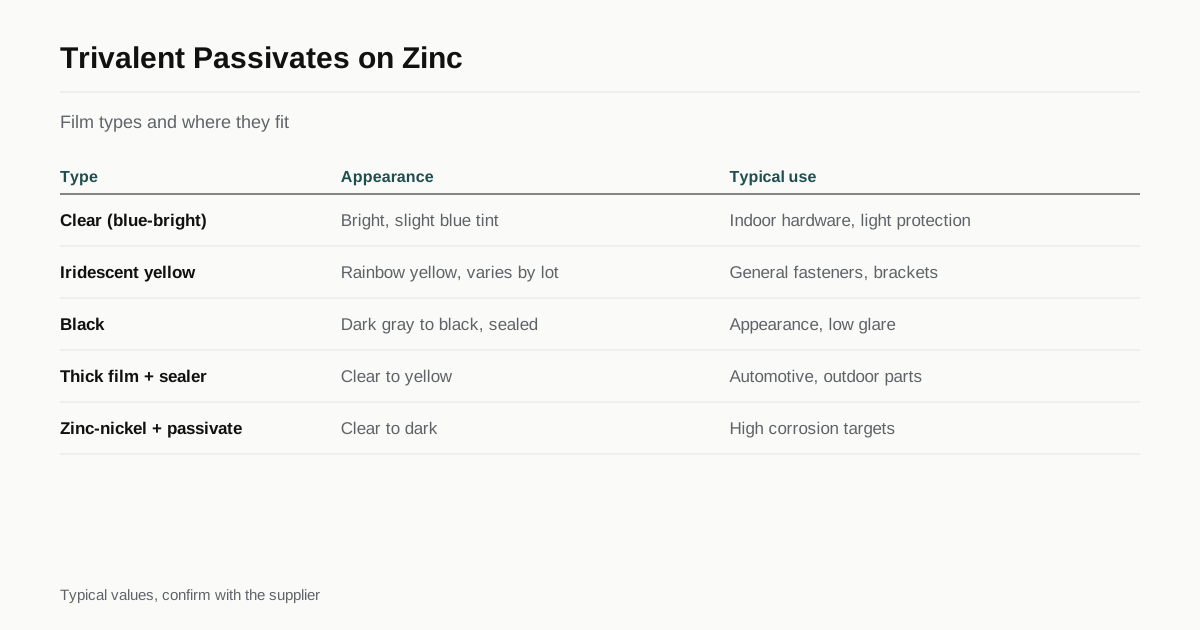
| Type | Appearance | Typical film | Typical use |
|---|---|---|---|
| Clear (blue-bright) | Bright, slight blue tint | Thin | Indoor hardware, light protection |
| Iridescent yellow | Rainbow yellow, varies | Medium to thick | General fasteners, brackets |
| Black | Dark gray to black | Medium, usually sealed | Appearance and glare reduction |
| Thick-film with sealer | Clear to yellow | Thicker plus topcoat | Automotive and outdoor parts |
Clear trivalent is thin and gives modest protection. It suits indoor parts and parts that will be painted. White corrosion can appear after fairly short salt spray exposure, on the order of one to a few days, so it is not a heavy-duty choice.
Yellow trivalent is a thicker film that gives better protection than clear. The color is iridescent and varies with thickness, so two lots rarely match exactly. Color alone is not an indicator of corrosion performance.
Black trivalent is made either by a black passivate chemistry or by a black dye or inorganic layer, usually on top of a clear or yellow base film. Black films almost always need a sealer to give reasonable corrosion protection and to stop rub-off.
Sealers and topcoats
A sealer is a thin organic or silicate coating applied over the passivate. It does four things:
- Raises the hours to white rust and to red rust.
- Evens out color.
- Reduces rub-off and handling marks, especially on black.
- Controls friction on fasteners when used with a lubricant additive.
Sealers do add some thickness, typically 1 to 3 µm, and they change the torque-tension relationship. Automotive and structural fasteners often have a friction specification such as a coefficient range under a tightening test, so tell the shop if that applies. Where friction control is the main goal, compare with zinc flake coatings for fasteners.
Corrosion performance in context
Passivate type is only one input. The zinc thickness and the part geometry matter at least as much. As a rough, typical orientation:
| System on steel | Typical salt fog life to first corrosion | Notes |
|---|---|---|
| Zinc + clear trivalent | One to a few days in salt fog | Thin film |
| Zinc + yellow trivalent | A few days | Medium film |
| Zinc + thick-film trivalent + sealer | Several days to over a week | Seal matters |
| Zinc-nickel + trivalent passivate | Weeks | Alloy gives the extra life |
These are typical, not promised, and test results vary by shop and thickness. See what salt spray hours really mean before you set a number on a drawing.
When the requirement is a few hundred hours or more to red rust, the passivate alone will not do it. An alloy such as zinc-nickel, or a zinc flake system, is the normal answer.
Scratches and heat
Hexavalent films were called self-healing because soluble chromium moved into a scratch and re-formed a film. Trivalent films do not do that to the same degree. A scratched trivalent part relies on the zinc to protect the steel, and the white rust that results is cosmetic until the zinc is used up.
Heat is another difference. Hexavalent films lose protection above roughly 60 to 70 °C, because water leaves the film and it cracks. Thick-film trivalent systems tolerate more heat, in the range of 100 to 200 °C depending on the product, which suits parts near engines or ovens. Confirm the limit with the shop, since it varies between chemistries.
Cobalt and other restricted substances
Some trivalent passivates, especially black and some thick-film ones, contain cobalt for color or corrosion performance. Cobalt compounds are under review in the EU and some buyers ask for cobalt-free systems. If your customer or region restricts cobalt, say so in the RFQ so the shop picks a compatible product. Also say whether you need RoHS or ELV compliance, a REACH statement or a material declaration with the certificate.
Zinc plating thickness and baking
Passivate performance starts with the zinc. Typical zinc thickness for fasteners and hardware is 5 to 12 µm and for outdoor brackets 8 to 15 µm. Too thin and the part has little reserve. Hardened steel over about 39 HRC needs a relief bake after plating, normally before passivation or as the process sequence requires. See hydrogen embrittlement relief bake. For the base process choice, see rack vs barrel plating.
How shops verify a passivate
A passivate is thin, so thickness gauges do not help. Shops verify it by other routes.
- Appearance against a sample. For colored films the main inspection is visual under a set light, against an approved sample or a color range.
- Spot tests. Some shops use a drop test or a stripping test to confirm a film is present.
- Salt spray. The standard proof is a salt fog test on parts or panels from the lot, with white rust and red rust defined on the drawing.
- Process records. Bath pH, temperature, immersion time and age are logged, and a stable process is the best predictor of a repeatable film.
Ask what the shop checks on every lot and what it checks only at process qualification. A shop that runs a salt spray test once a year on a panel and none on your lot cannot say much about your lot, and that may be fine for a hardware part and not fine for a safety part.
Handling and storage after passivating
Fresh passivate films are soft for the first day or so as they finish drying and curing. Parts that are stacked wet, handled with bare hands or packed too soon can stain, rub off or show fingerprints. Good practice is to dry parts fully, allow a short cure time and pack in clean, dry packaging. Black films in particular show scuffs. If parts will be shipped far or stored for months, ask about a light oil or a corrosion-inhibiting wrap, and whether the oil is compatible with later painting or bonding.
Common mistakes buyers make
- Ordering “yellow zinc” and expecting the look of the old hexavalent gold color. The trivalent film is paler and more iridescent.
- Assuming black always means better corrosion resistance. A sealed black film is good. An unsealed one is often weaker than clear.
- Specifying hours without saying white rust or red rust.
- Mixing parts from different lots in one assembly where the color must match.
- Forgetting that a sealer changes fastener friction.
Choosing between them
- Indoor, light duty or to be painted: clear trivalent.
- General fasteners and brackets: yellow trivalent, with sealer if you need more life.
- Appearance, low glare or matching a black assembly: black trivalent with sealer.
- Outdoor, vehicle or high corrosion targets: zinc-nickel with a trivalent passivate and sealer, or a zinc flake system.
If your drawing names only a color, ask what film type and corrosion target the color is meant to represent. Our guide to black oxide vs zinc plating covers another route to a black finish.
What to put on the RFQ
- Base material and hardness.
- Zinc thickness range.
- Passivate type and color, with a sample or color range if appearance matters.
- Sealer or topcoat requirement and any friction or torque specification.
- Corrosion test requirement and who runs it.
- Restricted substance requirements, such as RoHS, ELV, REACH and cobalt-free.
- Lot size and drawing.
See also: Zinc plating reference: classes, bath types, passivates and bake.
How we help
We are a matching service, not a plating shop. Send one RFQ with the film type and test requirement and we pass it to up to 3 shops that run those passivates. Replies come within 24 business hours. Start with the RFQ form or the coating RFQ checklist.
See also how to test for hexavalent chromium on plated parts.
Frequently asked questions
Is a trivalent passivate as good as the old yellow chromate?
For corrosion resistance in a salt fog, a thick-film trivalent yellow with a sealer can match or beat a traditional yellow hexavalent film. A thin clear trivalent film is weaker. The older films also repaired small scratches by themselves and trivalent films do not, so scratches and cut edges matter more.
Why do yellow trivalent parts come out different shades?
Trivalent yellow is an iridescent film, and its color shifts with thickness, base zinc, lighting angle and bath age. Parts from different lots can look different even when both pass the specification. If appearance matters, define a color range or a sample, not a color name.
Do I need a sealer on top?
Often yes if you want a higher corrosion rating, a uniform appearance, or control of friction on fasteners. A sealer adds a thin organic or silicate layer over the passivate. It changes torque-tension behavior, so tell the shop if the fasteners must meet a friction window.
Need a quote for this finish?
Send the drawing. We match you with up to 3 finishing shops that run your spec and reply within 24 business hours.
Get matched with a coating shop