Guides / Specs
Rack vs Barrel Plating: Which Process Your Parts Need and Why It Changes the Price
October 29, 2026
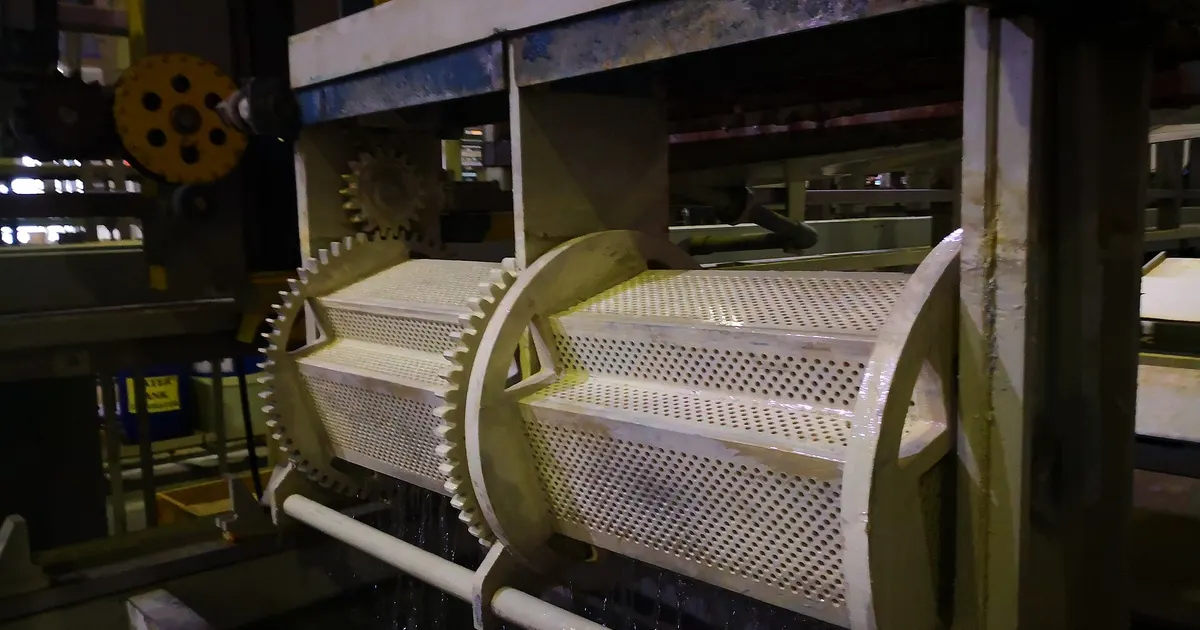
Rack and barrel are the two ways a shop holds parts in an electroplating line. They apply the same chemistry, such as zinc, nickel or tin, but they differ in how parts move, how current reaches them, what marks they carry and what they cost. The choice is made by part size and shape, lot size and finish requirements, and it is worth understanding before you send a drawing, because it affects thickness, appearance and price more than most buyers expect.
How each process works
Rack plating. Each part is fastened to a rack, a metal frame with contacts, using clips, wires or screws. The rack goes through the cleaning, plating and rinse tanks. The part stays still and is well connected to the current.
Barrel plating. Parts are loaded loose into a perforated drum, the barrel. The barrel rotates while it sits in the bath. Parts tumble against each other and against the contacts inside, which carry the current, and solution flows through the perforations.
A third option, vibratory plating, uses a vibrating bowl in place of a rotating drum for delicate parts. Some shops use it for small parts that scratch in a barrel.
Side-by-side comparison
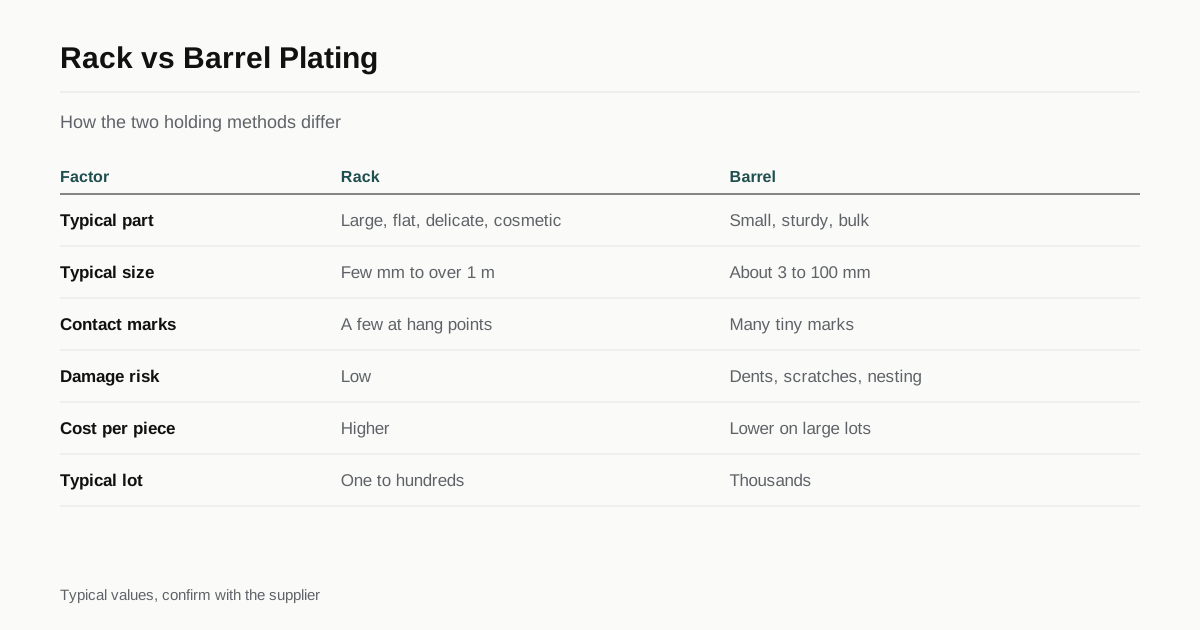
| Factor | Rack | Barrel |
|---|---|---|
| Typical part | Large, flat, delicate, cosmetic | Small, sturdy, bulk |
| Typical size | Few mm to over 1 m | About 3 to 100 mm |
| Handling | Hung by hand | Loaded in bulk |
| Contact marks | Small marks at hang points | Many tiny contact marks |
| Damage risk | Low | Dents, scratches, nesting |
| Cost per piece | Higher | Lower on large lots |
| Typical lot size | Single pieces to hundreds | Thousands |
| Deposit into recesses | Variable, depends on geometry | Poorer, current is low |
Ranges are typical, and each shop sets its own limits.
When barrel plating is the right choice
Barrel plating suits parts that are small, strong and numerous: screws, nuts, washers, clips, pins, rivets and stampings. It is cheaper per piece because one load handles thousands of parts and no one hangs them individually. Thickness averages across a load well, which is why fastener specifications are often barrel plated.
Several part shapes do poorly in a barrel:
- Parts that nest. Cups and cone shapes stack and stay stuck together, leaving uncoated areas.
- Parts that tangle. Springs and wire forms hook into each other.
- Fragile or soft parts. Aluminum clips and thin stampings dent and scratch.
- Flat parts. Thin flat pieces stick together face to face and coat unevenly.
- Blind holes and tubes. They can trap solution or fail to plate inside.
When rack plating is the right choice
Racking suits larger parts, delicate parts and parts that need a cosmetic finish. It also suits parts where the position of the contact mark matters, where you need a tight spread of thickness on one part or where a thread or a bore needs a specific position in the bath. Brackets, housings, machined components and decorative parts are normally racked.
The cost is labor. Each part is hung, inspected and unhung, and many shops price by rack position. A part that fits 20 to a rack costs less per piece than one that fits 4. Design for racking where you can. A hole or a tab that can serve as a hang point keeps the contact mark away from visible surfaces.
Thickness distribution
Electroplating deposits more where current density is high, such as edges and points, and less where it is low, such as recesses and inside corners. On a rack, this variation shows up within one part, so the thickness at an edge may be several times the thickness in a recess. In a barrel, the variation is partly averaged by tumbling, but the low current also means recesses are poorly covered and inner surfaces of tubes get little deposit.
Specifications describe a minimum thickness on a significant surface. Name that surface on the drawing. Our guide to coating thickness measurement covers where and how thickness is read.
Fasteners, threads and hardened parts
Many threaded fasteners run in barrels. The deposit thickness on a thread flank is lower than on the crest, and the plating adds to the thread size, so thread class after plating needs a call. See thread fits after plating for allowances.
Hardened steel, over about 39 HRC, needs a relief bake after electroplating regardless of rack or barrel. The bake needs to start within a defined time after plating, and barrel loads of small parts have to be baked in a layer thin enough for heat to reach every piece. See hydrogen embrittlement relief bake. For hardened fasteners, a zinc flake system avoids both the bake and the barrel, as covered in zinc flake coatings for fasteners.
A worked comparison
Take two parts from the same assembly. The first is an M6 machine screw, 20 mm long, in lots of 50,000. The second is a machined aluminum bracket, 120 mm long, with a cosmetic face, in lots of 200.
The screw goes in a barrel. One load carries many thousands of screws, so labor per piece is tiny. The deposit averages across the load, the tumbling hides small contact marks and the thread takes a thin coat. The shop watches the barrel fill level, since an overloaded barrel gives uneven coverage and a light one gives dents.
The bracket goes on a rack. The shop picks a hang point on the hidden underside, spaces the pieces so current reaches the recesses and checks thickness on the cosmetic face. It will quote per rack position, and the price per piece will be a multiple of the screw price even though the plating chemistry is the same. Neither choice is wrong. The mistake is to ask for barrel pricing on the bracket, or to expect rack appearance on the screw.
Designing parts so they plate well
A few design habits improve results in either process.
- Add a hang point. A small hole or a tab on a non-cosmetic area gives the shop a place for the contact.
- Avoid blind holes and deep pockets where you can, or add a drain hole. Trapped solution drains out later, stains the part and attacks the coating.
- Round sharp edges. Edges collect extra current and build up a thick, sometimes brittle deposit. A radius of about 0.3 mm or more helps.
- Keep wall thickness even on parts that will be baked, so heat reaches all areas in the same time.
- Allow for growth on fits, threads and bores, as described in the thread and masking guides.
Quality checks that differ by process
Rack lots are normally checked piece by piece for marks, coverage and thickness at named points. Barrel lots are checked by sample, for thickness, adhesion and appearance, plus a check for damage and nesting.
Ask how the shop decides a barrel load is acceptable, and what happens to parts that stick together or come out scratched. A shop that can answer those two questions in plain terms has run your kind of part before.
Cost drivers
- Labor for racking and unracking.
- Rack design and maintenance, since racks wear, and a rack for a new part may carry a tooling charge.
- Lot size, which sets how many parts share a barrel load or a rack position.
- Contact marks and the care needed to place them.
- Post-plating handling, such as drying and baking.
For the broader picture see plating and coating cost.
Questions to settle with the shop
- Which process do you plan to use for this part and why?
- Where will the contact marks fall, and can I name an area where they are not allowed?
- Do you have a rack for this part, or does it need tooling?
- What is the smallest lot you will run in a barrel?
- How do you handle drying, so parts do not stain after plating?
What to put on the RFQ
- Drawing, material and heat treat condition.
- Finish and specification, with thickness range.
- Lot size and expected repeat volume.
- Cosmetic areas and any area where racking marks are not allowed.
- Whether the parts nest, tangle or scratch easily.
- Any bake requirement.
How we help
We are a matching service, not a plating shop. Send one RFQ with part size, lot size and cosmetic needs and we pass it to up to 3 shops that run the right process line. Replies come within 24 business hours. Start with the RFQ form or read the coating RFQ checklist.
Frequently asked questions
Can a part that is normally barrel plated go on a rack?
Yes. Any part can be racked if the shop builds or owns a rack for it. The cost rises sharply, because each piece is hung by hand. Racking is chosen for parts that would be damaged or nest in a barrel, or when you need tight control of where the contact mark falls.
Does barrel plating give a thinner or thicker deposit than racking?
Neither by itself. The thickness is set by the time and current, and either process can meet a given minimum. What differs is the spread. Racked parts have more variation between high and low current areas of one part. Barrel parts average out across the load, but individual pieces vary, and the process throws poorly into recesses.
Is a minimum lot size needed for barrel plating?
Most shops need enough parts to cover the barrel and the load weight, often a few thousand small pieces, or they add dummy parts to fill it. A small lot of a few hundred fasteners may be racked or run in a small barrel, and the unit price will reflect it.
Need a quote for this finish?
Send the drawing. We match you with up to 3 finishing shops that run your spec and reply within 24 business hours.
Get matched with a coating shop