Guides / Specs
What Salt Spray Hours Really Mean for Coated Parts
October 30, 2026
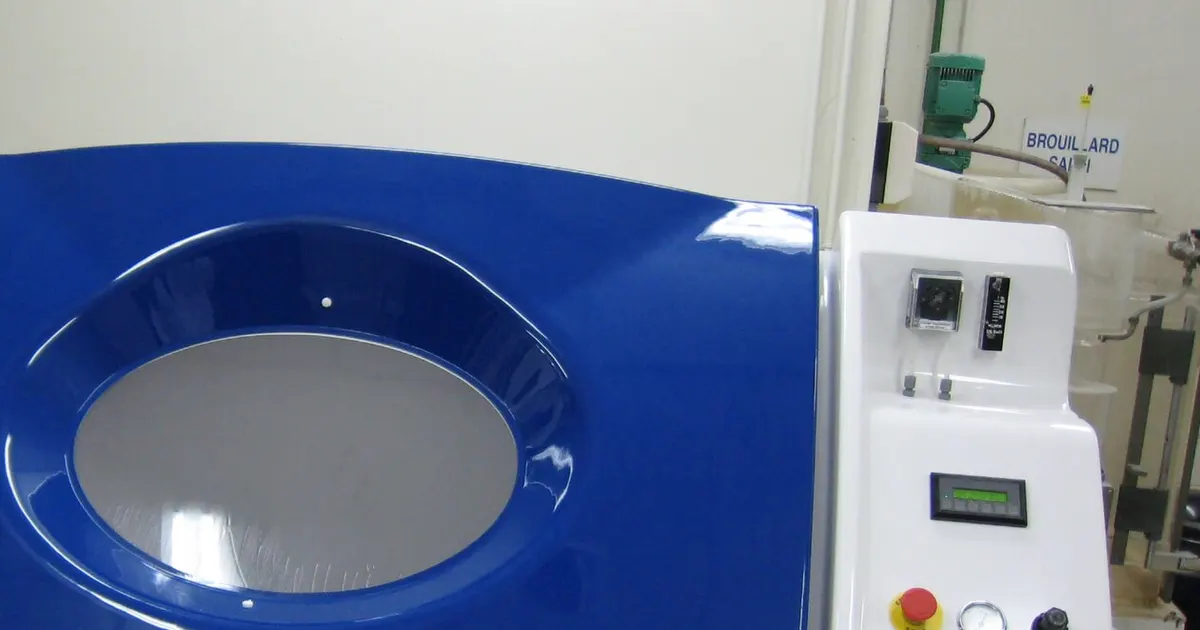
Salt spray hours are the number most often written on a coating drawing and the number least understood. A callout of “96 hours” or “720 hours” sounds like a measure of how long a finish will last. It is not. The test is a controlled, accelerated comparison, defined in ASTM B117, and it tells you how a finish ranks against another under one fixed set of conditions. Used that way it is very useful. Used as a lifespan estimate it misleads.
What ASTM B117 actually does
ASTM B117 is a standard practice for operating a salt fog chamber. The key conditions are:
- A 5 percent sodium chloride solution in water, with a controlled pH close to neutral.
- A chamber temperature of about 35 °C.
- A continuous fine fog that settles onto the test samples at a set collection rate.
- Samples held at a defined angle, typically close to vertical for parts and a few degrees from vertical for panels.
The test is called neutral salt spray to separate it from variants such as acetic acid salt spray and CASS, which are more aggressive and are defined elsewhere, for example ASTM B368 for CASS. Samples stay in the chamber for the specified number of hours and are then inspected. The standard defines how to run the equipment and what to record. It does not define pass or fail. The acceptance criteria come from the part specification or your drawing.
What the result looks like
Inspection looks for corrosion product on the surface.
- White rust is zinc corrosion product. On a zinc plated or galvanized part it means the coating is doing its job as a sacrificial layer.
- Red rust is iron corrosion from the base steel. It means the coating has been penetrated, and it is the failure point in most specifications.
- Blisters point to a problem in the coating, such as poor adhesion or trapped solution.
- Creep from a scribe measures how far corrosion spreads under a coating. It is common on paint and powder coat tests.
A specification should name what is counted. “720 hours” with no failure definition is incomplete.
Hours are a ranking, not a prediction
The chamber keeps samples wet all the time, at a constant temperature and with a single salt concentration. Real parts see rain, drying, sun, road salt, humidity swings and pollution. Zinc, for example, forms protective films when it dries and cycles, which the constant fog does not reproduce. Coatings that perform well in a salt fog can do worse outdoors, and the reverse also happens.
For that reason the same standards committees that publish the test warn against converting hours to years. Cyclic corrosion tests, such as those defined in SAE J2334 or ISO 11997 and by individual automotive makers, mix wet, dry and humid stages and track real exposure better. If the part’s real environment matters, ask whether a cyclic test is appropriate.
Typical specification targets
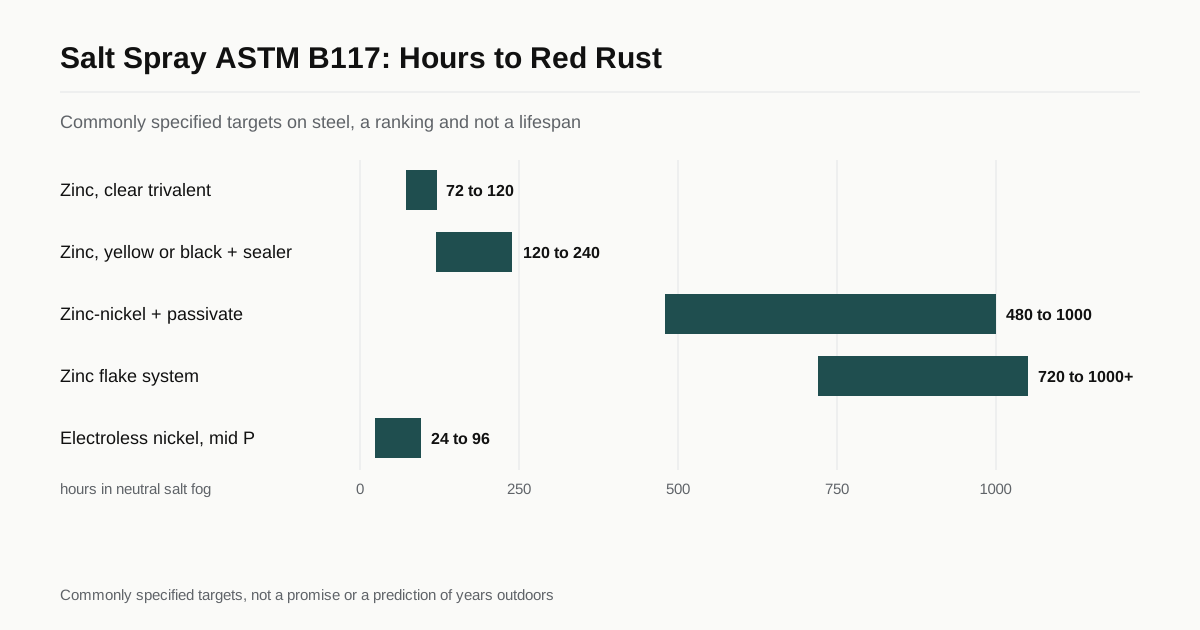
The table lists hours that are commonly specified to first red rust for typical finishes on steel, as an orientation. They are typical, not promised, and your specification should state its own number.
| Finish on steel | Commonly specified hours to red rust | Notes |
|---|---|---|
| Zinc plate, clear trivalent | 72 to 120 | Thin passivate, light use |
| Zinc plate, yellow or black trivalent with sealer | 120 to 240 | Thicker film, a sealer helps |
| Zinc-nickel with passivate | 480 to 1000 | Automotive and aerospace use |
| Zinc flake basecoat and topcoat | 720 to 1000 or more | Common for hardened fasteners |
| Electroless nickel, mid phosphorus | 24 to 96 | Barrier coating, pinholes matter |
| Hot-dip galvanized | Not usually tested in B117 | Thickness sets life |
If you need a target, name it explicitly and say it applies to a stated surface and a stated sample plan.
Common problems with salt spray callouts
- No failure criterion. The hours are named, but not what counts as a failure. State “no red rust” or “no more than x percent white rust”.
- No sample definition. Panels, production parts and parts after bending or torque all give different results. Say which.
- Testing parts that cannot hold up. Hardened parts need a relief bake after plating, and failing to bake affects fatigue and cracking, which salt spray will not reveal.
- Ignoring pretreatment. A coating that passes on a clean panel can fail on a part with residue or poor cleaning.
- Testing too early. Some passivates and sealers need curing time before they develop their resistance. Many specifications allow a stated waiting period before the test.
Preparing samples correctly
The result depends heavily on what goes into the chamber and how it is prepared. Three details are worth stating.
- Cleaning and handling. Samples should be clean and handled with gloves. Fingerprints and oil leave weak spots that fail early and tell you nothing about the coating.
- Cut edges and scribes. Cut edges of a coated panel are bare steel and corrode first. They are normally masked with tape or wax and left out of the evaluation. A scribe through a paint or powder film is deliberate, used to measure creep, and it is made to a defined depth and width.
- Placement. Samples must not touch each other, must not drip onto each other and must sit at the specified angle. A part placed in a corner of a crowded chamber does not see the same exposure as one in the middle.
Where you can, ask for samples that went through the same cleaning, plating or coating, curing and bake steps as production. A panel prepared specially for the test proves the chemistry. A production part proves the process.
Interpreting a pass or fail
A pass means the samples met the stated criterion under the stated conditions, nothing more. A fail needs a look at why. Early white rust on a zinc part may be a thin passivate that is working as expected for its class, while early red rust points to a thin deposit, a rough substrate or porosity. A shop that reports a fail and a likely cause, such as low thickness in a recess, is more useful than one that only reports a number.
If two labs disagree, compare the chamber collection rate, the temperature log and the sample angle before blaming the coating. Those three variables explain most of the difference between reports.
Alternatives and extra tests
Salt spray is one tool among several. Other tests you may see on a drawing include humidity exposure per ASTM D2247, condensation tests, cyclic corrosion tests and outdoor exposure racks. For coatings on hardened fasteners, tests for hydrogen embrittlement per ASTM F519 are separate from corrosion tests and neither replaces the other. For zinc flake coatings and automotive parts, cyclic tests are often the controlling requirement and salt spray is a secondary check.
Who runs the test and how to read a report
Many plating shops run their own chamber for process control, and many use an independent lab for formal reports. A useful report lists the standard, the chamber conditions, the sample identification, the start and end times, the inspection result and photographs. If you only receive a one-line pass statement, ask for the full report, since reproducing a test later is much easier with the record.
A shop’s salt spray result applies to the process and the samples tested. It does not become a promise for your lot unless you agree a sampling plan. For how that plan interacts with thickness checks, see coating thickness measurement.
Choosing a finish by environment, not only by hours
If your part will live outdoors, near salt or in a corrosive process, ask the shop about the environment, not only the hour count. Which metal finish for your part helps with the first screening and metal finishing spec cross-reference lists common specifications by finish. For outdoor products see outdoor powder coating for enclosures and brackets.
What to put on the RFQ
- The finish and the governing specification.
- The test standard, hours and pass criterion in one sentence.
- Whether it applies to panels or production parts.
- Who runs the test and who pays for it.
- Any waiting period before the test starts.
- Lot size and drawing.
How we help
We are a matching service, not a plating shop or a test lab. Send one RFQ with the test requirement stated and we pass it to up to 3 shops that run that finish and can test it or arrange it. Replies come within 24 business hours. Start with the RFQ form.
See also the specification reference for ASTM B117 and ISO 9227 salt spray tests.
For automotive programmes that cycle salt, humidity and drying, see GMW14872, SAE J2334 and VDA 233-102 cyclic corrosion tests.
Frequently asked questions
Do 500 salt spray hours equal a certain number of years outdoors?
No. There is no accepted conversion. The test is constant wet exposure to a strong salt fog, while real weather cycles between wet and dry and carries different chemistry. The hours rank coatings against each other under one set of conditions, and that is all they should be used for.
What is the difference between white rust and red rust?
White rust is the corrosion product of zinc, a white or gray powder. It means the zinc coating is being used up as designed. Red rust is iron oxide from the steel base, and it means the coating has been breached. Most specifications set hours to first red rust, and many treat white rust more leniently or set a separate limit.
Can a shop guarantee a salt spray result?
A shop can run the test and report the result, and a process qualified on test panels will usually repeat. It still cannot guarantee that every production part passes, because racking, geometry and pretreatment all affect the outcome. Agree whether the test is run on panels or on production parts.
Need a quote for this finish?
Send the drawing. We match you with up to 3 finishing shops that run your spec and reply within 24 business hours.
Get matched with a coating shop