Guides / Finishes
Cadmium Replacement Coatings for Aerospace Parts: Zinc-Nickel, IVD Aluminum and Others
October 18, 2026
Cadmium plating protected aircraft fasteners, landing gear, connectors and hydraulic parts for decades. It resists salt, has natural lubricity, sits close to aluminum in the galvanic series and tolerates marine air. It is also toxic, and the hexavalent chromium passivate normally applied over it is toxic too. Environmental and worker-safety rules have pushed most programs to look for replacements. This guide compares the common alternatives and explains why the swap is an engineering decision, not a drop-in change.
Why cadmium was hard to beat
Four properties made cadmium the default on aerospace steel.
- Corrosion protection that works as a sacrificial layer, including in marine air.
- Lubricity. Cadmium gives low and predictable friction on threads, which makes torque-tension consistent and prevents galling.
- Galvanic compatibility with aluminum. Cadmium plated steel in contact with aluminum airframe structure causes less galvanic attack than zinc does.
- Process versatility. It plates on high strength steel from low-embrittlement baths, solders well and tolerates bending and forming.
A replacement has to cover as many of these as possible. None covers all of them.
Main replacement options
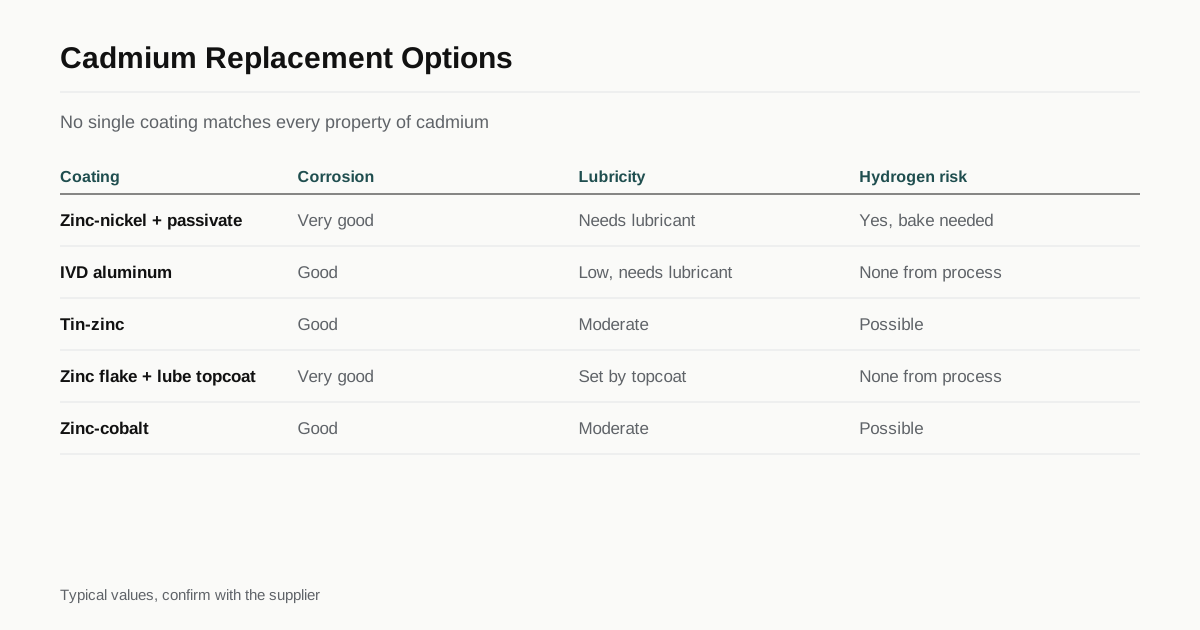
| Coating | Typical thickness | Corrosion | Lubricity | Hydrogen risk | Galvanic with aluminum |
|---|---|---|---|---|---|
| Zinc-nickel (12 to 16 percent Ni) + passivate | 8 to 25 µm | Very good | Needs a lubricant topcoat | Yes, needs bake | Good, slightly more than cadmium |
| IVD aluminum | 5 to 25 µm | Good | Low, needs lubricant | None from process | Very good |
| Tin-zinc | 8 to 15 µm | Good | Moderate | Possible | Good |
| Zinc flake with lubricant topcoat | 8 to 15 µm | Very good | Controlled by topcoat | None from process | Good with Al flake |
| Zinc-cobalt | 8 to 15 µm | Good | Moderate | Possible | Moderate |
Values are typical, not promised.
Zinc-nickel
Zinc-nickel alloy with about 12 to 16 percent nickel is the most widely adopted replacement. It resists corrosion much better than pure zinc and holds up in elevated temperature service, in some cases to around 120 to 200 °C. The aerospace specification AMS 2417 covers electrodeposited zinc-nickel. It is applied from alkaline baths for lower hydrogen pickup, followed by a relief bake on high strength steel. A trivalent passivate and an optional lubricant topcoat complete the system.
Trade-offs include the need for a lubricant on threads to match the friction cadmium gave, a slightly higher galvanic potential against aluminum, and more complex plating control, since the nickel content must stay in a narrow range across the part. Ask the shop how it holds alloy composition and checks it.
IVD aluminum
Ion vapor deposited aluminum is applied in a vacuum chamber. Aluminum is evaporated and condensed on the part, leaving a pure aluminum layer. It is specified under documents such as MIL-DTL-83488 and AMS 2427. Because no electrolytic process is used, it adds no hydrogen, which makes it attractive for ultra high strength steel. It is also close to aluminum structure galvanically.
Limits include a line-of-sight coating that struggles to reach deep recesses, higher cost, batch processing in a chamber and the need to handle the coating gently, since it is softer than plated alloys. Many programs use IVD on landing gear and on fasteners where embrittlement risk is high.
Tin-zinc and zinc-cobalt
Tin-zinc alloy plating gives good corrosion protection and has been used on some fittings and connectors. It tends to have moderate lubricity and some solderability. Zinc-cobalt gives modest protection and appears on some non-aerospace parts. Neither has as wide an aerospace record as zinc-nickel or IVD, so their use is narrower.
Zinc flake systems
Non-electrolytic zinc flake with a lubricant topcoat avoids hydrogen and gives controlled friction. It is widely used on automotive fasteners and in some aerospace and defense applications that accept the thickness. See zinc flake coatings for fasteners for details on thickness and thread fit.
Hydrogen embrittlement and high strength steel
Aerospace parts often use steel above 39 HRC, where electroplating needs a relief bake and, for qualification, tests that show the process does not embrittle the steel. Cadmium was long plated from low-embrittlement baths for that reason. A replacement process must go through the same validation. See hydrogen embrittlement relief bake. Aerospace practice often follows a specification for the bake time and temperature by tensile strength, such as AMS 2759/9.
For very high strength steel, a non-electrolytic option such as IVD aluminum can simplify the risk picture, since it removes the hydrogen source rather than managing it.
Fasteners and galling
Fasteners are where the loss of cadmium is felt most. Cadmium plated threads and nut faces have a low, predictable friction coefficient, so a tightening torque produces a known clamp load, and stainless or titanium nuts do not seize on them. A replacement with higher or more scattered friction changes the preload at the same torque, which is a structural matter and not just a coating matter.
Practical answers include a dry-film or wax lubricant over the passivate, a lubricated topcoat on zinc-nickel or zinc flake, and a changed torque value validated by testing. Aluminum nuts and titanium fasteners bring their own galling and galvanic issues, and each combination needs its own review. For that reason many programs qualify the coating together with the lubricant, and do not treat them as separate callouts.
Repair, rework and stripping
Parts in service eventually need re-coating. Cadmium and its replacements strip differently. Stripping high strength steel in acid carries a hydrogen risk of its own, so aerospace repair procedures specify the strip method and a bake afterward. IVD aluminum can be removed by alkaline stripping. Zinc-nickel strips in acid, and the parts need a relief bake. If your parts are overhaul items, ask the shop about stripping and re-coating, not only about the first coat.
Documentation to expect
A shop supplying coating for aerospace parts normally provides a certificate of conformance that lists the specification and revision, the lot or heat number, the thickness result, the bake record where used and the date. Aerospace buyers often add requirements for traceability of bath analysis, test coupon results and calibration records. Ask early which of those the shop keeps, so you do not find out after parts have shipped.
Approval and qualification
Changing a coating on an aerospace part is a design change. The design authority, the prime contractor or the customer controls drawings, and a supplier cannot approve a substitute on its own. A typical path looks like this:
- The engineer names candidate coatings and the requirements to meet.
- Candidate shops quote and run test coupons.
- Corrosion, adhesion, fatigue, hydrogen embrittlement and galvanic tests are done.
- The design authority approves the coating on the drawing or in a process specification.
- Shops are approved by the customer or prime, often with a source approval.
If you are a buyer without engineering authority over the part, bring the drawing callout and ask for matching shops. If the callout still says cadmium, do not change it yourself. Ask the design owner whether a replacement is already approved.
Environmental and regulatory drivers
Cadmium and hexavalent chromium are restricted under EU REACH, and cadmium plating faces restrictions in many regions, with limited exemptions for certain aerospace uses. In the US, worker exposure limits for cadmium and hexavalent chromium are tight, and plating shops invest heavily in controls. Those costs are one reason that fewer shops offer cadmium and why lead times are longer.
Other comparisons
For zinc coatings generally see trivalent passivates on zinc and hot-dip galvanizing vs zinc plating. Chromate conversion coatings on aluminum are covered in chromate conversion coating.
What to put on the RFQ
- Part, base alloy and heat treat or tensile strength.
- Current callout, such as cadmium plate per the drawing, and the approved replacement if one exists.
- Specification for the replacement, such as AMS 2417 or MIL-DTL-83488, with type and class.
- Thickness and where it is measured.
- Lubricant or topcoat requirements and friction targets.
- Hydrogen embrittlement bake and test requirements.
- Customer approvals required of the shop.
- Lot size and drawing.
How we help
We are a matching service, not a plating shop. We do not claim approvals for any shop. Send one RFQ with the specification and customer requirements and we pass it to up to 3 shops that say they run the process. Verify approvals directly with each shop. Replies come within 24 business hours. Start with the RFQ form or the coating RFQ checklist.
See also the specification reference for zinc-nickel plating to ASTM B841 and ISO 19598 and what a Nadcap chemical processing accreditation shows.
See also OEM process specs beyond MIL for the Boeing, Airbus, Pratt and GE families.
Frequently asked questions
Is there a single drop-in replacement for cadmium?
No. Cadmium combines corrosion protection, lubricity, low galvanic effect against aluminum and easy solderability, and no single replacement matches all four. Zinc-nickel comes closest on corrosion, IVD aluminum is closest for hydrogen-free use on high strength steel, and each leaves a gap somewhere else. The answer depends on the part and on what the design authority approves.
Can I swap the coating on a drawing myself?
On aerospace parts, no. The coating is part of the design, and changing it needs approval from the design authority or the customer. A supplier cannot make that decision. What you can do is request data and ask shops which alternatives they run so the engineer has options.
Does zinc-nickel cause hydrogen embrittlement?
Electroplated zinc-nickel can, like any electroplating on high strength steel. Low-embrittlement alkaline baths and a relief bake after plating manage the risk, as in the relevant aerospace specifications. IVD aluminum and some non-electrolytic coatings avoid the plating route entirely.
Need a quote for this finish?
Send the drawing. We match you with up to 3 finishing shops that run your spec and reply within 24 business hours.
Get matched with a coating shop