Guides / Finishes
Hot-Dip Galvanizing vs Zinc Electroplating: Thickness, Life and Where Each Fits
October 23, 2026
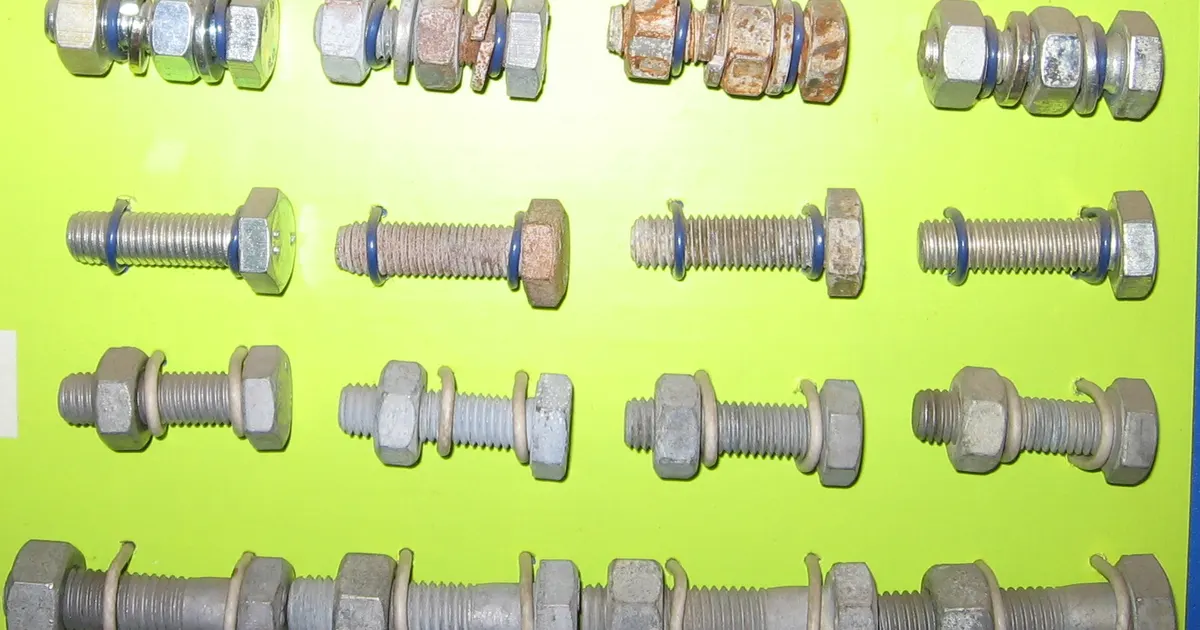
Both processes put zinc on steel, and both protect by sacrificing themselves. The difference is how much zinc and how it is applied. Hot-dip galvanizing builds a coating many times thicker than electroplated zinc and lasts decades outdoors. Zinc electroplating gives a thin, smooth, accurate coating for parts that fit together, and it lasts as long as its thickness and passivate allow. Choosing between them is mostly a matter of environment, part size and tolerance.
How each process works
Hot-dip galvanizing. Steel parts are degreased, pickled in acid, rinsed and coated with a flux. They are then dipped in a bath of molten zinc at roughly 450 °C. The zinc reacts with iron at the surface and forms a series of zinc-iron alloy layers, with a layer of nearly pure zinc on top. After withdrawal the part cools in air or water. The result is a metallurgically bonded, tough coating.
Zinc electroplating. Steel parts are cleaned, activated and immersed in a zinc bath. Electric current deposits zinc metal on the surface. A passivate is applied afterward, and for hardened parts a bake follows. The coating is a pure zinc layer, thin and even, without alloy layers.
Side-by-side comparison
| Property | Hot-dip galvanizing | Zinc electroplating |
|---|---|---|
| Typical thickness | 45 to 100 µm | 5 to 25 µm |
| Governing standards | ASTM A123, A153, ISO 1461 | ASTM B633, ASTM F1941 for fasteners |
| Appearance | Gray, spangled, rougher | Bright to matte, smooth |
| Outdoor life | Decades in many environments | Months to years, passivate dependent |
| Bath temperature | About 450 °C | Near room temperature |
| Part size limit | Kettle size | Tank size and rack |
| Dimensional effect | Large, thread fits affected | Small |
| Hydrogen risk on hardened steel | Low in practice | Yes, needs bake |
| Cost | Lower per tonne on structural steel | Lower per piece on small parts |
All numbers are typical. Standards give minimum thickness by steel section thickness and by article type.
Thickness and life
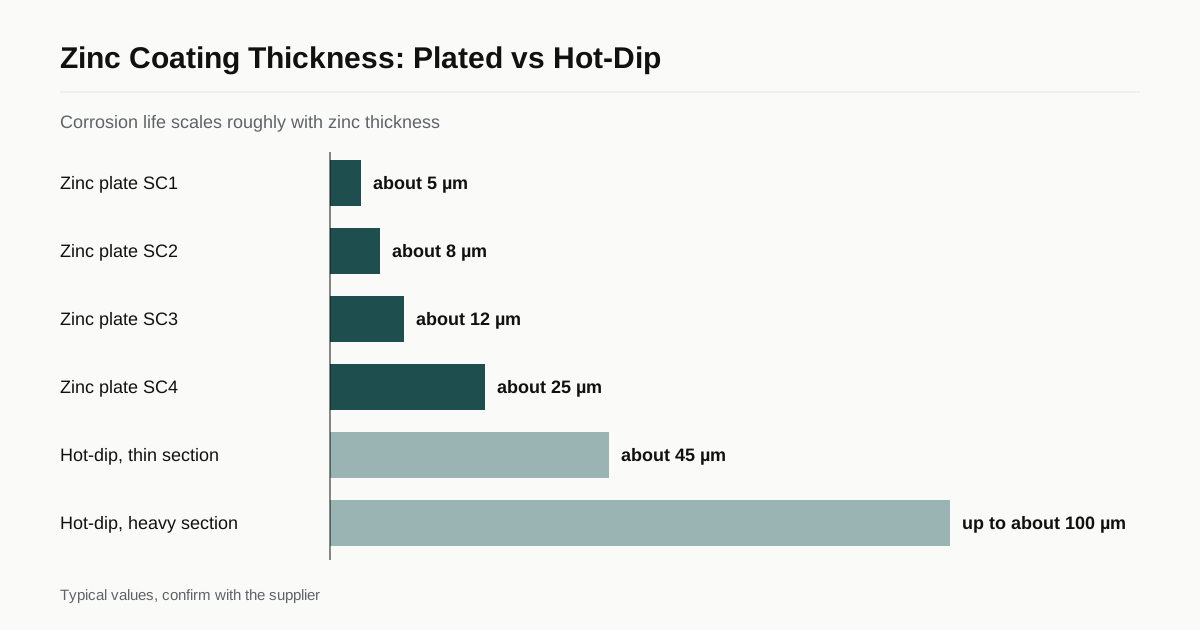
For hot-dip galvanizing, ASTM A123 sets minimum average coating by steel thickness, so heavier sections receive thicker zinc, roughly 45 µm on thin material and up to about 100 µm on heavy plate. ASTM A153 covers hardware and small parts such as bolts, with thinner minimums scaled to the article. ISO 1461 is the international equivalent.
Zinc plating thickness is set by service class under ASTM B633. Common classes are SC1 at about 5 µm, SC2 at 8 µm, SC3 at 12 µm and SC4 at 25 µm. Most hardware sits at 5 to 12 µm.
The corrosion rate of zinc is roughly constant in a given environment, so life scales almost linearly with thickness. A coating ten times thicker lasts about ten times longer, other things equal. That is why a galvanized guardrail can last decades and a zinc plated bolt starts to show white corrosion in months of outdoor exposure. Environment changes the rate a lot. Marine and industrial air are harsher than dry inland air.
Appearance
Galvanizing is not a cosmetic coating. The surface can be spangled, matte or slightly rough, with drip lines, runs and visible bare patches around fixtures. The color is a bright silver when new, weathering to dull gray. Galvanizing over steel with high silicon content can come out darker and thicker.
Zinc plating is smoother, with a bright or satin finish and a passivate color. It suits visible hardware and parts that will be painted.
Dimensions, threads and fits
Galvanizing adds 45 to 100 µm per surface, which closes small gaps. Fasteners are galvanized separately. Nuts are tapped oversize after or before galvanizing, according to the fastener standard, so that they accept a galvanized bolt. External threads are normally galvanized to size and not re-cut. Parts with tight fits, holes or close tolerances usually need masking, re-reaming or a different finish.
Zinc plating adds much less, typically 5 to 25 µm per surface, which is why it is common for machined parts. Even so, threads need an allowance. See thread fits after plating.
Distortion and steel condition
The molten zinc bath at about 450 °C brings thermal stress. Thin sheet, unsymmetrical welded assemblies and parts with large mass differences can warp. Hollow sections and closed boxes need vent and drain holes so air and zinc can flow, otherwise they can trap liquid and burst in the bath. Design for galvanizing is a subject in itself, and galvanizers publish guides.
Steel chemistry matters. Silicon and phosphorus in the steel change the coating growth rate. Heat-treated steel can lose strength if it was tempered below the bath temperature. Cold-worked or notched steel can be prone to strain-age embrittlement.
For electroplated zinc on steel above about 39 HRC, a relief bake after plating is required. See hydrogen embrittlement relief bake. Hot-dip galvanizing involves acid pickling too, but the hot bath drives hydrogen out, so risk is small on normal grades. For high strength bolts, follow the specific guidance in the fastener standard.
Inspection and acceptance
Galvanizing inspection is mostly visual and by thickness. The galvanizer checks coating thickness with a magnetic gauge per ASTM E376 or ISO 2178 on several points of each article, and the standard sets how many readings count for a lot. Visual defects that matter include uncoated areas, blisters, flux inclusions, heavy runs and rough surface that interferes with function. Minor roughness and spangle are normal and are not rejection reasons.
Zinc plating is checked with XRF or a magnetic gauge, plus a visual check of passivate color and coverage, and a salt spray test on a sample plan if the drawing requires one. See coating thickness measurement for method details.
Both processes issue a certificate. For galvanizing it normally lists the standard, the steel description and the coating thickness range. Ask for it if the project requires documentation, since structural and utility jobs often do.
Repair of damaged zinc
Cut, welded or drilled areas after galvanizing are bare steel. Repair is done by thermal spraying zinc, by zinc-rich paint or by zinc solder sticks, with minimum thickness and a coverage rule set in ASTM A780. Zinc plated parts are not normally repaired locally, since the coating is thin. A scratch heals itself to a degree because the surrounding zinc keeps protecting the steel by sacrificial action, up to about a few millimeters from the bare edge in many environments.
Plan welding and drilling before coating. Welding after galvanizing burns the zinc around the weld and releases fumes, so ventilation and cleaning rules apply, and the area needs repair.
Environment guidance
Corrosion rate of zinc depends on where the part lives.
- Dry indoor or sheltered: thin zinc plate with a passivate is often enough for years.
- Rural outdoor: galvanizing gives very long life. Plated zinc is short-lived without paint.
- Marine or coastal splash zone: zinc corrodes several times faster. Galvanizing still helps, and duplex paint systems are common.
- Industrial or acidic air: sulfur compounds attack zinc faster. A duplex system or a more resistant alloy plating may be needed.
- Immersion in water: galvanizing has a long record in water tanks, with limits on water chemistry such as very soft or very hot water.
The environment, not the process name, should drive the finish choice. If the real exposure is severe, ask the shop whether zinc is the right base at all.
Duplex systems
Many outdoor structures use both. A galvanized steel part is painted or powder coated for appearance and extra life. The paint protects the zinc and the zinc protects the steel, and the combined life exceeds the sum of the parts. The surface needs preparation for the paint to stick, such as a light sweep blast or an etch. See powder coating pretreatment and cure and outdoor powder coating for enclosures and brackets.
Cost and logistics
Galvanizers charge by weight and minimum batch, and they usually serve structural steel, fabrications and hardware in bulk. Lead times depend on the kettle schedule. Zinc platers charge per piece or per rack and handle small and mid-size parts, with shorter turnaround on small lots. Our guide to plating and coating cost lists other drivers.
Choosing between them
- Structural steel, fences, poles and large fabrications outdoors: hot-dip galvanizing.
- Fasteners outdoors for long life: hot-dip galvanized to the fastener standard, or a zinc flake system. See zinc flake coatings for fasteners.
- Small machined parts, tight fits, indoor or mild outdoor use: zinc plating with a passivate.
- Parts that will be painted: either, with surface preparation agreed.
- Hardened parts: consider zinc flake or a mechanical process instead of either.
What to put on the RFQ
- Part size, weight, steel grade and any heat treatment.
- Process and standard, such as ASTM A123, A153 or B633.
- Thickness class and where it is measured.
- Cosmetic requirements and fixture marks allowed.
- Threads, holes and fits that need protection.
- Downstream painting or powder coating.
- Lot size and drawing.
See also: Hot-dip galvanizing reference: ASTM A123 and ISO 1461 thickness tables, steel chemistry and design.
How we help
We are a matching service, not a coating shop. Send one RFQ with the part and the process you expect and we pass it to up to 3 shops that run zinc plating or hot-dip galvanizing. Replies come within 24 business hours. Start with the RFQ form or read which metal finish for your part.
Frequently asked questions
Why is hot-dip galvanizing so much thicker than zinc plating?
Hot-dip galvanizing immerses the part in molten zinc at around 450 °C, where zinc reacts with the steel and builds alloy layers plus an outer zinc layer. Typical coating is 45 to 100 µm. Electroplating deposits zinc with an electric current for a short time, typically 5 to 25 µm. The thickness gap is the main reason for the life gap outdoors.
Can I galvanize a heat-treated or very hard part?
Be careful. The molten zinc bath is around 450 °C, which can temper some heat-treated steels and soften them. High strength fasteners above about Grade 8.8 need specific guidance from the fastener standard. Cold-worked parts can also strain-age. State the steel and its heat treat on the RFQ.
Do galvanized nuts fit galvanized bolts?
Yes, because the nut is tapped oversize before galvanizing to leave room for the coating. The bolt thread is galvanized to size. Standard galvanized fastener sets are matched for that reason, so mixing a plain nut with a galvanized bolt, or the reverse, can give a poor fit.
Need a quote for this finish?
Send the drawing. We match you with up to 3 finishing shops that run your spec and reply within 24 business hours.
Get matched with a coating shop