Guides / Specs
Chromate Conversion Coating: MIL-DTL-5541 Type I vs Type II on Aluminum
October 19, 2026
Chromate conversion coating, often called by a trade name such as Alodine or simply “chem film”, is the thin protective layer applied to aluminum when a designer wants corrosion resistance without adding thickness and without losing electrical conductivity. It is common on aerospace, defense, electronics and enclosure parts. The governing specification is MIL-DTL-5541, and the two choices that matter most on a drawing are Type I vs Type II and Class 1A vs Class 3. Getting those right means the part passes both the corrosion requirement and the electrical one.
What the coating is
Unlike plating, a conversion coating does not add a separate metal layer. The part is dipped, sprayed or brushed with an acidic solution that reacts with the aluminum surface and builds a very thin film of chromium compounds and aluminum oxide on it. The film is typically less than a micrometer thick, in the range of tens to a few hundreds of nanometers. It is soft and gel-like when fresh and hardens over about a day as it dries.
The result protects the aluminum against corrosion, gives a good base for paint and primer, and, because it is so thin, stays electrically conductive enough for grounding in the right class.
Type I and Type II
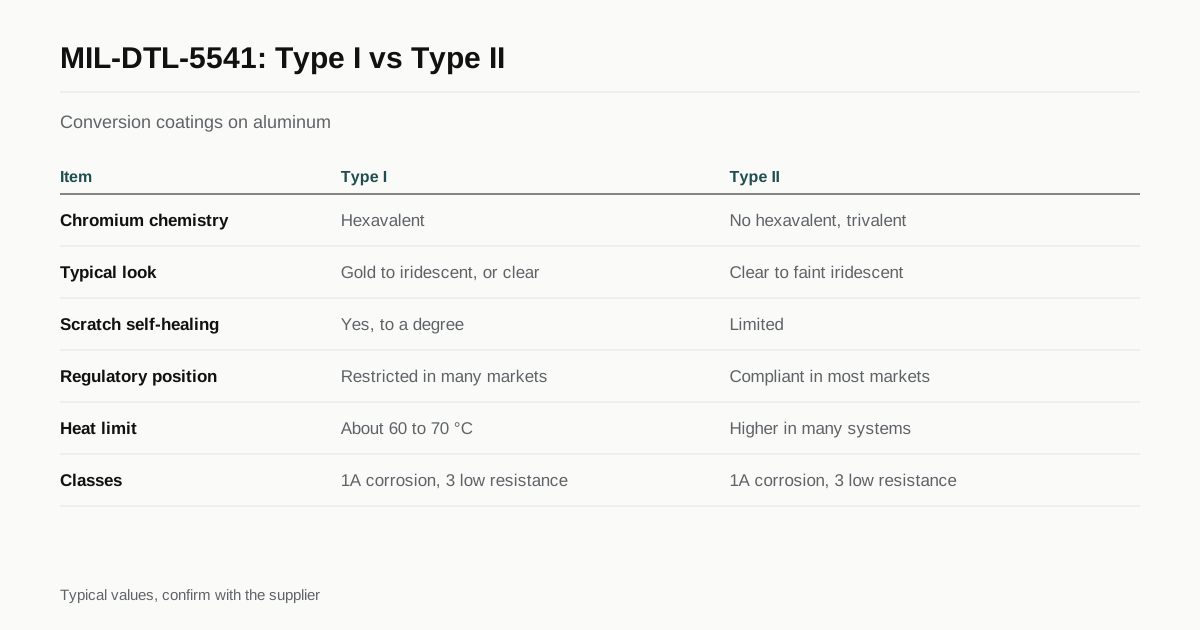
| Item | Type I | Type II |
|---|---|---|
| Chromium chemistry | Contains hexavalent chromium | No hexavalent chromium, trivalent systems |
| Typical appearance | Golden yellow to iridescent, or clear | Clear to faint iridescent, sometimes pale blue |
| Corrosion protection | High | Meets the same spec requirements when properly run |
| Self-healing of scratches | Yes, to a degree | Limited |
| Regulatory position | Restricted in the EU and other markets | Compliant in most markets |
| Heat limit | About 60 to 70 °C before the film degrades | Higher in many systems, check with the shop |
Type I was the original system and has a long track record. The hexavalent chromium it contains is toxic and subject to restrictions such as EU RoHS and REACH, and to occupational limits in many countries. Type II was added to the specification to allow trivalent systems that pass the same salt spray and electrical resistance tests. Unless a legacy drawing or a contractual flow-down requires Type I, specify Type II for new designs and ask the shop for the qualified products and their documentation.
Class 1A and Class 3
The class describes the intended performance.
- Class 1A gives maximum corrosion protection. It is used bare or as a paint base. The film is thicker and the color is more visible.
- Class 3 gives protection where low electrical resistance is needed. The film is thinner and lighter, so it conducts better. Typical uses include grounding studs, bonding surfaces, connector housings and enclosure joints.
If you need both a painted surface and a bare conductive area on the same part, you can specify Class 1A on the part and mask the bonding area, then treat that area with Class 3 afterward, or the reverse. The simpler route is Class 3 everywhere and a primer that bonds to it, but that depends on the paint specification.
Testing
The specification sets acceptance tests for the film, run on test panels or on production parts depending on the agreement.
- Salt spray. Per ASTM B117, with the hours and pass criterion named in the spec. See what salt spray hours really mean.
- Paint adhesion. Cross-hatch or wet tape tests of the paint applied over the film.
- Electrical resistance for Class 3. Measured between two points on the surface under a defined contact pressure.
- Appearance. The film must be continuous, uniform and free of powder, streaks or bare patches.
Ask for the test reports, since “to MIL-DTL-5541” on a certificate means little unless the type, class and test results are stated.
Processing and handling
Several details decide whether the film works.
- Cleaning and deoxidizing. Aluminum must be clean and free of its natural oxide for the film to form. Shops use an alkaline clean and an acid deoxidizer, which removes a little material.
- Immersion time and pH. The film grows with time, and Class 3 uses shorter times.
- Rinsing. Proper rinsing removes unreacted chemistry.
- Drying. Parts must dry at room temperature or with warm air. Type I films degrade if hot-dried above the limit.
- Curing. The film is soft for the first day. Wiping, rubbing and stacking can damage it.
- Time to paint. Paint specifications often require primer within a set time after conversion coating. A common figure is within a day or so, and some specs allow longer if parts are stored clean.
Application methods
Conversion coating can be applied in several ways, and the method affects what the shop can do with your part.
- Immersion. Parts go in a tank. This gives the most consistent film and suits small and mid-size parts. Racked parts leave a small contact mark.
- Spray. Large parts and assemblies can be sprayed in a booth. It is common for aircraft sections and large enclosures.
- Brush or pen. A swab, brush or pen applies the chemistry locally for touch-up after machining, welding or damage. The film is of the same type but harder to control, and the specification allows it for repair.
If a part has been anodized and later machined, bare areas can be touched up with brush-applied conversion coating to restore protection. Many aerospace repair procedures follow that route, and MIL-DTL-5541 treats brush application as an approved method for touch-up of a specified class.
Common reasons parts fail inspection
- Powdery or loose film. The film was too thick, the bath too old or the rinse poor. A powdery film also ruins paint adhesion.
- Low conductivity on Class 3. The film was left too long in the bath, or the part was painted over a contact area.
- Poor salt spray. The surface was not deoxidized properly, or the film was damaged during handling in the first day.
- Color mismatch. Type II films have little color, and a buyer expecting gold sees almost nothing. Color is not a reliable way to confirm a film is present.
- Heat damage. Type I films dried above their temperature limit lose protection.
Because the film is so thin, many buyers ask for a simple test of presence, such as a drop test or a salt spray on a witness panel from the same lot.
Storage and shelf life before paint
A coated part waiting for paint should be kept clean, dry and handled with gloves. Contamination with fingerprints, oils or shop dust spoils paint adhesion. Specify the maximum waiting time between conversion coating and priming, and require packaging that keeps dust off. If the gap exceeds the limit, the usual remedy is to strip and re-coat, or to wipe with an approved cleaner, as the paint spec allows.
What the coating cannot do
Chromate conversion films protect, but they do not replace anodizing or paint where abrasion or a heavy corrosion exposure is expected. The film is soft, easily scuffed and thin. For wear surfaces see hard anodize, nitriding or hard chrome. For thick protective oxide with decorative color, see Type II vs Type III anodizing.
A conversion coating is also not a good choice where the part will be hot-formed after coating, or where it will run above the heat limit of the film chemistry.
Alloys and substrates
Most wrought aluminum takes conversion coating well. High copper alloys such as 2024 give darker, less uniform films, and cast alloys with high silicon give patchier ones. See anodizing 6061, 7075 and cast aluminum for how alloy shifts surface chemistry. The same lesson applies. Name the alloy and temper on the drawing. When chem film or anodize fits a part is covered in our guide to aluminum anodizing.
Masking
Conversion coatings are applied by immersion, so masking is needed wherever bare metal must remain bare. Plugs, tape and lacquer work as they do for anodizing, with the added requirement that the masking must survive the acid clean. See masking for plating and anodizing.
Regulation and documentation
If your product is sold in the EU or to a customer with a restricted substances list, ask for the compliance documents with the certificate. These typically cover RoHS status, REACH statements and, for trivalent systems, any cobalt content. Aerospace and defense programs may also require the product to be listed on a qualified products list. Name the requirement in the RFQ so the shop can confirm it first.
What to put on the RFQ
- Aluminum alloy and temper.
- Specification, type and class, for example MIL-DTL-5541 Type II Class 3.
- Areas that need to be bare or need low resistance, with the test point locations if relevant.
- Paint or primer to be applied afterward and the time limit.
- Salt spray and resistance test requirements.
- Regulatory requirements, such as RoHS, REACH or cobalt-free.
- Lot size and drawing.
See the coating RFQ checklist for more.
How we help
We are a matching service, not a coating shop. Send one RFQ with the type, class and test requirements and we pass it to up to 3 shops that run conversion coating lines for aluminum. Replies come within 24 business hours. Start with the RFQ form.
See also what a Nadcap chemical processing accreditation shows for conversion coating.
Frequently asked questions
What is the difference between Type I and Type II in MIL-DTL-5541?
Type I films are made from chemistry containing hexavalent chromium. Type II films are made from chemistry that contains no hexavalent chromium, normally trivalent chromium systems. Both are conversion coatings on aluminum, and the spec lets the buyer name which one applies. For new products Type II is the usual starting point, because Type I is restricted in many markets.
What do Class 1A and Class 3 mean?
Class 1A is for maximum corrosion protection, either on its own or as a base for paint. Class 3 is for protection where low electrical resistance is needed, such as grounding and bonding surfaces. A Class 3 film is thinner and lighter than a Class 1A film so it conducts better.
Does a chromate conversion coating change dimensions?
For practical purposes no. The film is typically well under a micrometer thick, so it does not need an allowance on fits, unlike plating or anodizing. It does change the surface chemistry, so masking bare areas can still matter.
Need a quote for this finish?
Send the drawing. We match you with up to 3 finishing shops that run your spec and reply within 24 business hours.
Get matched with a coating shop