Guides / Specs
DLC Coating Types: From a-C:H and WC/C to ta-C
October 18, 2026
DLC coating types are classified by VDI 2840 into hydrogen-free and hydrogenated amorphous carbon films, each with plain, sp3-rich and modified variants: a-C, ta-C, a-C:Me, a-C:H, ta-C:H, a-C:H:Me and a-C:H:X. Hydrogen content and the share of diamond-type sp3 bonds decide hardness, friction, behavior in humid air and the temperature limit. In production most parts get one of three films: hydrogenated a-C:H, tungsten-doped WC/C or hydrogen-free ta-C. Values in this guide are typical, not promised.
The PVD overview introduces DLC next to TiN and CrN. This guide breaks the DLC family apart so you can name the right film on a drawing.
Why “DLC” alone is not a specification
“Diamond-like carbon” covers films with hardness from around 10 GPa to well above 40 GPa, temperature limits from about 300 °C to about 500 °C and very different friction behavior in dry or humid air. Some are made by sputtering, some by arc and some by plasma-assisted CVD. A drawing note that says only “DLC” lets each shop deliver whatever it runs.
VDI 2840 is the guideline from the Association of German Engineers on carbon films. It gives each film type a short designation and describes its structure and typical properties. It also covers crystalline diamond and graphite films, which are outside the DLC family. Using its designations on an RFQ gets you comparable quotes.
Three ingredients: sp2, sp3 and hydrogen
Amorphous carbon is a mix of two bonding types plus hydrogen:
- sp2 bonds, as in graphite. They give low hardness, electrical conductivity and a dark color.
- sp3 bonds, as in diamond. They give hardness, stiffness and wear resistance.
- Hydrogen, bonded to carbon. It stabilizes the amorphous network, lowers stress and changes friction. Too much of it gives a soft, polymer-like film.
Materials science describes every amorphous carbon film as a point in a triangle between these three corners. ta-C sits near the sp3 corner with almost no hydrogen. a-C:H sits in the middle with a moderate sp3 share and a significant hydrogen content. The sp3 fraction is measured in the lab by electron energy loss spectroscopy or estimated from Raman spectra. Buyers rarely see that figure. Hardness, hydrogen content and process are the practical proxies.
The VDI 2840 family at a glance
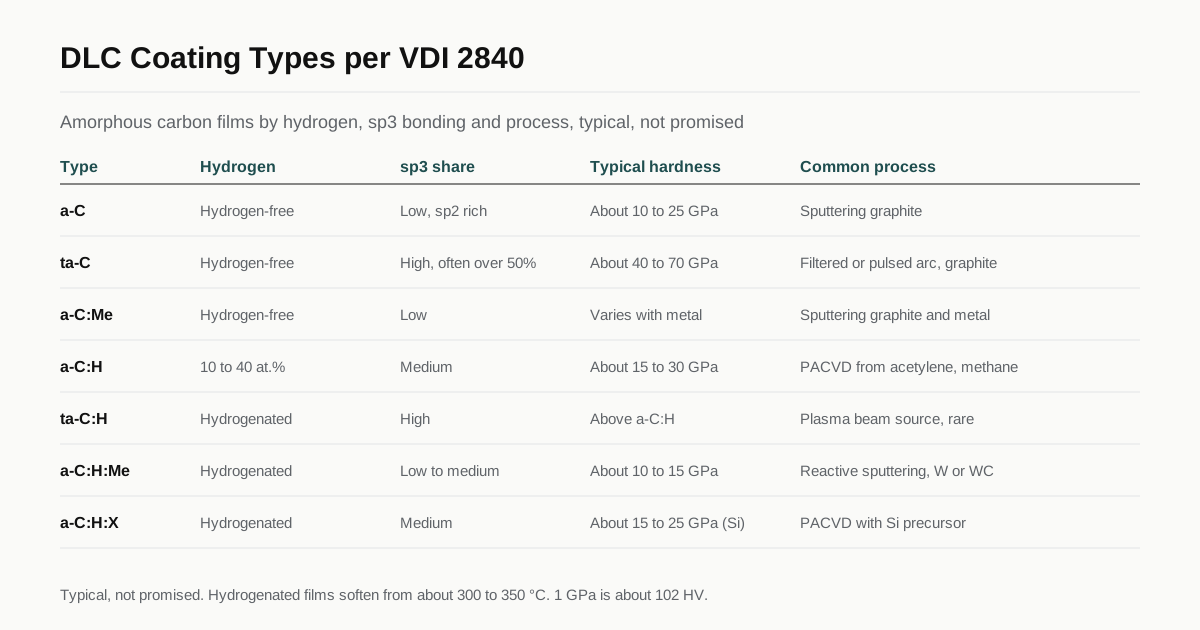
| Designation | Hydrogen | Modifier | Typical sp3 share | Typical hardness | Common process |
|---|---|---|---|---|---|
| a-C | Hydrogen-free | None | Low, sp2 rich | About 10 to 25 GPa | Sputtering graphite |
| ta-C | Hydrogen-free | None | High, often over 50% | About 40 to 70 GPa | Filtered or pulsed arc from graphite |
| a-C:Me | Hydrogen-free | Metal, e.g. Cr, Ti, W | Low | Varies with metal | Sputtering graphite and metal |
| a-C:H | Commonly 10 to 40 at.% | None | Medium | About 15 to 30 GPa | PACVD from acetylene or methane |
| ta-C:H | Hydrogenated | None | High | Above a-C:H | Plasma beam sources, less common |
| a-C:H:Me | Hydrogenated | Metal, mostly W | Low to medium | About 10 to 15 GPa | Reactive sputtering of W or WC |
| a-C:H:X | Hydrogenated | Si, O, N, F or B | Medium | About 15 to 25 GPa for Si | PACVD with a silicon precursor |
One GPa is about 102 HV, so a-C:H at 20 GPa is roughly 2000 HV. Hardness on a film 1 to 3 µm thick should be measured by nanoindentation under ISO 14577, not by microhardness. The PVD adhesion and thickness testing guide explains why.
Hydrogen-free films: a-C and ta-C
ta-C
Tetrahedral amorphous carbon is the hardest DLC. It is made by cathodic arc from a graphite target, either through a magnetic filter that removes droplets or with a pulsed arc followed by polishing. Its high sp3 share gives hardness commonly in the range of 40 to 70 GPa, with very high compressive stress. That stress limits thickness, so ta-C is often kept to about 1 to 2 µm and needs careful interlayer design for thicker builds.
ta-C holds higher temperatures than hydrogenated DLC, often cited around 450 to 500 °C in air. Its friction against steel is low in air and drops further under oil. Unlike hydrogenated DLC, hydrogen-free films keep low friction in humid air and can show higher friction in very dry or inert gas.
Common uses: carbide end mills and drills for aluminum, copper alloys, plastics and composites. Piston rings, cam followers and highly loaded sliding parts. Forming tools for aluminum sheet where pickup is the problem.
a-C and a-C:Me
Sputtered hydrogen-free a-C is sp2 rich, softer than ta-C and electrically conductive. Metal-containing a-C:Me adds chromium, titanium or tungsten to tune stress, toughness and conductivity. Both are less common on drawings than ta-C or a-C:H. If a shop proposes one, ask for its datasheet and the reason for the choice.
Hydrogenated films: a-C:H and ta-C:H
a-C:H
a-C:H is the most widely produced DLC. It is usually made by plasma-assisted CVD (PACVD): a pulsed DC or RF glow discharge cracks acetylene or methane at the part surface. The literature commonly gives hydrogen contents of 10 to 40 atomic percent. Typical hardness is about 15 to 30 GPa and typical film thickness is 1 to 4 µm on top of an interlayer.
Process temperatures commonly stay below about 200 to 250 °C, which allows coating of case hardened steels tempered at low temperature. The plasma wraps around the part better than a pure line-of-sight PVD flux. Narrow bores still coat thin.
Friction against steel in dry sliding is low, commonly around 0.05 to 0.2. Hydrogenated films give their lowest friction in dry or inert gas. Friction rises in humid air. Above about 300 to 350 °C, hydrogen leaves the film and the network turns more graphitic, so hardness drops. a-C:H is black, which makes it a decorative coating as well as a wear coating.
ta-C:H
ta-C:H combines high sp3 content with hydrogen. It is made with plasma beam sources and is far less common in production than a-C:H or ta-C. You are unlikely to need to specify it.
Modified films: a-C:H:Me and a-C:H:X
a-C:H:Me, mostly WC/C
The most common metal-containing DLC adds tungsten. Shops make it by reactive sputtering of tungsten or tungsten carbide targets in argon with acetylene. The film holds tungsten carbide nanoclusters in a hydrogenated carbon matrix and is often written WC/C or a-C:H:W. Hardness is lower than a-C:H, commonly about 10 to 15 GPa, but stress is lower and the film is tougher. Friction is low, around 0.1 to 0.2 against steel.
WC/C is used on its own for gears, bearings and fuel system parts. It also serves as the transition layer between a chromium bond layer and an a-C:H top layer.
a-C:H:X, mostly silicon-doped
a-C:H:X adds a nonmetal. Silicon is the common one, introduced from a precursor such as tetramethylsilane or hexamethyldisiloxane. The second brings oxygen with it and gives a-C:H:Si:O. Silicon is reported to reduce the sensitivity of friction to humidity, raise thermal stability somewhat and lower surface energy, which helps release and anti-stick uses. Typical hardness for silicon-doped films is about 15 to 25 GPa.
Adhesion: interlayers and substrate support
Carbon films bond poorly to steel on their own and carry high compressive stress. Shops therefore build a stack:
- Metal bond layer, usually chromium or titanium, a fraction of a micrometer.
- Transition layer, such as CrN, chromium carbide or tungsten carbide, often graded.
- Graded WC/C or silicon-containing layer to step the stress down.
- Functional carbon top layer: a-C:H, ta-C or a modified film.
The total stack on a sliding part is commonly 2 to 5 µm. Adhesion is checked with a Rockwell C indentation on a coupon and graded HF1 to HF6 under VDI 3198, with HF1 to HF4 commonly accepted and the best classes often asked for on highly loaded parts.
Substrate support matters as much as the coating. A hard film on a soft substrate breaks like an eggshell when the substrate yields under load. For heavily loaded contacts, shops look for a hardened substrate, commonly around 58 HRC or above. A plasma nitrided case under the coating is the other route. Surface finish matters too: DLC follows the substrate topography. Sliding parts are often polished to a low Ra before coating. Ask the shop to confirm the starting Ra it needs.
DLC is thin and contains defects. It is not a standalone corrosion barrier on carbon steel. Firearm and outdoor parts still need a corrosion resistant substrate or a suitable underlayer.
Applications by type
| Application | Common DLC types | Why |
|---|---|---|
| Valvetrain: bucket tappets, finger followers, cam followers | a-C:H, WC/C, ta-C | Low friction and scuffing resistance in boundary lubrication |
| Fuel injection: needles, plungers, valve pieces | a-C:H, WC/C | Wear in low-lubricity fuel at high pressure |
| Piston pins and piston rings | a-C:H, ta-C | Friction and scuffing |
| Racing engines and gearboxes | a-C:H, ta-C, WC/C | Friction under marginal lubrication |
| Firearm parts: bolt carriers, slides, triggers | a-C:H | Sliding wear and a black finish |
| Watch cases and consumer parts | a-C:H | Scratch resistance and black color on stainless |
| Surgical instruments | a-C:H, Si-doped a-C:H | Wear and anti-stick |
| Tools for aluminum, copper, plastics | ta-C | No built-up edge, very hard |
| Forming of aluminum sheet | a-C:H, ta-C | Low pickup |
For medical parts, biocompatibility is proven on the finished device, not claimed by a coating datasheet. See the medical device coating guide. For black decorative finishes on stainless steel, compare DLC with nitride-based black PVD before you choose.
Limits to plan around
- Temperature. Hydrogenated DLC softens from about 300 to 350 °C. ta-C goes higher. None of them suits hot steel cutting.
- Ferrous machining. Carbon diffuses into iron at cutting temperatures, so DLC wears fast on steel and cast iron. Use TiAlN, AlTiN or AlCrN there, as covered in types of PVD coating.
- Thickness. Commonly 1 to 4 µm including the interlayer, less for ta-C. The film does not fill roughness or correct size.
- Counterface. Many DLC films lay a thin carbon transfer film on the mating part. This helps friction but means the pair, not the coating alone, decides the result. Test the pair.
- Sharp edges. High stress can chip the film on sharp edges and corners. Small edge radii help.
- Strip and recoat. Removing DLC from a part without damaging the substrate is possible but often slower than stripping nitrides. Ask the shop before you plan regrinds.
If you are comparing DLC with hard chrome or electroless nickel on a hardened steel part, note that electroplated steel over 39 HRC needs a hydrogen embrittlement relief bake under ASTM B850. DLC does not use a plating bath, so the bake does not apply. Its process temperature, compared with your tempering temperature, is the check that matters. See the hydrogen embrittlement guide.
Getting DLC quoted
Describe the contact, not just the coating. A useful DLC RFQ lists:
- Substrate, hardness, heat treatment and tempering temperature.
- The sliding pair: counterface material and hardness, load or contact pressure, speed and lubrication.
- Operating temperature and environment, including humidity, fuel or coolant.
- Coating designation per VDI 2840, for example “a-C:H on Cr and WC/C interlayer”. If unsure, write “as proposed, with datasheet”.
- Total thickness range and the faces to coat and to keep free.
- Ra before coating and the target Ra after coating.
- Appearance needs, for example uniform black on visible faces.
- Coupons, thickness by ball crater, adhesion class by Rockwell indentation and the report you expect.
For the wider decision between DLC, nitride coatings and plating, see our guide to PVD coating services.
The coating RFQ checklist covers the general items. We are a matching service, not a coating shop. Choose “PVD” as the finish on the RFQ form and name the DLC type in the notes. We pass your request to up to 3 shops that run that carbon film, they quote you directly and you get a reply within 24 business hours. Send your DLC RFQ.
Sources
- Diamond-like carbon, Wikipedia (film types, sp2 and sp3 bonding, hydrogen, deposition)
- Plasma-enhanced chemical vapor deposition, Wikipedia (glow discharge deposition from hydrocarbon gases)
Frequently asked questions
What are the main types of DLC coating?
VDI 2840 splits amorphous carbon films into hydrogen-free and hydrogenated groups. Hydrogen-free films are a-C, sp3-rich ta-C and metal-containing a-C:Me. Hydrogenated films are a-C:H, sp3-rich ta-C:H, metal-containing a-C:H:Me such as tungsten-doped WC/C and a-C:H:X modified with a nonmetal such as silicon. In production most parts get one of three: hydrogenated a-C:H, tungsten-doped WC/C or hydrogen-free ta-C. Name the designation on the RFQ.
What is the difference between a-C:H and ta-C?
a-C:H contains hydrogen, commonly in the range of 10 to 40 atomic percent. It is usually made by plasma-assisted CVD from a hydrocarbon gas. ta-C is hydrogen-free with a high share of diamond-type sp3 bonds and is made by filtered or pulsed arc from graphite. ta-C is typically harder and holds higher temperatures. a-C:H is the more common and generally lower cost choice for sliding parts.
What temperature can a DLC coating take?
Hydrogenated DLC such as a-C:H typically starts to lose hydrogen and soften from about 300 to 350 °C, so it suits parts that run cooler than that. Hydrogen-free ta-C is commonly rated higher, often cited around 450 to 500 °C in air. Deposition itself usually runs below about 200 to 250 °C. Confirm both the service limit and the process temperature with the shop.
Can DLC be used for cutting steel?
Generally not. At the temperatures reached when cutting steel, carbon from the coating diffuses into the iron and the film wears quickly. DLC, ta-C in particular, is used on tools for aluminum, copper alloys, plastics and composites. For steel and cast iron, nitride coatings such as TiAlN, AlTiN or AlCrN are the usual choice.
Why does DLC need an interlayer?
Carbon films carry high compressive stress and bond poorly to steel on their own. Shops deposit a thin metal layer, usually chromium or titanium, then a transition such as CrN or tungsten carbide, often grading into a WC/C layer before the top carbon film. The interlayer carries adhesion and spreads stress. Adhesion is then checked with a Rockwell indentation test on a coupon.
Need a quote for this finish?
Send the drawing. We match you with up to 3 finishing shops that run your spec and reply within 24 business hours.
Get matched with a coating shop