Guides / Specs
Electroless Nickel Phosphorus Content: Choosing Low, Mid or High Phosphorus
October 21, 2026
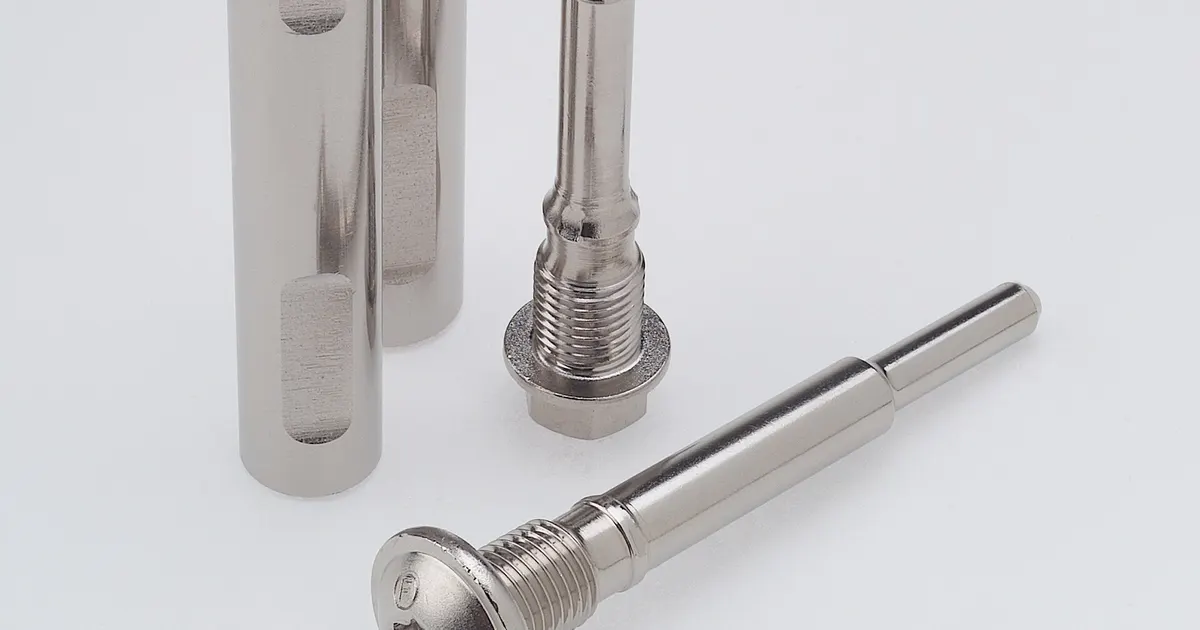
Electroless nickel is not one coating. It is a family of nickel-phosphorus alloys, and the amount of phosphorus in the deposit sets most of its behavior: how hard it is, how it resists acid, whether it is magnetic and how well it holds up when parts rub together. A drawing that says “electroless nickel” with no further detail leaves the shop to pick, and the choice changes the result. Naming the phosphorus level takes one line and removes most surprises.
What electroless nickel is
Electroless nickel is deposited by a chemical reaction, not by electric current. A hot bath, typically around 85 to 95 °C, contains nickel salts and a reducing agent, usually sodium hypophosphite. The reducing agent releases phosphorus into the deposit as it plates the metal. Because no current is involved, the coating builds up at nearly the same rate on edges, in holes and on flat faces. That even coverage is the main reason engineers choose it over electroplated nickel for complex parts. Typical thickness runs from about 5 to 25 µm, and thicker deposits are used for wear and salvage.
The three phosphorus bands
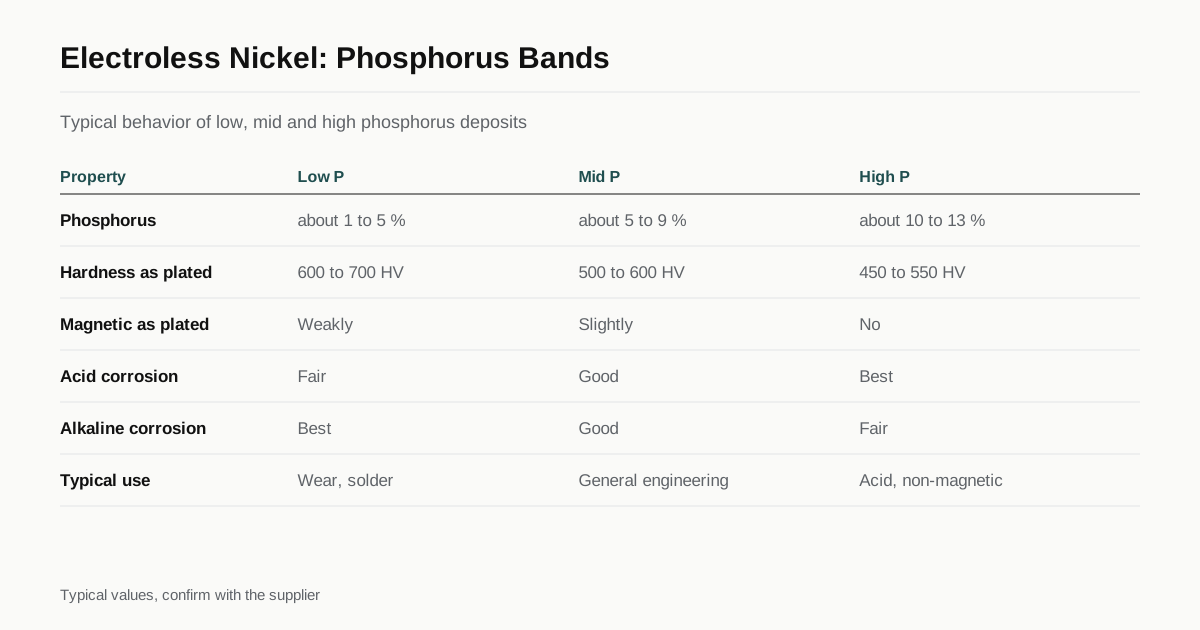
Shops group deposits into low, mid and high phosphorus. The band edges vary a little between sources.
| Property | Low phosphorus | Mid phosphorus | High phosphorus |
|---|---|---|---|
| Phosphorus in deposit | about 1 to 5 percent | about 5 to 9 percent | about 10 to 13 percent |
| Structure as plated | Microcrystalline | Mixed | Amorphous |
| Hardness as plated | About 600 to 700 HV | About 500 to 600 HV | About 450 to 550 HV |
| Magnetic as plated | Yes, weakly | Slightly | No |
| Corrosion in acid | Fair | Good | Best |
| Corrosion in alkaline | Best | Good | Fair |
| Typical use | Wear, solder, hard disk style parts | General engineering | Oilfield, chemical, electronics |
Values are typical, not promised. Hardness figures are approximate, since bath chemistry and age change them.
Low phosphorus gives the hardest as-plated surface and the best wear performance, along with good resistance to caustic solutions. It is more brittle and less protective against acid than higher phosphorus grades.
Mid phosphorus is the workhorse. It plates reliably, resists many environments and costs less to run than the extremes. Most hydraulic, machinery and tooling parts use it.
High phosphorus has an amorphous structure with no grain boundaries for corrosion to follow. That makes it the choice for acid, sour oil and gas service and for non-magnetic parts. The cost is lower hardness as plated, though heat treatment narrows the gap.
Heat treatment
All electroless nickel hardens when heated. A common cycle is about one hour at 350 to 400 °C. The deposit forms hard nickel phosphide particles and reaches roughly 850 to 1000 HV, comparable to hard chrome. Wear performance improves a great deal after hardening.
Heat treatment brings trade-offs worth knowing:
- Corrosion resistance falls slightly, because the structure becomes crystalline.
- High phosphorus deposits become magnetic.
- Aluminum alloys that rely on a heat-treated temper cannot take 400 °C without losing strength. A lower temperature bake of about 130 to 190 °C is used on aluminum for adhesion, with modest hardness gain.
- Dimensional change is small but real, since the coating shrinks a little. Precision fits should be checked after heat treat.
Specifications you will see
Several standards cover the process.
- ASTM B733 defines autocatalytic nickel-phosphorus coatings and sets phosphorus bands, thickness classes and heat treatment options.
- AMS 2404 is a commonly referenced aerospace spec for electroless nickel, and AMS 2405 covers the low phosphorus version.
- MIL-C-26074 was an older military spec and is often still cited on legacy drawings. Ask the shop what it maps to today.
Name the standard, the type or phosphorus band, the thickness and whether heat treatment is required.
Substrates and surface preparation
Electroless nickel adheres well to steel, copper alloys, stainless and aluminum with the right preparation. Aluminum needs a zincate or similar pretreatment, since the oxide layer blocks direct nickel bonding. Stainless steel needs an activation step. Cast surfaces with porosity can trap bath solution and later weep, causing stains or blisters.
Hardened steel over about 39 HRC needs a hydrogen relief bake after plating. Electroless nickel baths and the acid cleaning ahead of them can introduce hydrogen. See hydrogen embrittlement relief bake. The bake can be combined with a hardening cycle when the base material allows it.
Corrosion performance and pinholes
Electroless nickel is a barrier coating, not a sacrificial one. Zinc protects steel even when scratched, because it corrodes first. Nickel only works while it covers the base completely. Any pinholes, scratches or porosity can let corrosion reach the steel. Thicker deposits close pinholes, which is why corrosion-critical parts are often specified at 25 µm or more. Salt spray on electroless nickel over steel is therefore often shorter than on zinc-nickel. Read what salt spray hours really mean before you attach hours to this finish.
Thickness, tolerance and threads
Because electroless nickel deposits evenly, you can predict growth more easily than with electroplating. The coating adds to both outside and inside dimensions, so a bore shrinks by two times the thickness and a shaft grows by the same. On threads, the pitch diameter grows by about four times the flank thickness. See thread fits after plating for the allowances.
Many shops can plate to a tight thickness tolerance, such as plus or minus 2 to 3 µm on a 10 to 20 µm deposit, and the thickness is normally verified by XRF. See coating thickness measurement.
What affects deposit quality
Electroless nickel is a chemical process, so the bath has to be held in a narrow window. A few conditions matter for the buyer.
- Bath age. Baths are measured in metal turnovers, the number of times the nickel has been replenished. As a bath ages, by-products build up, phosphorus content drifts and the deposit can become more stressed or less corrosion resistant. Shops control this by analysis and by bleeding off and replacing the solution.
- Stress. Low phosphorus deposits tend toward tensile stress, which can cause cracking on thick deposits, while high phosphorus deposits are often close to neutral or slightly compressive.
- Surface condition. Pits, inclusions, residual oil or trapped abrasive on the part show up as rough spots or lifted coating.
- Part geometry. Even coverage does not mean even in every blind hole. Deep, narrow holes may need agitation or a fixture to refresh the solution inside.
Ask a shop how it verifies phosphorus content. Typical checks include XRF on the deposit, a chemical analysis of the bath and a control coupon run with each load.
Common mistakes buyers make
- Writing only “electroless nickel” and expecting hard chrome performance. Without heat treatment it is softer.
- Specifying a thickness without allowing for dimensional growth on fits.
- Using high phosphorus with heat treat for a non-magnetic part, which makes it magnetic.
- Heat treating aluminum to the steel schedule and losing the temper.
- Assuming electroless nickel gives sacrificial protection like zinc.
Choosing a level
- Strong acids, sour service or non-magnetic requirement: high phosphorus.
- Wear and abrasion, hardening after plating, caustic environments: low phosphorus.
- Everything else, general engineering parts: mid phosphorus.
- Ultimate hardness for a sliding fit: any level plus heat treatment, or compare with hard anodize, nitriding or hard chrome.
What to put on the RFQ
- Base material and heat treat condition.
- Standard, such as ASTM B733 or AMS 2404, with the phosphorus band.
- Thickness and tolerance, and where it is measured.
- Heat treatment cycle, if required.
- Masked areas and fit-critical dimensions.
- Corrosion or wear test requirements.
- Lot size and drawing.
How we help
We are a matching service, not a plating shop. Send one RFQ with the phosphorus level and thickness and we pass it to up to 3 shops that run that bath. Replies come within 24 business hours. Start with the RFQ form or read the coating RFQ checklist.
Frequently asked questions
Which phosphorus level is the default if I do not specify?
Mid phosphorus, roughly 5 to 9 percent, is the most widely run bath and the usual default for general engineering use. It balances hardness, corrosion resistance and cost. If your part sees strong acid, needs to be non-magnetic or must be very hard, name the level rather than leaving it to the shop.
Can electroless nickel be hardened after plating?
Yes. A heat treatment, commonly about one hour at roughly 400 °C, turns the as-plated deposit into a harder structure of nickel phosphide particles. The same heat treatment lowers corrosion resistance somewhat and is not safe for every base metal, such as heat-treated aluminum.
Is electroless nickel non-magnetic?
High phosphorus deposits are non-magnetic as plated. Low and mid phosphorus deposits are weakly magnetic or become magnetic after heat treatment. If magnetic properties matter, such as in a magnetic sensor housing or an MRI-related part, state a high-phosphorus requirement.
Need a quote for this finish?
Send the drawing. We match you with up to 3 finishing shops that run your spec and reply within 24 business hours.
Get matched with a coating shop