Guides / Finishes
Silver, Gold and Tin Plating for Electrical Contacts: Thickness, Wear and Failure Modes
October 31, 2026
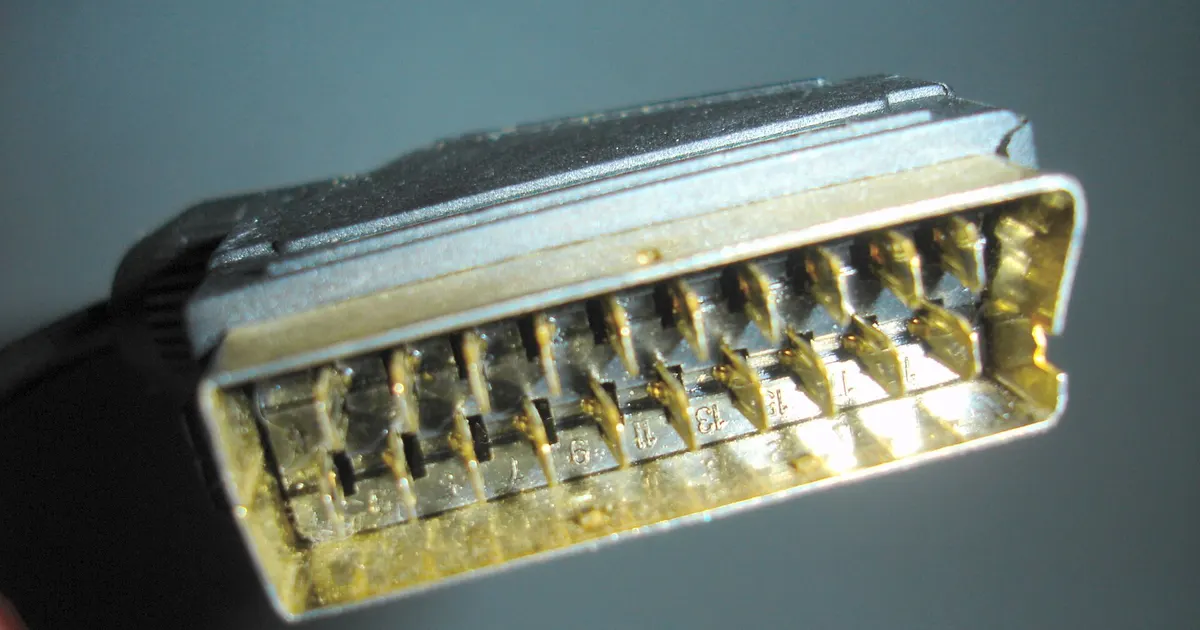
Electrical contacts have one job: pass current through a small, imperfect interface without rising resistance over years of use. The plating on the contact sets how well that works. Gold, silver and tin are the three metals most often named on drawings, and each has strengths and failure modes that do not overlap. Choosing by price alone, or copying a drawing from another product, is a common reason a design passes testing and then drifts in the field.
What the plating has to do
A contact plating faces five demands at once.
- Low and stable resistance across the interface, including after aging.
- Wear resistance during mating cycles and vibration.
- Corrosion resistance in the product’s air, humidity and contaminants.
- Solderability if the other side is a solder joint.
- Compatibility with the mating surface, since dissimilar metals corrode faster.
No metal wins on all five. Hardness helps wear but costs ductility. Soft metals conform and give low resistance but wear fast.
The three metals compared
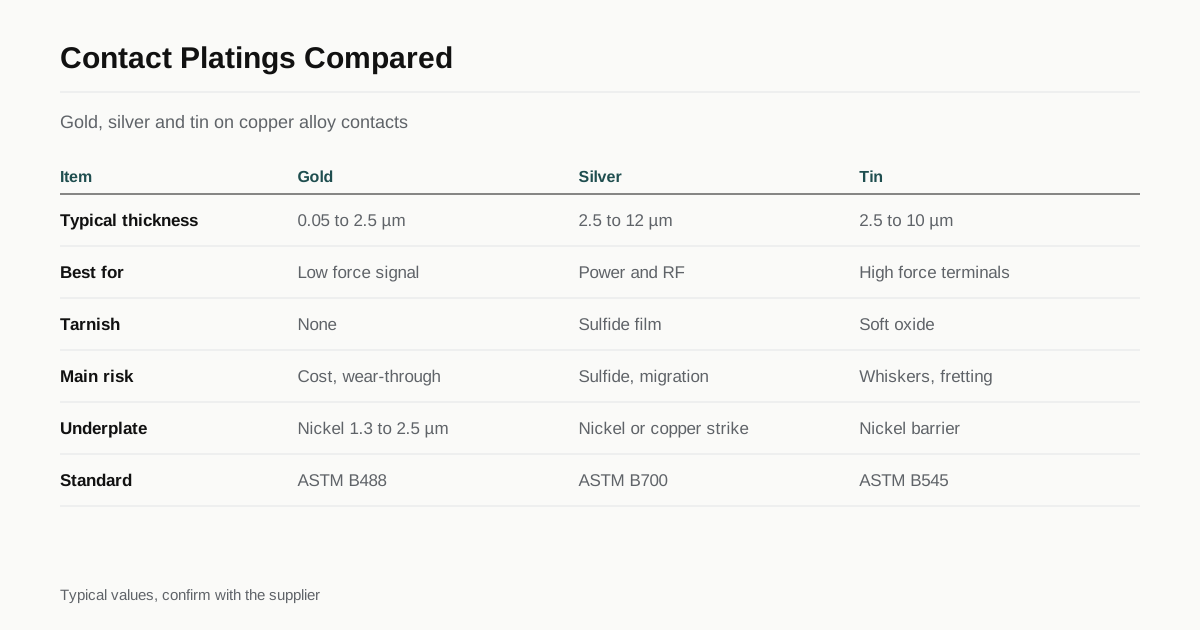
| Property | Gold | Silver | Tin |
|---|---|---|---|
| Typical thickness | 0.05 to 2.5 µm | 2.5 to 12 µm | 2.5 to 10 µm |
| Resistivity | Low | Lowest of the three | Higher |
| Tarnish | None | Sulfide film forms | Oxide film, soft and breakable |
| Hardness | Hard gold: good wear | Soft | Soft |
| Contact force needed | Low | Low to medium | Medium to high |
| Solderability | Good, thin layers | Good, fresh | Good |
| Main risks | Cost, pores, wear-through | Sulfide, migration | Whiskers, fretting |
| Typical use | Connectors, signal contacts | Power contacts, RF | Terminals, busbars, high force connectors |
Values are typical, not promised.
Gold
Gold does not tarnish or form an oxide, so resistance stays low and stable even at very low contact force and low voltage. That makes it the standard for signal connectors, memory sockets and any contact that sees dry-circuit conditions.
- Hard gold is alloyed with cobalt or nickel to give a hardness of roughly 130 to 200 Knoop. It is used where mating cycles are many. Thickness is commonly 0.76 to 2.5 µm, or about 30 to 100 microinches, with thicker layers for more mating cycles.
- Soft gold is high purity and used for wire bonding and some solder joints, not for sliding contacts.
- Flash gold is a very thin layer of about 0.05 to 0.1 µm, used to protect a nickel or palladium layer from oxidizing and to keep solderability. It does not give wear life.
ASTM B488 covers electrodeposited gold for engineering use, with types and grades that define purity and hardness. Name the type and grade.
Silver
Silver has the highest electrical and thermal conductivity of any metal, which suits power contacts, switchgear, busbars, relay contacts and RF components, where skin effect and contact resistance both matter. Typical thicknesses run from 2.5 to 12 µm, with heavier layers on switchgear. ASTM B700 covers electrodeposited silver.
Silver has two known weaknesses.
- Tarnish. Sulfur compounds in air form a dark silver sulfide film. In a power contact, mating wipes and current often break it, and the film’s effect is small. In a low-force contact the film can raise resistance. Anti-tarnish treatments, a thin gold or rhodium layer or sealed enclosures reduce the problem.
- Migration. In humid air under DC voltage, silver can migrate across insulation and bridge adjacent contacts. This is a design issue for fine-pitch electronics. Keep spacing, humidity control and conformal coating in the design review.
Silver is also a common finish on aerospace and RF parts, where low insertion loss matters. Parts like waveguides and cavity filters are plated with silver for conductivity, usually over copper alloys with a nickel barrier, and sometimes with a thin protective layer.
Tin
Tin is cheap, solderable and widely used on terminals, bus bars, lugs and connectors with high contact force. Its oxide layer is thin and brittle, so mating force breaks it and metal-to-metal contact forms. ASTM B545 covers electrodeposited tin.
Tin has its own risks.
- Whiskers. Pure tin can grow thin crystalline whiskers that bridge nearby conductors. The risk is higher with bright tin, with compressive stress and with thin deposits on brass. Matte tin, a nickel or copper underplate, reflow or a thicker layer reduce the risk. Products with long life or high reliability needs often add a whisker mitigation plan.
- Fretting corrosion. Under vibration or thermal cycling, tin contacts with low force can wear through the oxide repeatedly and build up debris, which raises resistance. A minimum normal force, often around 1 N or more, is typical.
- Low-force performance. Tin is not suited to low-force, low-voltage signal contacts.
Tin-lead was once common for solderability and whisker resistance. It is restricted in most consumer and industrial electronics in the EU under RoHS, so lead-free tin is the norm.
Underplates
Nickel is the standard underplate. It acts as a diffusion barrier against copper and zinc from brass and copper alloys, adds hardness under thin gold and covers pores. Typical thickness is 1.3 to 2.5 µm. On silver, a nickel or copper strike under the silver improves adhesion on some alloys. In the case of tin over copper, a nickel barrier of a couple of micrometers slows intermetallic growth, which otherwise consumes the tin from below and hurts solderability.
Mind the magnetic properties of nickel. In RF or sensor parts, nickel’s magnetism can affect signals. Some designs use non-magnetic underplates, such as copper or palladium alloys, for that reason.
Wear, hardness and thickness choice
Thickness sets how many mating cycles a contact survives. A connector rated for a few hundred cycles often carries 0.76 µm of hard gold over nickel, while one rated for tens of thousands may need 1.27 to 2.5 µm. Thin gold can wear through to the nickel, which then oxidizes and ruins the contact. Silver on a sliding power contact wears too, and is often specified thicker with a harder, brightener-assisted grade. Tin wears fastest of the three on sliding contacts, so it suits parts that are mated a few times, such as terminals and lugs.
Hardness and ductility pull against each other. A very hard deposit can crack when a contact is formed or bent after plating. If the part is stamped and formed after plating, say so, so the shop can choose a ductile grade or plate after forming.
Environment and storage
Contacts fail when the environment surprises the design. Sulfur from rubber, paper and industrial air attacks silver. Chlorides and humidity attack tin over time. Outgassing from plastics, adhesives and packaging can leave films on gold. Where parts will sit in storage before assembly, ask the shop about packaging that keeps sulfur away, such as sulfur-free paper or sealed bags, and avoid touching plated surfaces with bare hands.
Selective and partial plating
Contacts are often plated only where they touch. Reel-to-reel stripe plating, brush plating and masking all put the precious metal on the contact area only, which saves cost. A drawing should mark the plated zone and the tolerance on its edge, in the same way as other masked areas. See masking for plating and anodizing.
Inspection
Common checks include XRF for thickness of each layer, a solderability test, porosity tests for gold, a tape adhesion test and a bend test on stamped contacts. For the gauge side, see coating thickness measurement. The certificate should list each layer’s thickness, not only the top layer.
Related finishes
For cost and corrosion reasons some designs use palladium, palladium-nickel or electroless nickel immersion gold (ENIG) on circuit boards. See electroless nickel phosphorus content for electroless nickel basics. If your question is which finish suits a general metal part, see which metal finish for your part.
What to put on the RFQ
- Base metal of the contact, such as brass, copper alloy or steel.
- Finish stack, such as nickel 1.3 to 2.5 µm, hard gold 0.76 µm minimum.
- Standard, such as ASTM B488, B700 or B545, with type and grade.
- Plated zone, mask boundary and tolerance.
- Mating cycle count, contact force and environment.
- Test requirements, such as porosity, solderability and thickness method.
- Restricted substance needs such as RoHS and cobalt content in hard gold.
- Lot size and drawing.
How we help
We are a matching service, not a plating shop. Send one RFQ with the finish stack and contact data and we pass it to up to 3 shops that plate precious metals and tin. Replies come within 24 business hours. Start with the RFQ form or the coating RFQ checklist.
Frequently asked questions
Why is a nickel underplate used under gold or silver?
Copper and its alloys diffuse into thin gold and silver over time and reach the surface, where they oxidize and raise contact resistance. A nickel layer of about 1.3 to 2.5 µm acts as a diffusion barrier. It also adds hardness and helps cover pores in the top layer. Without it, a thin precious metal layer can fail early.
Does silver plating tarnish, and does it matter?
Silver reacts with sulfur compounds in air and forms a dark silver sulfide film. In power contacts, wiping and current often keep it acceptable. In low-force or low-voltage contacts the film can raise resistance. Protection options include anti-tarnish treatments, a thin gold flash or an alternative finish.
Which is the cheapest choice that works for a connector?
Tin is usually the lowest cost, and it works well when contact force is high and the connector is mated rarely. Gold costs more but handles low force, low voltage and many mating cycles. Silver sits between them and suits power and high-frequency contacts. The right answer depends on force, cycle count and environment.
Need a quote for this finish?
Send the drawing. We match you with up to 3 finishing shops that run your spec and reply within 24 business hours.
Get matched with a coating shop