Guides / Specs
How to Specify PVD Coating on a Drawing and RFQ
October 18, 2026
A PVD coating specification works best when it states the function first, then the coating and a thickness range, the surfaces to coat and not coat, where fixture contact is allowed, the surface finish before and after, a maximum process temperature tied to the heat treatment and the tests that prove it. PVD has no single governing spec like the ASTM and MIL documents for plating, so your drawing note carries the whole requirement. Values in this guide are typical, not promised.
For the basics of the process and the common coatings, start with our PVD coatings overview. This guide is the next step: turning a coating choice into a note a shop can quote and inspect against.
Start with the function
Physical vapor deposition films are 1 to 5 µm thick in most uses. They change friction, wear and appearance, not dimensions in any large way. The shop needs to know which of those you are buying. Write one line that a coating engineer can act on:
- “Wear resistance on cutting edges, dry milling of 50 HRC steel.”
- “Galling resistance on forming radii against 304 stainless sheet, 1.5 mm.”
- “Low friction on a sliding pin against a hardened bushing, light oil.”
- “Release and wear on an injection mold core, glass-filled PA66.”
- “Decorative gold color on polished 316L, indoor use.”
Then name a preferred coating and allow an equivalent: “TiAlN by PVD or equivalent proposed by the coater, data sheet required.” Different shops run different chemistries on different equipment. A note that names only a coating gets quotes for that coating even when another one suits the job better.
Do not specify PVD as the corrosion barrier on carbon or low-alloy steel. Thin films have pinholes and fine porosity, so rust can start under them. If corrosion matters, the substrate or an underlayer has to carry it.
Coating, thickness and where it is measured
Give a thickness range, not a single value. Say where it applies. “2 to 4 µm on surfaces A” is clear. “3 µm” is not, because PVD thickness varies with position in the chamber and with how each face sees the targets. Exposed edges and corners tend to build more than flat faces, while bores, slots and the bottom of pockets build less.
Agree how thickness is checked. Most shops measure a coupon from the same load by ball crater to ISO 26423. That reports the process, not the inside of a bore. For critical features, add a sectioned first article part. Our PVD testing guide explains the methods.
On tight fits, say whether dimensions apply before or after coating. At 2 to 4 µm per surface a diameter grows by 4 to 8 µm, which matters on a ground pin or a precision bore.
Coat, no-coat and contact zones
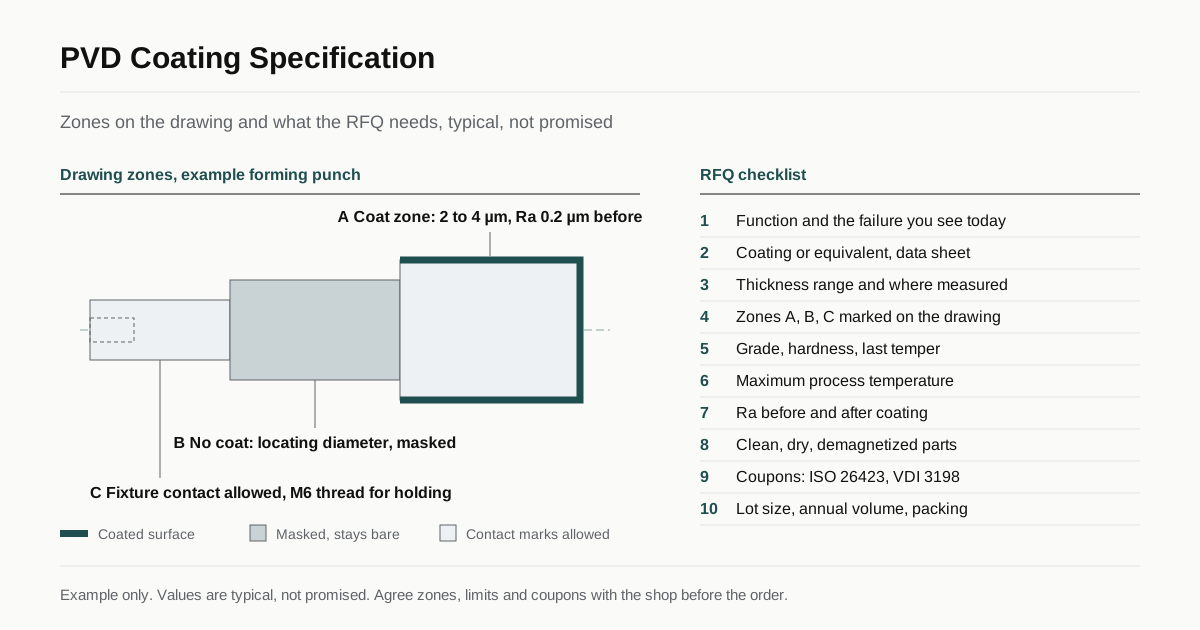
Mark three kinds of zones with letters on the drawing.
Coat zones (A). Surfaces where the film must meet thickness and appearance.
No-coat zones (B). Bores, locating faces, threads or brazed areas that must stay bare. PVD masking is mostly mechanical: caps, plugs, sleeves and fixture covers. Many tapes and paints used in plating cannot go into a hot vacuum chamber, so ask what the shop uses. A masked edge has a soft transition band, not a sharp line. State how wide a band you accept. Our masking guide covers masking callouts in general.
Contact zones (C). Every part is held on a fixture, usually on rotating spindles with 2-fold or 3-fold rotation. Where the part touches the fixture it stays uncoated or thin. Tell the shop where contact is allowed. A threaded hole, a shank or a non-functional face makes fixturing easy. Cutting tools are usually held by the shank, which is also the clamping surface and does not need coating.
Two geometry points help the quote:
- Blind holes and slots. PVD is line of sight. Coverage drops quickly with depth. As a rough guide, expect much less film beyond a depth of about one hole diameter. If a bore needs coating, ask the shop before you design around it.
- Magnetism. Parts ground on a magnetic chuck must be demagnetized. Residual magnetism holds grinding swarf and debris that ends up as defects in the film. Ask the shop for its limit.
Edge preparation and surface finish before coating
The film copies the surface under it. Most adhesion and appearance problems start here.
- Edges. On cutting tools a controlled edge hone, often a few micrometers to a few tens of micrometers set by the tool designer, helps the film stay on. A raw ground edge with a burr chips. On forming tools and molds, break sharp corners and remove burrs.
- EDM surfaces. The recast or white layer left by wire or sinker EDM is brittle. Coating over it risks flaking with the layer. Specify removal by polishing or stoning before coating.
- Grinding. Burned or decarburized surfaces give poor support for a hard film. Ground surfaces should be free of burn.
- Ra before coating. For forming, sliding and mold surfaces, many shops ask for a polished finish, commonly Ra about 0.1 to 0.2 µm or better. Decorative mirror parts are finer still.
- Ra after coating. Arc processes add small droplets that raise Ra. Specify the finished value and say whether post-polishing or fine blasting is allowed to reach it.
Substrate, heat treatment and process temperature
Give the material grade, the hardness and the last tempering temperature from the heat treatment certificate. Common PVD processes run between about 150 and 500 °C. A common rule of thumb keeps the coating temperature at least about 20 to 30 °C below the last tempering temperature.
Examples. A D2 (1.2379) part tempered high at about 520 °C can take most standard nitride processes. A low-tempered tool steel or a 440C part tempered near 200 °C needs a low-temperature process, which narrows the choice of coatings and shops. Aluminum alloys are limited by their aging temperature. Our guide on PVD coating temperature and substrates lists the common steels.
Materials that outgas in vacuum are a separate problem. Zinc, cadmium, lead-bearing free-machining brass, porous castings, adhesives and some brazing alloys can contaminate the chamber or the film. Name every material in the assembly. If the part is nitrided before coating (a duplex treatment), say so, because the nitrided surface condition affects adhesion.
Cleanliness and incoming condition
PVD shops clean every load, usually in ultrasonic alkaline lines followed by an in-chamber ion etch. They cannot always clean what is trapped in blind holes, threads or porosity. Ask for parts to arrive:
- Clean, dry and free of rust.
- Free of marker ink, labels, stickers and paint marks. Laser marking before coating is usually fine.
- Free of wax-based rust preventives, silicone and polishing compound or lapping paste in holes.
- Demagnetized, with burrs and EDM recast removed.
Handle cleaned parts with gloves. Fingerprints on a polished surface can show through a decorative film.
Lot size, chamber load and lead time
PVD is a batch process. The price depends largely on how much of a chamber load your parts take and how long the cycle runs. Give part size, weight, quantity per lot and expected annual volume. Many shops run common coatings on a fixed schedule and mix customers in one load. A dedicated run for an unusual coating or temperature costs more and waits longer. Our guides on plating and coating cost and finishing lead times explain these drivers.
Strip, recoat and regrind
Decide in advance what happens when a part fails inspection or a tool needs refurbishing.
- Stripping. Many nitride coatings can be stripped chemically from steel. On cemented carbide, some strippers attack the cobalt binder at the surface, so tool recoaters often limit the number of strip cycles. DLC usually needs a different stripping method. Stripping can change the surface finish slightly.
- Recoat. State whether strip and recoat is allowed, how many times and whether the buyer must approve it.
- Regrind and recoat. Reground tools are often recoated over the remaining film on the flank. Say whether that is acceptable or full stripping is required.
The full strip and recoat procedure is in how to strip and recoat a PVD coating, and the cost view is in PVD coating cost.
Tests, coupons and documents
List the tests and acceptance limits on the drawing:
- Thickness by ball crater, ISO 26423, on a coupon from each chamber load.
- Adhesion by Rockwell C indentation, VDI 3198, with an agreed limit such as HF1 to HF4.
- Scratch test, nanoindentation, roughness or color if the function needs them.
- Certificate of conformance with batch number, results and methods.
Coupons should be the same grade and hardness as the parts and polished like the functional surface. The coating RFQ checklist covers the general documents.
Packaging. Ask for clean, dry packing with no coated-to-coated contact and separators between parts. Decorative parts may need protective film.
Sample PVD drawing note
Adapt the values to your part. They are an example, not a recommendation for your application.
PVD COATING NOTES (UNLESS OTHERWISE SPECIFIED)
1. FUNCTION: WEAR AND GALLING RESISTANCE ON FORMING SURFACES "A".
2. COATING: CrN BY PVD OR EQUIVALENT PROPOSED BY COATER. DATA SHEET REQUIRED.
3. THICKNESS: 2 TO 4 µm ON SURFACES "A". MEASURE ON COUPON BY BALL CRATER, ISO 26423.
4. NO COATING ON SURFACES "B". MASK MECHANICALLY. TRANSITION BAND 1 mm MAX.
5. FIXTURE CONTACT ALLOWED IN ZONE "C" ONLY. M6 THREAD MAY BE USED FOR HOLDING.
6. SUBSTRATE: D2 / 1.2379, 58 TO 60 HRC, LAST TEMPER 520 °C.
   COATING PROCESS TEMPERATURE NOT TO EXCEED 490 °C.
7. SURFACES "A": Ra 0.2 µm MAX BEFORE COATING, Ra 0.3 µm MAX AFTER COATING.
   DROPLET REMOVAL BY POLISHING ALLOWED.
8. PARTS DELIVERED CLEAN, DRY, DEMAGNETIZED, FREE OF INK, WAX AND POLISH RESIDUE.
9. ADHESION: HF1 TO HF4 PER VDI 3198 ON A HARDENED COUPON FROM EACH CHAMBER LOAD.
10. CERTIFICATE OF CONFORMANCE WITH BATCH NUMBER, THICKNESS AND ADHESION RESULTS.
11. STRIP AND RECOAT ALLOWED ONCE WITH BUYER APPROVAL.
12. DIMENSIONS APPLY AFTER COATING.
Getting PVD quoted
Send the drawing with the note above, the material and heat treatment certificate, quantities per lot and per year, photos of the part if the geometry is complex and your test requirements. If you are unsure which coating fits, describe the function and the failure you see today.
We are a matching service, not a coating shop. Choose “PVD” as the finish on the RFQ form. We pass it to up to 3 shops that run that coating. They quote you directly. You get a reply within 24 business hours. Send your PVD RFQ.
Frequently asked questions
Is there a standard specification for PVD coating?
Not one that covers the whole job the way ASTM and MIL documents cover plating and anodizing. Standards exist for parts of it: ISO 26423 for ball crater thickness, VDI 3198 for Rockwell C adhesion classes, ISO 14577 for nanoindentation and VDI 2840 for naming carbon coatings. The drawing note has to pull these together with the coating, thickness, zones and temperature limit.
Should I name the PVD coating or describe the function?
Do both. State the function first, for example galling resistance against stainless sheet or wear on a cutting edge in hardened steel. Then name your preferred coating and allow an equivalent proposed by the coater with a data sheet. Shops run different chemistries on different equipment, so a function-led note gets you comparable quotes instead of quotes for the wrong coating.
How do I stop PVD coating on a bore or locating face?
Mark those surfaces as no-coat zones on the drawing and say how much transition you accept at the edge. PVD masking is mostly mechanical, with caps, plugs, sleeves and fixture covers, since many tapes and paints used in plating cannot go into a hot vacuum chamber. Masked edges show a soft transition rather than a sharp line, so leave room for it.
Why does the coater need my tempering temperature?
PVD processes commonly run between about 150 and 500 °C. If the coating temperature comes close to or above the last tempering temperature of the steel, the part can lose hardness or move in size. Giving the grade, the hardness and the last tempering temperature lets the shop choose a process that stays below it, often with a margin of about 20 to 30 °C.
What condition should parts be in when they arrive at the PVD shop?
Clean, dry, free of rust and demagnetized. No marker ink, labels, wax rust preventives, silicone or polishing compound in holes and recesses. EDM recast layers and grinding burrs should already be removed. Residues trapped in blind holes or porosity outgas in the vacuum chamber and cause poor adhesion or spots that the shop cannot always clean out.
Need a quote for this finish?
Send the drawing. We match you with up to 3 finishing shops that run your spec and reply within 24 business hours.
Get matched with a coating shop