Guides / Finishes
Outdoor Powder Coating for Enclosures and Brackets: Systems That Last
October 26, 2026
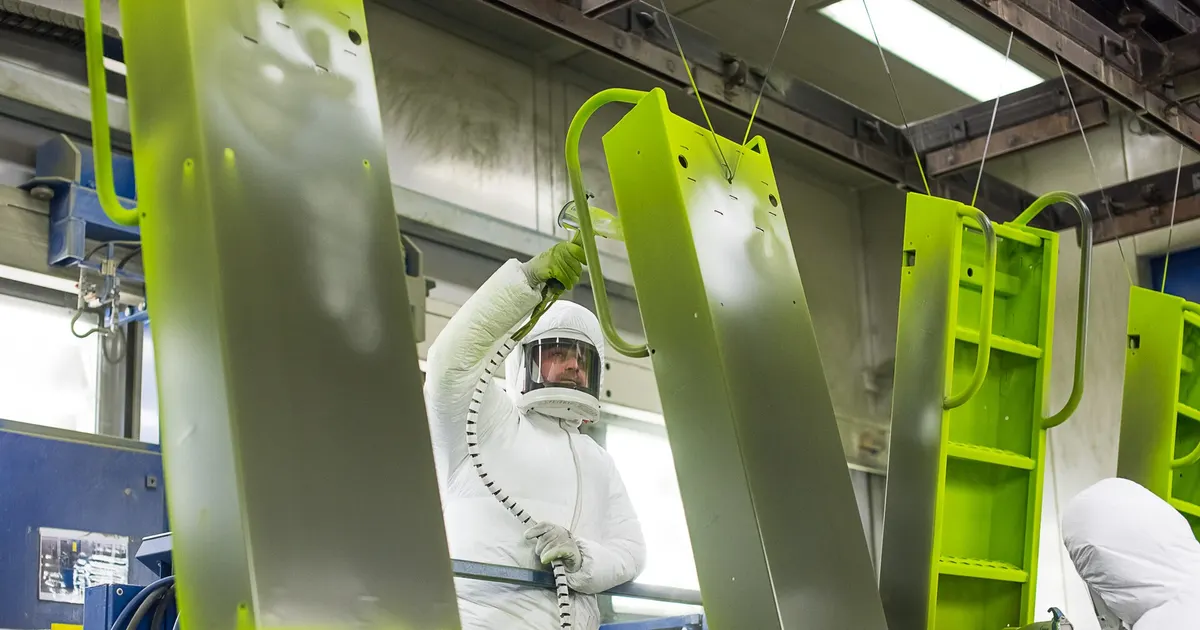
Powder coating is the default finish for outdoor enclosures, electrical boxes, brackets, frames and street furniture, and it can last many years in sun, rain and salt air. It can also chalk, peel and rust in the first season when the wrong system is chosen or the preparation is skipped. The difference comes from three decisions: the powder chemistry, the pretreatment under it and the way the part is designed. This guide covers each one in the order a buyer meets them.
Why outdoor use is harder than indoor
Outdoor parts face several attackers at once.
- UV light breaks down some resins, causing chalking, color fade and loss of gloss.
- Water and humidity reach the steel through thin spots, edges and scratches.
- Salt and pollution speed corrosion, especially near the coast or roads.
- Temperature cycling expands and contracts metal and film at different rates.
- Impact and abrasion from gravel, tools and handling.
An indoor-grade coating can look fine on delivery and fail after a few seasons. The choice of powder is the first filter.
Powder chemistries compared
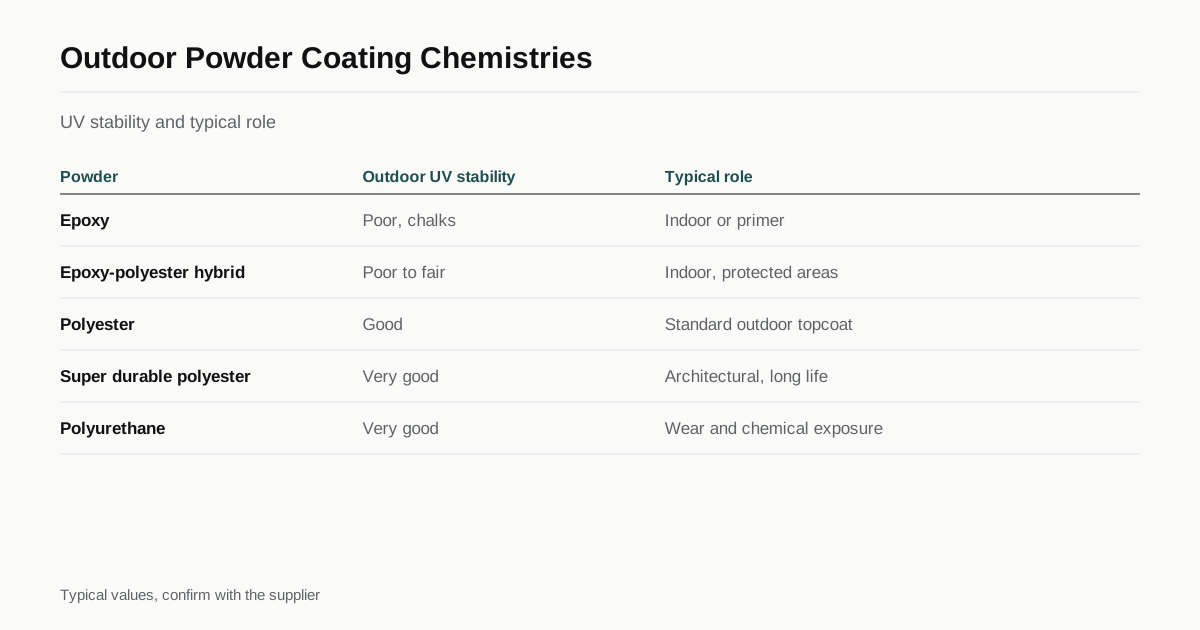
| Powder type | Outdoor UV stability | Adhesion and chemical resistance | Typical role |
|---|---|---|---|
| Epoxy | Poor, chalks | Excellent | Indoor, or primer under topcoat |
| Epoxy-polyester hybrid | Poor to fair | Good | Indoor, protected areas |
| Polyester (TGIC or TGIC-free) | Good | Good | Standard outdoor topcoat |
| Super durable polyester | Very good | Good | Architectural and long life outdoor |
| Polyurethane | Very good | Very good | High wear, graffiti or chemical exposure |
| Fluoropolymer (PVDF) | Excellent | Good | Specialist, mainly liquid applied |
Ratings are typical. A powder maker’s data sheet and test results for the exact product are the proof.
Standard polyester is the usual choice for brackets and enclosures. Super durable polyester is sold for architectural aluminum and long outdoor life. Polyurethane gives a harder, more chemical-resistant film and suits parts that see hand contact or cleaning agents.
Pretreatment: the base of the system
Most outdoor failures start at the metal, not in the powder, so pretreatment matters more outdoors than in any other use. See powder coating pretreatment, cure and adhesion testing for the full sequence. In short:
- Steel outdoors normally gets zinc phosphate or a thin-film zirconium conversion, not just iron phosphate.
- Aluminum gets a chromate-free conversion, or a chromate conversion where a specification requires it. See chromate conversion coating.
- Galvanized steel needs a clean, lightly etched zinc surface, or a conversion made for zinc.
- Weld and laser edges need oxide removed before pretreatment.
A primer under the powder gives the best outdoor life on steel. Epoxy or zinc-rich primers followed by a polyester topcoat form a two-coat system that resists corrosion creep far better than a single coat.
Film thickness and edges
Typical outdoor powder film runs 60 to 100 µm for a single coat, and more for two-coat systems. Thin films, under about 50 µm, show pinholes and early failure. Very thick films can crack, run or lose flexibility. Edges are the weak point. Powder tends to pull thin at sharp edges as it cures, so the film at an edge can be a fraction of the flat-face thickness.
Design and process steps that help:
- Break sharp edges to a small radius, about 0.5 mm or more.
- Specify a minimum film thickness on edges and a measuring method.
- Add a second coat or an edge-build powder where required.
- Avoid razor-sharp laser-cut edges. Deburr them before pretreatment.
Design details that decide life
Many outdoor failures come from design, not coating. A few habits help a lot.
- Drain and vent. Enclosures and tubes need drain holes so water does not sit inside. Closed tubes and boxes that are welded shut can also trap pretreatment liquid and bleed rust later.
- Seal or continuously weld seams. Skip-welds and lap joints trap water and salts. Continuous welds with ground-flat beads coat better.
- Avoid crevices. Overlapping plates and tight gaps are protected by neither coating nor access.
- Separate dissimilar metals. Stainless fasteners in steel brackets cause galvanic corrosion at the contact. Use isolating washers or coated fasteners.
- Keep coated fasteners. Bare screws shed rust that stains the coating. Zinc flake fasteners give a long-life match. See zinc flake coatings for fasteners.
Galvanized steel plus powder
Duplex systems, hot-dip galvanized steel with powder coating on top, can last much longer than either alone. The zinc protects steel at scratches and the powder shields the zinc and adds color. The galvanized surface needs preparation, such as a light sweep blast, and it may outgas during cure and cause pinholes, so a low-temperature or degassing powder is used. See hot-dip galvanizing vs zinc plating for the zinc side.
Color, gloss and fade
Colors differ a lot in UV stability. Light grays and whites hold up well. Strong reds, oranges and yellows fade fastest because their pigments are less stable. Dark colors absorb heat and show chalking and scratches more. If color retention matters, ask the powder maker for the specific pigment’s performance data and for outdoor exposure results for the color.
Gloss also affects look. High-gloss films show chalking early, while matte and textured finishes hide minor dulling and scratches, though they can hold dirt.
Testing and standards
Outdoor performance claims should link to test data. Common references include:
- AAMA 2603, 2604 and 2605, architectural specifications for coatings on aluminum, with increasing exposure and performance requirements.
- QUALICOAT classes in Europe for architectural aluminum coating.
- ASTM G154 or D4587 accelerated UV exposure, and ASTM D523 gloss measurement.
- ASTM B117 salt spray and cyclic corrosion tests, with limits as noted in what salt spray hours really mean.
- ASTM D3359 adhesion, and ASTM D2794 impact.
A shop can say that a process follows a standard. A certification or approval statement is a separate claim, and we do not make it for any shop.
Field repair and maintenance
Outdoor coatings get scratched and chipped in service, and small damage left alone grows into rust. Touch-up with a compatible paint stops the spread if it is done early. Cut or drilled areas made after coating should be cleaned, primed with a zinc-rich product and painted. For fleets of enclosures or street furniture, a yearly wash removes salt and dirt that hold moisture on the surface, and a visual check of edges, seams and fasteners finds trouble before it spreads.
Recoating after many years is possible when the old film is sound. The surface is cleaned, lightly abraded and recoated with a compatible system. If the film has failed to bare metal, strip and start from pretreatment. Name the original powder type on the drawing, so a repair shop knows what it is working with.
Typical mistakes on outdoor jobs
- Using an epoxy topcoat outdoors because it was the cheapest powder on the shelf.
- Skipping the primer on steel in a coastal location.
- Specifying a color with poor UV stability for a part in full sun.
- Powder coating over mill scale or weld oxide without cleaning.
- Leaving enclosures with no drain holes, so the inside rusts through.
- Writing “powder coat, black” with no film thickness, pretreatment or test requirement.
- Ordering bare stainless fasteners for a coated steel bracket and expecting no staining.
Masking and grounding
Enclosures often need bare metal for grounding studs, gasket seats or bonding points. Masking has to survive the cure oven, which means silicone plugs and high-temperature tape. See masking for plating and anodizing for the general approach. Gasket faces may be better coated, with a defined thickness, than masked, depending on the design.
What to put on the RFQ
- Base metal, thickness and whether parts are welded, laser cut or galvanized.
- Environment, such as coastal, industrial, desert or inland, and expected service life.
- Powder system, such as primer plus polyester topcoat, with color and gloss.
- Pretreatment required.
- Film thickness range, edge minimum and measuring method.
- Tests required, such as adhesion, salt spray or UV exposure, with standards.
- Masked areas and allowed hang points.
- Lot size and drawing.
See the coating RFQ checklist for more.
How we help
We are a matching service, not a powder coating shop. Send one RFQ with the exposure and the system you want and we pass it to up to 3 shops that run outdoor powder lines. Replies come within 24 business hours. Start with the RFQ form.
For architectural aluminium, see Qualanod, Qualicoat and GSB approvals.
Frequently asked questions
Can I use an epoxy powder outdoors?
Not as the top layer. Epoxy has excellent adhesion and chemical resistance, but it chalks and fades quickly in sunlight. It works well as a primer under a polyester or polyurethane topcoat, and it is fine for indoor parts. For a single outdoor coat, use a UV-stable polyester.
Why does powder coat fail first at edges and welds?
Sharp edges pull the film thin, since powder does not wrap them well, and thin film lets moisture reach the steel. Welds and seams trap water and salts in crevices. A small edge radius, sealed seams and drainage reduce edge failure far more than a thicker coat does.
How long will outdoor powder coat last?
There is no single number. Life depends on pretreatment, powder type, thickness, color, exposure and design. Architectural standards define performance targets over years of outdoor exposure for specific products. Ask the powder maker or shop for test data on the exact system rather than a general promise.
Need a quote for this finish?
Send the drawing. We match you with up to 3 finishing shops that run your spec and reply within 24 business hours.
Get matched with a coating shop