Guides / Finishes
Automotive Fastener Coatings: Corrosion Hours, Friction and Torque Behavior
October 17, 2026
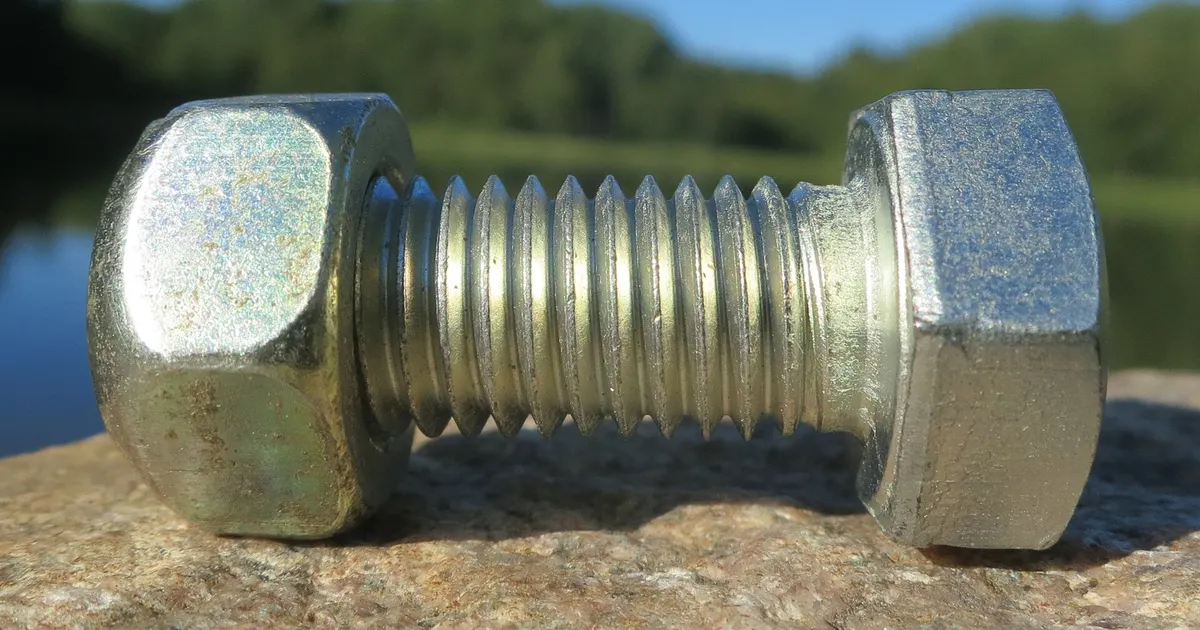
A vehicle holds together with thousands of fasteners, and the coating on each one does two jobs. It keeps the bolt from rusting through in salt, mud and heat, and it sets how the bolt behaves when it is tightened. Designers pick the torque for a bolted joint on the assumption that friction stays inside a known range. A coating that drifts outside that range gives joints that are too loose or too tight, and neither shows up until a joint loosens or a thread strips. Understanding the corrosion and friction sides together is the key to a sound specification.
What the coating must do
- Resist corrosion for the part’s location, such as underbody, engine bay, chassis or interior.
- Hold friction inside a defined window.
- Avoid hydrogen embrittlement on hardened parts.
- Meet restricted substance rules, which means no hexavalent chromium in vehicles sold in the EU and many other markets.
- Stay adherent through assembly, heat and vibration.
- Keep a thin, predictable thickness that fits threads.
Common coating systems
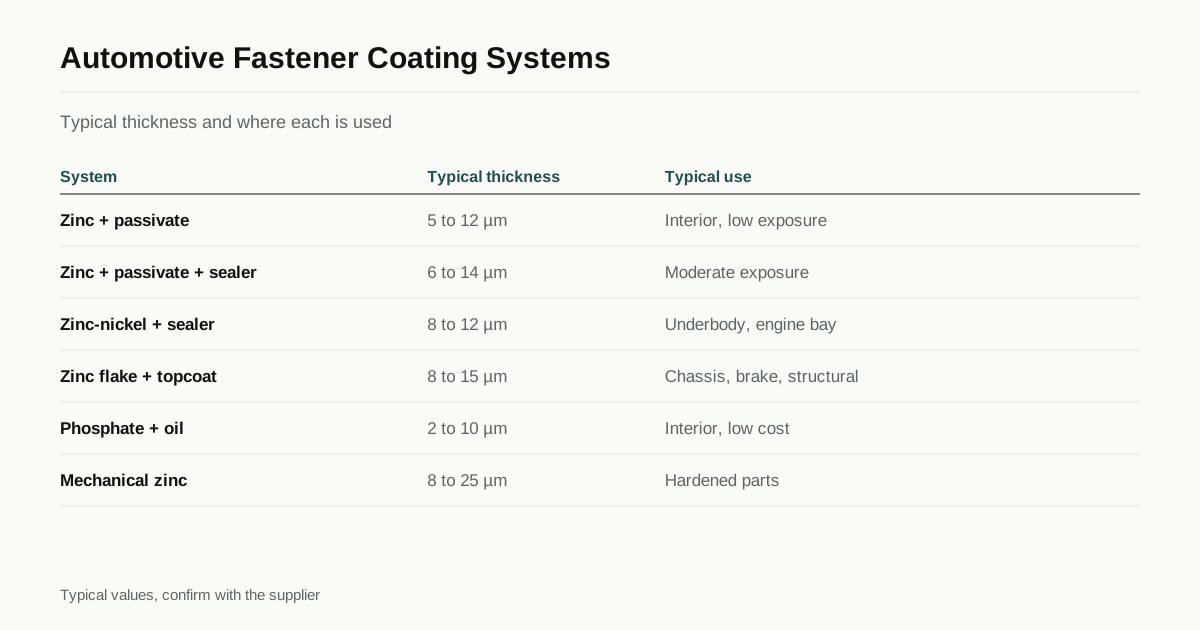
| System | Typical thickness | Typical use | Notes |
|---|---|---|---|
| Zinc + trivalent passivate | 5 to 12 µm | Interior, low exposure | Lowest cost, short corrosion life |
| Zinc + passivate + sealer | 6 to 14 µm | Moderate exposure | Better life, controlled friction with lube sealer |
| Zinc-nickel + passivate + sealer | 8 to 12 µm | Underbody, engine bay | Long life, needs bake on hardened parts |
| Zinc flake basecoat + topcoat | 8 to 15 µm | Chassis, brake, structural | High life, no hydrogen from process, integral lubricant |
| Phosphate + oil | 2 to 10 µm | Interior, low cost | Poor outdoor protection |
| Mechanical zinc | 8 to 25 µm | Hardened parts, no hydrogen | Thicker, tumble process |
All values are typical, not promised. Vehicle makers publish their own coating specifications with required thickness, test methods and approved process suppliers, and those control.
Corrosion targets and test methods
Automotive specifications use several test methods.
- Neutral salt spray per ASTM B117 or ISO 9227, with hours to white rust and to red rust. Typical targets run from about 96 hours for interior hardware up to 720 hours or more for underbody parts with zinc-nickel or zinc flake.
- Cyclic corrosion tests such as VDA 233, GMW14872 and SAE J2334, which cycle salt spray, humidity and drying and correlate better with road performance.
- Heat aging and corrosion after exposure to high temperature for parts near the engine or exhaust.
Hours are not a lifetime. See what salt spray hours really mean before writing a number on a drawing. For zinc finishes see trivalent passivates on zinc.
Friction and torque
For a bolt tightened by torque, the relation between torque and preload is commonly written as T = K × d × F, where T is torque, d is nominal diameter, F is preload and K is the nut factor. K combines thread friction, head friction and geometry. Plain dry steel runs near 0.2. Coated fasteners with lubricant are designed for lower, tighter ranges, often K of about 0.12 to 0.16.
Automotive specifications usually state the coefficient of friction instead, defined by a torque-tension test per ISO 16047 or a customer standard. A typical window is a total friction coefficient of about 0.09 to 0.14, with a limit on scatter within the lot. Fasteners from a lot that falls outside the window are rejected, even if they look fine.
Friction is sensitive to many things.
- Coating type and topcoat.
- Thickness and lubricant content.
- Thread tolerance and surface finish.
- Mating part material and surface, such as the nut or the clamped plate.
- Number of tightening cycles and re-use.
- Temperature and the age of the coating.
Because friction is a system property, the test fixture should be set up to match the real joint, as far as possible.
Hydrogen embrittlement
Hardened fasteners above property class 10.9, roughly 320 to 380 HV, are sensitive to hydrogen introduced during electroplating. ISO 4042 calls for baking after plating on parts of that strength, and strongly cautions against electroplating class 12.9 parts. Aerospace and automotive customers often add a sustained-load test for embrittlement. See hydrogen embrittlement relief bake for details of timing and temperature.
Zinc flake coatings and mechanical zinc avoid the electrolytic route, which is why they are common on high-strength brake, chassis and engine fasteners. See zinc flake coatings for fasteners.
Thread fit
Coating adds to thread size. With threads that must accept a mating coated nut or a tapped hole, the coating thickness and the thread class must work together. Zinc-nickel at 8 to 12 µm and zinc flake at 8 to 15 µm both need allowances on the thread. See thread fits after plating for the geometry. Many automotive nuts are tapped oversize, or they carry a thin lubricated coating, to keep fit within limits.
Where on the vehicle the fastener sits
Exposure sets the coating. Four zones cover most decisions.
- Interior and cabin. Dry, mild. Zinc with a passivate or phosphate and oil is often enough.
- Underbody and chassis. Splash, road salt, gravel and mud. Zinc-nickel or zinc flake with a topcoat is common, and cyclic tests set the pass criterion.
- Engine bay and exhaust area. Heat plus salt. The coating must keep its protection after heat aging. Zinc flake and zinc-nickel tolerate higher temperatures than zinc with a hexavalent-free passivate and sealer, though the limits depend on the product.
- Brake and suspension. Safety critical, high strength, high load. Zinc flake with a lubricated topcoat or zinc-nickel with a validated friction window is typical, and customer approval of the coating supplier is common.
For fasteners near aluminum parts, galvanic corrosion also matters. Zinc flake with aluminum flakes and some zinc-nickel systems are chosen partly for compatibility with aluminum.
Re-use, service and field repairs
Fasteners are sometimes re-used in service. Each tightening wears the coating a little and changes friction, so the torque value for re-used fasteners may differ from the first assembly, and some safety joints use replace-only fasteners. Service parts, supplied for repair, often carry a standard coating while production parts carry an approved one, and the two should be compatible. Mention service use if the part number is shared.
Cost and volume
Automotive fasteners run in very large volumes, so price per thousand pieces matters. Zinc plating is the lowest cost, zinc-nickel and zinc flake cost more because of materials, cure time and process control, and mechanical zinc costs more again on a per-part basis. Cost per part is not the only number. A coating that avoids a field failure or a recall is worth far more than its price difference. For the full cost picture see plating and coating cost.
Process choice: rack, barrel or dip-spin
Small fasteners in bulk are barrel plated or dip-spin coated. Larger bolts and special parts may be racked. See rack vs barrel plating for how the choice affects thickness distribution. Zinc flake dip-spin processes can bond parts that nest or touch, so part geometry matters.
Quality records
Automotive customers typically expect the shop to run a process control plan. That means control of bath chemistry, thickness checks by XRF, friction tests on production samples, salt spray tests at defined frequency, and traceability by lot. Many customers ask for a PPAP submission or an equivalent for new parts. We make no claim that any shop holds a particular quality certification. Ask each shop directly and request the documents you need.
Common mistakes
- Specifying only “zinc plated” with no thickness, passivate or friction requirement.
- Mixing coating systems in one joint, such as a zinc-nickel bolt and a zinc flake nut, without testing friction.
- Applying a customer corrosion target to a coating that cannot meet it.
- Forgetting that re-use and re-torquing change friction.
- Electroplating hardened fasteners without a bake.
- Changing the coating supplier without re-running friction and corrosion tests.
What to put on the RFQ
- Fastener type, size, property class and quantity.
- Customer specification and approved coating system.
- Thickness range and thread class after coating.
- Corrosion test, hours and criterion.
- Friction window and test method.
- Hydrogen embrittlement requirements.
- Documentation, sampling plan and traceability needs.
- Lot size and drawing.
Read the coating RFQ checklist for more.
How we help
We are a matching service, not a coating shop. Send one RFQ with the specification and test requirements and we pass it to up to 3 shops that coat automotive fasteners. Replies come within 24 business hours. Start with the RFQ form.
See also the specification reference for zinc-nickel plating to ASTM B841 and ISO 19598 and the CQI-11 and CQI-12 assessments automotive customers ask for.
Frequently asked questions
Why does the coating change the tightening torque?
Most of the torque applied to a bolt is spent overcoming friction under the head and in the threads, and only a small share becomes clamp load. A coating changes that friction, so the same torque gives a different preload. Joint designers set a torque for a known friction window, and the coating has to stay inside it.
How many salt spray hours do automotive fasteners need?
It depends on the vehicle maker and the location of the part. Underbody and engine bay fasteners commonly face targets of several hundred hours to red rust, set in the maker's specification. Interior fasteners often need far less. The drawing or the customer standard states the number, and shops should not guess it.
Do hardened fasteners need a hydrogen bake?
If the fastener is hardened and electroplated, yes. Property class 10.9 and above is the usual threshold in fastener standards such as ISO 4042, and 12.9 is often treated with extra caution or finished without electroplating. Zinc flake is a common choice for high strength fasteners because it avoids the electrolytic route.
Need a quote for this finish?
Send the drawing. We match you with up to 3 finishing shops that run your spec and reply within 24 business hours.
Get matched with a coating shop