Guides / Finishes
Decorative PVD Colors on Stainless Steel and Brass
October 18, 2026
PVD colors on stainless steel come from the coating chemistry, not from a dye: titanium nitride gives gold, zirconium nitride a paler brass tone, carbonitrides shift toward rose and bronze, chromium nitride stays silver grey and carbon-rich or DLC layers give black. Polished 304 and 316 stainless are coated directly, while brass and zinc die-cast parts need an electroplated nickel and chrome base first. The shade is held to a measured CIELAB ΔE tolerance against a master sample. The surface finish under the film shows through unchanged. Values in this guide are typical, not promised.
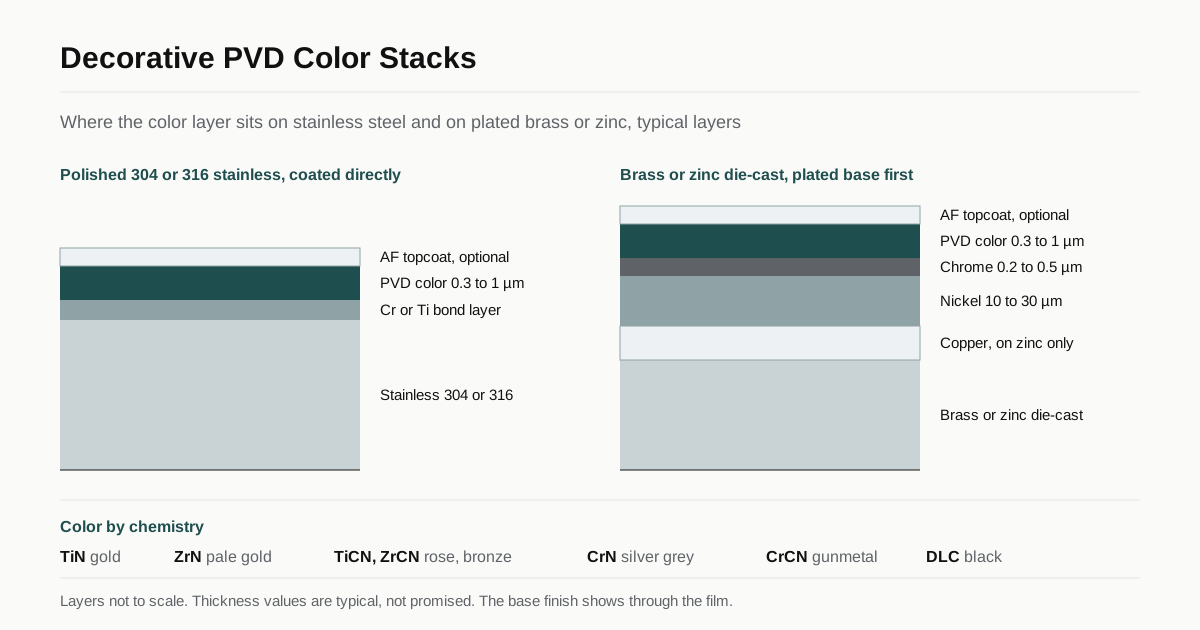
Our PVD overview covers TiN, CrN and DLC on tools and wear parts. This guide stays on the decorative side: how each color is made, how it is measured and what the part needs before a color repeats batch after batch.
How PVD makes a color
A decorative PVD layer is a thin ceramic or metal-ceramic film. Its color comes from how the compound reflects light, which depends on the metal, the reactive gas and the ratio between them. In a TiN layer, a nitrogen-poor film looks pale and metallic, a balanced film looks warm gold and a nitrogen-rich film goes darker and browner. Adding a carbon-bearing gas such as acetylene moves the shade toward bronze, rose or grey. Adding a second metal, for example aluminum or zirconium, shifts it again.
The shop controls color through gas flows, target power, bias voltage and temperature. Two shops running the same chemistry can land on different shades. A color name is a starting point, never a specification.
Typical colors by chemistry
| Color family | Typical chemistry | Notes |
|---|---|---|
| Classic gold | TiN | Warm yellow gold, the longest track record |
| Pale gold, brass, champagne | ZrN, ZrCN | Lighter and cooler than TiN, often chosen to match brass |
| Rose gold, bronze, copper tones | TiCN, ZrCN, TiN with added metal | Carbon and metal content set the warmth |
| Silver, stainless grey | CrN | Close to bare stainless, used for wear upgrade without color change |
| Gunmetal, graphite | CrCN, TiCN with higher carbon, TiAlN | Shade depends on carbon and aluminum content |
| Black | DLC (a-C:H), TiC or TiAlCN with high carbon | Depth of black varies a lot between processes |
| Blue, purple, rainbow | Thin transparent oxides such as TiOx | Interference color, set by layer thickness |
Interference colors behave differently from the nitride colors above. A transparent oxide a fraction of a micrometer thick reflects light from its top and bottom surfaces. The two reflections interfere. The color is set by thickness, so a few tens of nanometers shift the hue. It also changes with viewing angle. Blue and rainbow finishes are therefore harder to repeat across a large part or between batches than gold or black.
Thickness
Decorative color layers are commonly about 0.3 to 1 µm. Hardware that sees daily hand contact, such as door levers and faucet handles, often gets 1 to 3 µm or a multilayer with a hard nitride underneath and a color layer on top. Stress rises with thickness, so very thick decorative films can chip on sharp edges.
Substrates: what can be coated directly
Stainless steel 304, 316 and 430
Austenitic 304 and 316 and ferritic 430 are the standard direct substrates for decorative PVD. They do not outgas, they tolerate the typical decorative process temperature of roughly 150 to 300 °C and their passive oxide is removed by in-chamber ion etching before deposition. 316 and 316L are common for marine, bathroom and jewelry use because the base metal itself resists corrosion at any pinhole in the film.
Brass and zinc die-cast
Brass and zinc alloys are the usual materials for faucets and many lock bodies. Zinc has a high vapor pressure. Lead-bearing brasses such as CuZn39Pb3 contain lead that also releases under vacuum and heat. Both contaminate the chamber and ruin adhesion. Zinc die castings also carry surface porosity that traps cleaning fluids.
The standard route is an electroplated base:
- Zinc die-cast: cyanide-free or cyanide copper strike, then acid copper to level the casting.
- Brass and zinc: semi-bright plus bright nickel, commonly in the range of 10 to 30 µm in total.
- Chrome: a thin decorative chrome layer of about 0.2 to 0.5 µm. Trivalent chrome works here and avoids a hexavalent bath. See trivalent vs hexavalent decorative chrome.
- PVD color: applied at a low process temperature, often below about 200 °C, so the plating does not blister.
The plated stack carries the corrosion resistance and the PVD carries the color and scratch resistance. A defect in the nickel, such as a pit over casting porosity, will show through the color. If the plated base is applied to a steel part hardened above 39 HRC, the electroplating needs a hydrogen embrittlement relief bake per ASTM B850, done before the PVD step.
Carbon steel and aluminum
Carbon steel can carry a decorative PVD color, but the thin film has pinholes. Rust starts at them quickly in humid use. It needs a plated nickel or nickel chrome base, just like brass. Aluminum is possible with special processes, but its softness and low aging temperatures limit what a decorative line will accept. The PVD temperature and substrates guide covers those limits in detail.
Surface finish shows through
A 0.5 µm film follows the surface beneath it exactly. Every scratch, polishing line, orange peel or weld blemish stays visible. A dark color makes it more visible, not less. The finish has to be right before the part goes into the chamber.
| Base finish | Typical description | What PVD does to it |
|---|---|---|
| Mirror | No. 8 or polished, Ra commonly well below 0.1 µm | Keeps full gloss, shows every handling mark and fingerprint |
| Satin, brushed | No. 4 style, Ra commonly below about 0.6 µm | Hides light wear and fingerprints well |
| Hairline | Long continuous grain lines | Grain direction must match across mating parts |
| Bead blasted | Matte, diffuse | Gives a soft color, more prone to holding grease |
| Vibration or swirl | Random fine pattern | Good scratch hiding on high-touch hardware |
Define the base finish with a reference sample, not just a number, because brushing direction and grain depth affect the measured color as much as the coating does. If polishing and coating are done by different shops, write who owns rework when the coating reveals a defect that was invisible on bare metal.
Electropolished stainless can also be coated. Expect it to soften the look of brushing slightly. Failures such as color variation and delamination are covered in PVD coating defects.
Measuring and holding the color
CIELAB and ΔE
Color on decorative PVD is measured with a spectrophotometer in the CIELAB color space, standardized as ISO 11664-4. L* is lightness, a* runs from green to red and b* from blue to yellow. The difference between a part and the master is reported as ΔE.
Points to fix in the specification:
- Formula. ΔE*ab (CIE76) is simple, ΔE2000 tracks what the eye sees more closely. Name one. ASTM D2244 describes the calculation.
- Illuminant and observer. D65 and the 10 degree observer are the usual choice.
- Geometry. On metallic surfaces the reading changes a great deal between specular included (SCI) and specular excluded (SCE). Brushed and mirror parts can read very differently under the two. State which one applies.
- Tolerance. Many decorative hardware specifications use ΔE of about 1.0 to 2.0 against the master. Matching sets mounted side by side need the tighter end. Some buyers also set separate limits on Δa* and Δb* so the color cannot drift warm or cool inside the total.
- Visual check. A light booth with D65 and a second source such as store lighting catches metamerism, where two parts match in daylight and not under LEDs.
Master samples
Keep a signed master set, with upper and lower limit samples where practical. Store it away from light and handling. Agree how often the master is replaced. For a long program, ask the shop to keep a duplicate set measured against yours on the first article. When you send an RFQ, photos of the master and its Lab* readings let a shop say early whether its process can reach that shade.
Batch to batch variation
Color moves with target wear, chamber cleanliness, load size and part position. Parts at the top and bottom of a tall fixture can differ from parts in the middle. Shops control this with fixed loading patterns and witness coupons on each run. Ask the shop what ΔE spread it sees within one load, not only against the master. Lock the agreed spread in at first article inspection.
Wear, chemicals and fingerprints
Nitride colors are commonly in the range of 1,500 to 2,500 HV, far harder than the stainless beneath, so they resist light scratching well. They do not stop the base metal from denting. A 0.5 µm film on soft annealed 304 can crack when the sheet is struck, showing a fine bright line. A thicker multilayer or a harder base helps.
Common checks on coupons or parts include linear abrasion, adhesion by tape or indentation, artificial sweat exposure for watches and jewelry and resistance to household cleaners. Strong acids and chlorine bleach attack some colors. Abrasive scouring pads remove thin color layers. Black DLC finishes vary widely in wear resistance between processes. Ask for test data on the specific color.
For corrosion, the stack below the color does most of the work. Salt spray tests such as ISO 9227 NSS or CASS are often used to compare stacks, but the result depends heavily on the base and the plating, so treat any hour figure as a property of a tested stack, not of the color itself. For sanitary tapware, EN 248 sets requirements for the electroplated nickel chrome coating under the finish.
Anti-fingerprint topcoats are thin clear layers, often silane or fluorine based, applied after PVD. They reduce visible fingerprints on dark and mirror finishes. Ask for the chemistry: if it is fluorinated, check it against PFAS rules in your market. See PFAS restrictions and PTFE coatings. For jewelry and watch parts that touch skin, the nickel in a plated base under the color may also bring EN 1811 nickel release into scope.
Typical uses
- Faucets and shower sets. Brass or zinc with nickel chrome base and PVD color. Tight ΔE between parts sold as a set.
- Door and cabinet hardware. Stainless or plated zinc, often brushed. Wear from daily hand contact drives thickness.
- Watches and jewelry. 316L stainless, mirror or brushed. Sweat resistance and skin contact rules matter.
- Kitchen fixtures and appliance trim. Stainless, often with anti-fingerprint topcoat.
- Architectural panels and elevator interiors. Stainless sheet in large formats. Fewer shops run chambers that large. Check sheet flatness after heating.
Getting PVD quoted
Put these on the RFQ so a shop can quote the color, not a guess:
- Base material and condition. Grade (304, 316L, 430, CuZn39Pb3 brass, zinc die-cast alloy) and whether parts arrive bare, polished or already plated.
- Base finish. Mirror, brushed, hairline or blasted, with a reference sample and brushing direction.
- Color. Color name plus master sample, with Lab* values if you have them.
- Color measurement. ΔE formula, tolerance, D65 and 10 degree observer, SCI or SCE.
- Plated base if needed. Nickel and chrome thickness, trivalent chrome preferred, plating spec and hydrogen embrittlement bake if a steel part is above 39 HRC.
- Coating thickness. Range in µm and whether a hard multilayer is wanted under the color.
- Surfaces. Significant surfaces, surfaces that may stay uncoated and contact points for fixtures.
- Topcoat. Anti-fingerprint yes or no, with any chemistry limits.
- Tests. Adhesion, abrasion, chemical and sweat tests, with acceptance criteria.
- Quantity and part size. Annual volume, batch size and largest dimension.
The PVD vs electroplating guide helps if you are still choosing between a PVD color and a plated finish. The coating RFQ checklist covers the general basics.
We are a matching service, not a coating shop. Choose PVD as the finish on the form, attach the drawing and photos of the master sample. We pass the RFQ to up to three shops that run decorative PVD. They quote you directly. You get a reply within 24 business hours. Start with the RFQ form.
Frequently asked questions
Which PVD coating gives a gold color on stainless steel?
Titanium nitride is the classic gold, with a warm yellow tone. Zirconium nitride gives a paler, brass-like gold. Shops tune the exact shade by adjusting the nitrogen flow, adding carbon or blending in a second metal, so two shops can both call a finish champagne gold and still differ. Agree a physical master sample and a measured ΔE tolerance rather than relying on a color name.
Can brass or zinc die-cast parts be PVD coated directly?
Usually not. Zinc and lead-bearing brass release metal vapor under vacuum and heat, which spoils adhesion and contaminates the chamber. The standard route is to electroplate the part first, typically copper on zinc, then nickel and a thin chrome layer. The PVD color goes on top at a low process temperature. Polished 304 or 316 stainless steel, by contrast, is coated directly.
How thick is decorative PVD and how long does it last?
Decorative PVD color layers are commonly about 0.3 to 1 µm, thinner than most functional tool coatings. Hardware for heavy contact often runs 1 to 3 µm. Life depends on the base hardness, the cleaning agents used and abrasive contact. A hard film on soft stainless can still dent with the base metal, so ask the shop for abrasion and chemical resistance test results on coupons rather than a general life claim.
What ΔE tolerance should I put on a PVD color drawing?
Many decorative hardware buyers specify a ΔE between about 1.0 and 2.0 against a master sample, measured with a spectrophotometer under D65 and a 10 degree observer. Parts mounted side by side, such as a faucet next to a matching shower set, need the tighter end. State the color formula, the measurement geometry and whether specular reflection is included, because these change the number on metallic surfaces.
Does a black PVD finish show fingerprints?
Dark and mirror finishes show fingerprints more than satin or light finishes. Many shops offer a thin anti-fingerprint topcoat applied after PVD. Ask what the topcoat chemistry is, because some are fluorinated and may fall under PFAS rules in your market. Also confirm whether it changes gloss or the measured color.
Need a quote for this finish?
Send the drawing. We match you with up to 3 finishing shops that run your spec and reply within 24 business hours.
Get matched with a coating shop