Guides / Finishes
PVD vs Electroplating, Hard Chrome and Electroless Nickel
October 18, 2026
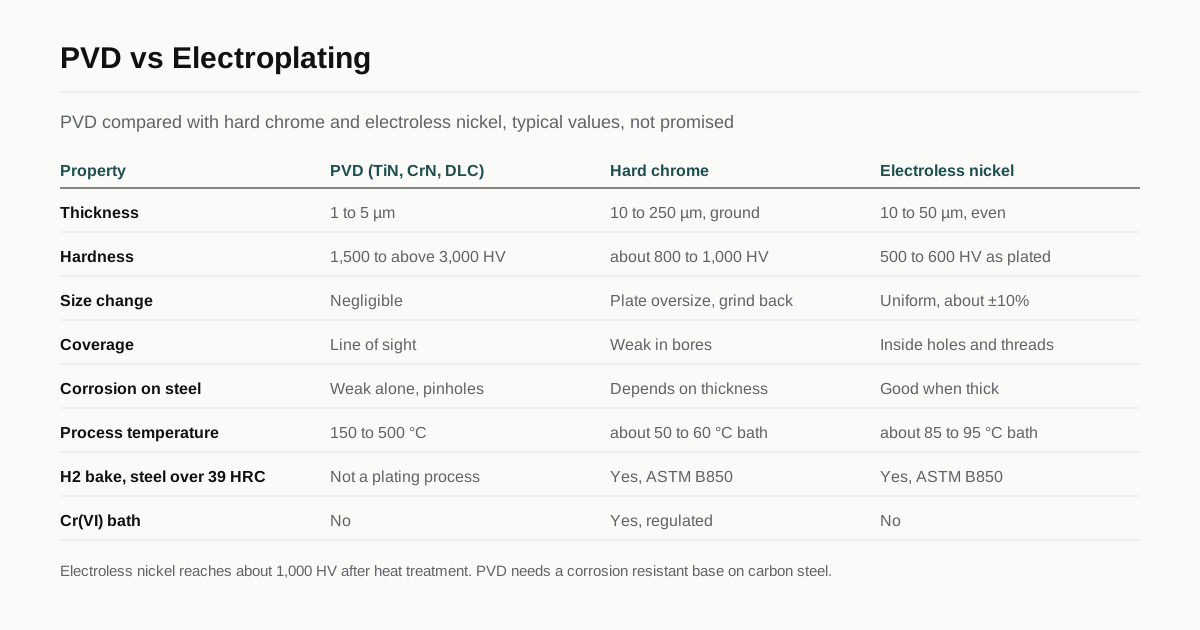
PVD vs electroplating comes down to thickness and what the coating has to do. PVD gives a very hard film of 1 to 5 µm that adds almost no size and runs dry in a vacuum chamber. Electroplating gives a thicker, softer metal layer from a bath: hard chrome for wear and rebuild, electroless nickel for uniform corrosion protection, nickel and chrome for decorative finishes. PVD wins on hardness and friction. Plating wins on corrosion barrier, thickness and coverage inside holes. The two are often combined. Values in this guide are typical, not promised.
The PVD overview explains TiN, CrN and DLC. This guide sets PVD against the three plated finishes buyers most often weigh it against.
Two different ways to build a coating
Electroplating deposits metal ions from a water-based bath onto the part, which is the cathode. Hard chrome comes from a chromic acid bath. Electroless nickel uses a chemical reducing agent, usually sodium hypophosphite, instead of current, which is why it builds evenly. Bath temperatures run roughly 50 to 95 °C.
PVD vaporizes a solid target in vacuum by arc or sputtering. The metal reacts with nitrogen or a carbon gas and condenses as a ceramic film such as TiN or CrN. For DLC it condenses as amorphous carbon. The part is heated to roughly 150 to 500 °C and the film grows only on surfaces that face the source.
Everything else follows from that: thickness, coverage, corrosion behavior and the risk to hardened steel.
Typical values side by side
| Property | PVD (TiN, CrN, DLC) | Hard chrome | Electroless nickel, mid phosphorus | Decorative nickel chrome |
|---|---|---|---|---|
| Typical thickness | 1 to 5 µm | 10 to 250 µm, ground | 10 to 50 µm | Ni 10 to 30 µm, Cr 0.2 to 0.5 µm |
| Hardness | 1,500 to above 3,000 HV | about 800 to 1,000 HV | 500 to 600 HV, up to about 1,000 HV after heat treatment | Cr layer hard, but too thin to carry wear |
| Coverage | Line of sight | Poor in bores without special anodes | Uniform, inside holes | Uneven in recesses |
| Corrosion barrier on steel | Weak alone, pinholes | Microcracked, depends on thickness | Good when thick and pore free | Good as a full stack |
| Process temperature | 150 to 500 °C | about 50 to 60 °C bath | about 85 to 95 °C bath | below 70 °C bath |
| Hydrogen embrittlement bake on steel over 39 HRC | Not a plating process | Yes, ASTM B850 | Yes, ASTM B850 | Yes, ASTM B850 |
| Common specs | Customer drawing, VDI 2840 for DLC | ISO 6158, AMS 2460 | ASTM B733, AMS 2404 | ASTM B456, ISO 1456 |
Thickness and dimensional change
PVD adds so little that most drawings treat it as zero growth, about 2 to 10 µm on a diameter. A ground punch, a reamer or a fuel injector part keeps its size and edge. That is the main reason PVD is used on precision tools.
Hard chrome builds thick and builds unevenly. Current concentrates on edges and corners, so they grow more than flat faces, the dog-bone effect. Functional chrome is usually plated oversize and ground back. That grinding step costs time and money, but it also means chrome can rebuild a worn shaft by 100 µm or more. PVD cannot rebuild anything.
Electroless nickel builds evenly, commonly within about plus or minus 10 percent of nominal thickness, because there is no current distribution. It can hold a tolerance without grinding. Our electroless nickel phosphorus guide covers how low, mid and high phosphorus differ.
Hardness, wear and friction
PVD nitrides typically measure 1,800 to 3,300 HV and DLC from about 1,500 to above 3,000 HV by type. That is two to three times harder than hard chrome. DLC also has low friction against steel, often around 0.1 to 0.2 dry, which is why it runs on valvetrain and injection parts.
Hardness alone does not decide wear life. A 2 µm film needs a hard base under it. On a soft substrate the film cracks under load, like an eggshell. Hard chrome, at 50 to 250 µm, carries load itself. For heavy contact loads or abrasive slurries, thickness can matter more than surface hardness.
PVD films also carry compressive residual stress, often a few GPa, which helps resist cracking on cutting edges. Hard chrome is microcracked by nature. The crack network can lower fatigue strength of the steel underneath. If the part is fatigue loaded, ask for data on your substrate, as in our HVOF vs hard chrome guide.
Corrosion: why PVD needs a corrosion resistant base
PVD films are dense, but they are thin and contain pinholes and growth defects, often around droplets from arc processes. On carbon or low alloy steel, moisture reaches the base through those defects. The film is more noble than the steel, so corrosion concentrates at each pinhole and can pit faster than on bare steel.
So PVD is not a corrosion coating on its own. It works for corrosion when the base already resists it: stainless steel, titanium, carbide, nitrided steel or a plated base. Plated stacks work the other way round. A thick electroless nickel layer or a multilayer nickel with chrome on top acts as the barrier. Corrosion resistance rises with thickness and layer design.
Neither should be specified by salt spray hours alone. Test results depend on the full stack, the substrate and the test method, so compare stacks on your own parts.
Adhesion
PVD adhesion is built inside the chamber. After washing, the parts are ion etched to remove oxides, then a thin metallic bond layer such as Cr or Ti goes down before the hard layer. Adhesion is checked by Rockwell indentation per VDI 3198 or ISO 26443. A scratch test is the other common check. Most PVD adhesion failures trace back to residue, EDM recast or oxide left on the surface.
Plating adhesion depends on activation in the cleaning and etching steps before the bath. On steel it is checked by bend, file or heat-quench tests, as described in ASTM B571. Chrome on poorly activated steel can peel in sheets. Nickel on zinc die castings blisters over porosity.
Coverage: line of sight vs bath
A PVD source coats what it can see. Parts rotate on two-fold or three-fold planetary fixtures to reach all outer faces, but bores and blind holes coat only near the opening. A rough guide many shops use is coating depth of about one hole diameter. Internal channels and the inside of tubes stay largely uncoated.
Electroplating fills a bore with solution, but current still prefers the outside. Hard chrome in a bore needs an inside anode. Electroless nickel needs no current, so it covers holes, threads and internal passages evenly, provided the solution is moved through them.
If the part has internal wear surfaces, electroless nickel or chrome with conforming anodes usually beats PVD.
Hardened steel: hydrogen vs heat
Electroplating releases hydrogen at the part surface. Hardened steel absorbs it. Steel above 39 HRC plated with hard chrome, electroless nickel or nickel chrome needs a hydrogen embrittlement relief bake per ASTM B850, typically at 190 to 220 °C for several hours, started soon after plating. Acid pickling and cathodic cleaning before plating add hydrogen too. See hydrogen embrittlement and the relief bake.
PVD does not have this mechanism, but it heats the part. The coating temperature must stay below the steel’s last tempering temperature. Above it, the part loses hardness. A D2 die tempered at 200 °C cannot take a 450 °C tool coating. Our PVD temperature and substrates guide compares common steels.
Both risks belong on the drawing: base hardness, tempering temperature and the bake requirement where plating is used.
Environment and regulation
Hard chrome and traditional decorative chrome use hexavalent chromium baths. Cr(VI) is a carcinogen. In the EU, chromium trioxide needs authorisation under REACH and a broader restriction is in progress. Shops face strict air and wastewater controls. For decorative work, trivalent chrome baths are an established alternative. For functional hard chrome, trivalent processes exist but are not yet a drop-in replacement for every spec. Our RoHS and REACH guide covers what to ask suppliers.
PVD has no plating bath. Parts still pass through alkaline cleaning lines. Some processes use chromium metal targets, but no Cr(VI) bath is involved. This is one reason buyers look at PVD when a chrome spec comes under review. The switch only works where PVD also meets the thickness, corrosion and coverage needs above.
General background on the process family is in the physical vapor deposition article on Wikipedia.
Cost and lead time
Plating lines run continuously and large racks or barrels carry many parts. For big or simple parts, plating is often cheaper per part, before grinding. PVD runs in batches sized by the chamber. Small tools packed into a full load can coat at a low cost per piece. Large or heavy parts take up space and raise it.
Lead time follows the same pattern. Plating shops often run daily. PVD runs are scheduled when a load for that coating is full. Size matters too: hard chrome tanks take rods several meters long, while many PVD chambers stop well short of that. Ask about chamber or tank envelope early.
Rework differs. Chrome can be stripped and replated. PVD can usually be stripped and recoated. The strip chemistry depends on coating and substrate. Some combinations attack carbide or steel. Ask before you need it.
When to combine PVD and plating
As the overview notes, functional PVD normally goes on the bare base metal. Two combinations are established:
- Decorative nickel chrome plus PVD. Brass and zinc die-cast parts are plated with nickel and chrome, then coated with a PVD color at low temperature. The plating gives corrosion protection and a sealed surface. The PVD gives color and scratch resistance. See decorative PVD colors.
- Electroless nickel plus low-temperature PVD or DLC. On steel or aluminum, a thick EN layer adds corrosion protection and load support under a thin DLC. The PVD process must stay cool enough to avoid blistering or cracking the EN, so the shop qualifies it on coupons.
Nitriding plus PVD, the duplex treatment, is the other common stack, but no plating is involved.
Which one fits
- Precision cutting and forming tools: PVD.
- Sliding parts needing low friction without lubricant: DLC.
- Long hydraulic rods and rebuilt shafts: hard chrome or a thermal spray alternative.
- Complex parts with internal surfaces needing corrosion and wear protection: electroless nickel.
- Decorative hardware with color: nickel chrome plus PVD. On stainless, PVD directly.
- Stainless or titanium parts needing wear and appearance: PVD.
If PVD is the likely route, our guide to PVD coating services covers choosing, specifying and verifying it.
Getting PVD or plating quoted
On the RFQ, describe the function first: wear mode, mating part, load, environment and any corrosion need. Then give base material, hardness and tempering temperature, surfaces to coat, dimensions with tolerance, internal features, quantity and whether you accept PVD, plating or a combination. If plating is possible on steel above 39 HRC, state the ASTM B850 bake requirement.
We are a matching service, not a coating shop. Choose PVD as the finish on the form. If you are comparing it with a plated finish, say so in the notes. We pass the RFQ to up to three shops that run those processes. They quote you directly. You get a reply within 24 business hours. Start with the RFQ form.
Frequently asked questions
Is PVD better than chrome plating?
It depends on the job. PVD is far harder and only 1 to 5 µm thick, so it suits precision tools and parts that cannot grow in size. Hard chrome is softer but can be tens or hundreds of micrometers thick, ground to size and used to rebuild worn shafts. PVD alone is a poor corrosion barrier on carbon steel, while thick plated nickel and chrome stacks protect much better.
Can PVD replace hard chrome on hydraulic rods?
Usually not on its own. Hydraulic rods need a thick, ground, corrosion resistant surface and often several meters of length. PVD is too thin to grind, has pinholes that let rust start on steel and few chambers take long rods. Thermal spray coatings are the more common hard chrome replacement on rods. PVD fits shorter precision parts where wear and friction matter more than thickness.
Does PVD cause hydrogen embrittlement?
PVD deposits in vacuum without the electrochemical reaction that drives hydrogen into steel during electroplating, so it is not treated as a hydrogen embrittlement process. The concern for hardened steel is heat: the part must stay below its tempering temperature. Electroplated steel above 39 HRC, by contrast, needs a hydrogen embrittlement relief bake per ASTM B850 soon after plating.
Can PVD be applied over nickel or chrome plating?
On decorative parts, yes, routinely. Faucets and door hardware made of brass or zinc are plated with nickel and chrome, then a PVD color goes on top at low temperature. On functional parts it is less common. Electroless nickel under a low-temperature PVD or DLC layer is used to add corrosion protection and load support, but it needs qualification on coupons by the shop.
Need a quote for this finish?
Send the drawing. We match you with up to 3 finishing shops that run your spec and reply within 24 business hours.
Get matched with a coating shop